Imperial College London scientists built a photoelectrochemical mass-spectrometry platform that counts oxygen molecules as they form during solar water splitting, revealing that hematite—a widely studied rust-coloured catalyst—wastes much of its electrical current on side reactions until surface charge crosses a threshold where oxygen efficiency reaches roughly 80 percent. The work, led by Dr Flurin Eisner and colleagues and published in the Journal of the American Chemical Society, challenges the assumption that photocurrent alone measures hydrogen-ready performance.
Why current lied
Researchers illuminated hematite samples while tracking both electrons and oxygen. At low current, charge disappeared into competing surface pathways that never produced gas; standard electrochemical tests missed the gap because they inferred oxygen from current. Once enough positive charge accumulated, selectivity flipped and oxygen generation surged.
Remarkably, some loss pathways persisted in darkness, suggesting intrinsic material behaviour rather than a lighting artefact.
Instrument details
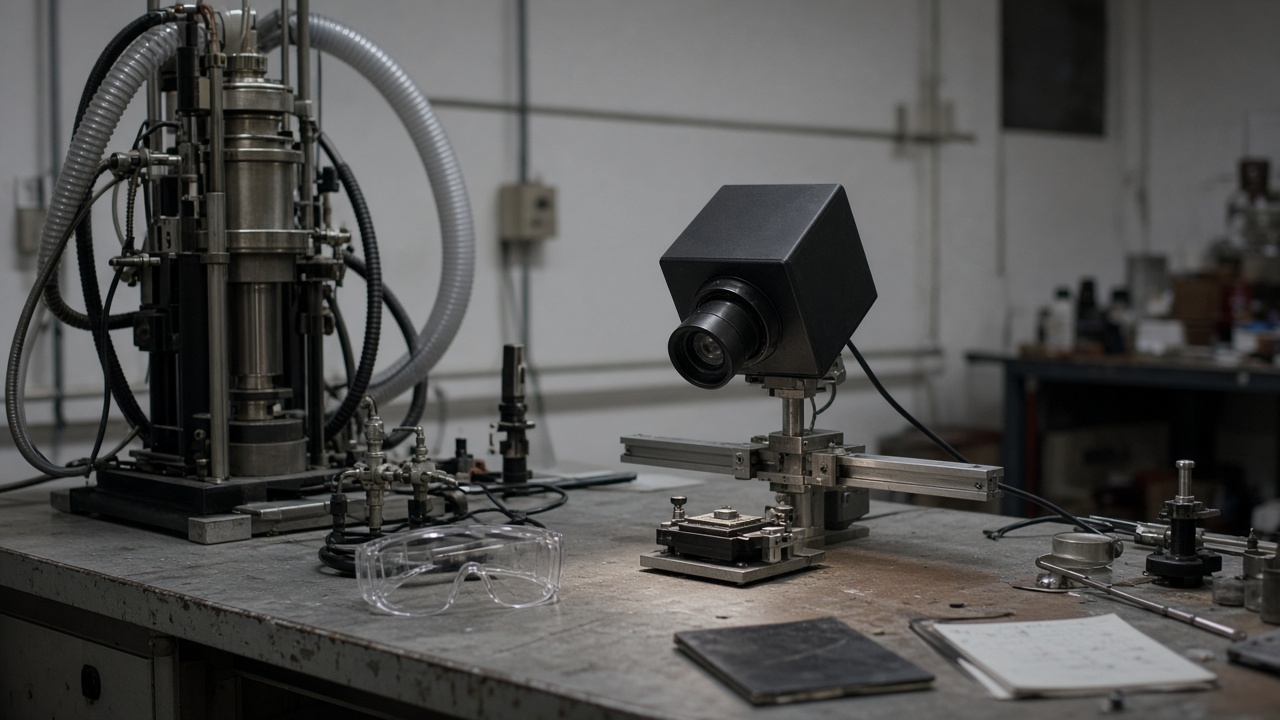
The Royce at Imperial team adapted electrochemical mass spectrometry to run under controlled light at the White City facility, funded partly through a small-equipment grant. The setup lets teams compare photocurrent with direct oxygen counts in real time—a combination the authors say is unusually sensitive for metal oxides.
Implications for green hydrogen
Solar fuels remain far from grid scale, but accurate screening could save years chasing materials that look productive on paper. The group plans to test other metal oxides and reactions such as carbon dioxide reduction, where hidden losses may be equally large.
For UK industrial strategy, the result is a measurement win: better rulers for a field that has relied on proxies.
Collaboration network
Co-authors included Professor Ifan Stephens and Professor James Durrant at Imperial, with Dr Daniele Benetti from the chemistry department integrating spectroscopy data. Dr Eisner, now at Queen Mary University of London, said the platform will travel with him for comparative studies on bismuth vanadate and other oxides that investors hype for green hydrogen hubs.
Funding and facilities
Royce at Imperial's small-equipment fund paid for mass-spectrometer modifications; authors acknowledged Diamond Light Source collaborations for related structural work, though this study centred on lab-scale cells. Industry partners watching the paper include electrolyser makers who need honest efficiency curves before signing offtake deals with wind farms.
Open questions
The team has not yet proven the selectivity switch in full-device stacks with membranes and pumps attached—lab cells can mislead when scaled. Peer reviewers asked for longer-duration runs; authors promised follow-up datasets under accelerated ageing. If the effect holds, catalyst designers might engineer surfaces to reach the high-charge regime faster, cutting wasted current at startup.