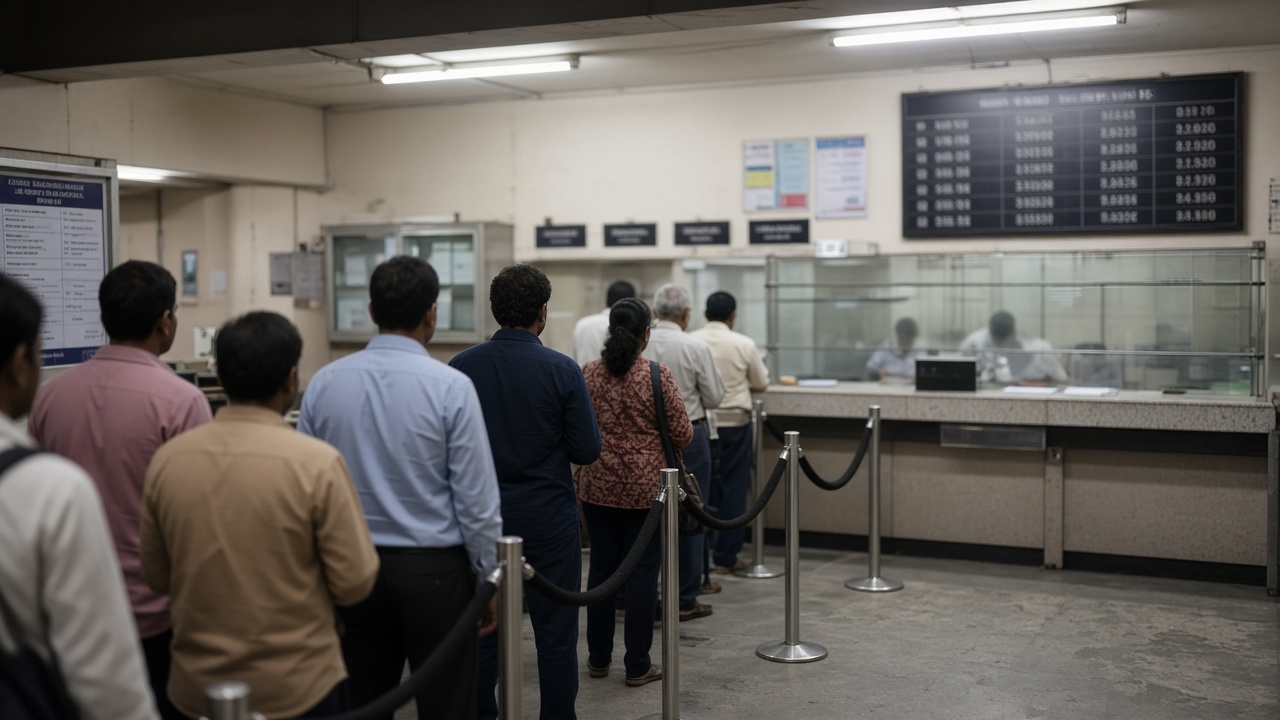
The Reserve Bank of India left the repo rate at 5.50 percent on October 1, and headline writers called it a breather for borrowers. That framing hides a quieter curve: weighted average lending rates on fresh rupee loans have fallen materially this year, while weighted average domestic term deposit rates on outstanding balances have barely moved. Savers are still funding the margin repair at banks—and the MPC’s neutral stance does not, by itself, fix that asymmetry.
Transmission is not symmetric
The central bank’s own bulletin shows fresh loan rates down sharply since the easing cycle began, but deposit rates on money already parked in one- and two-year certificates decline more slowly because banks reprice liabilities in laddered tranches. A household renewing a five-year FD this month may still see a headline rate above 7 percent at a few private banks, yet the median offer on public-sector benches remains sticky near 6.75 percent even after policy easing. Borrowers with floating home loans tied to external benchmarks have felt relief; retirees living off interest income have not felt equivalent gains.
We are not arguing for punitive rate cuts or for punishing lenders—banks need stable deposits to fund credit growth. We are arguing that politicians and pundits should stop treating a repo pause as a universal win. Until deposit curves catch down, consumption supported by interest income, especially among urban seniors, will stay muted relative to the EMI savings enjoyed by new mortgage entrants.
Why the MPC waited
Governor Sanjay Malhotra’s October statement emphasized global tariff uncertainty and the need to let prior cuts work through the system. That caution is defensible macroeconomics. It does not change the micro experience at the branch counter, where relationship managers pitch “special” FD rates that apply only to new money above ₹2 crore while retail slips renew at the board rate. Transparency on renewal spreads matters as much as the policy repo print.
What policymakers could do without cutting again
The Reserve Bank could sharpen disclosure rules on FD renewal letters, requiring banks to show the previous rate, the new rate, and the best available rate for the same tenor on the renewal date. Competition policy could scrutinize cartel-like board-rate moves when every major lender posts identical cuts on the same afternoon. None of that requires an accommodative stance; it requires treating depositors as counterparties, not captive funding.
Household math before Diwali
Families financing durables on EMIs will benefit from lower marginal lending rates if banks pass through further easing later this year. Families financing Diwali travel from FD interest will not see parallel relief unless they chase promotional tenors or shift to government small savings schemes with explicit resets. The repo pause is real; the deposit curve pause is realer for millions of voters. Acknowledging both is the minimum honesty this cycle deserves.
Small savings as pressure valve
Post office schemes with quarterly resets have drawn inflows whenever banks lag on deposit cuts; that migration shrinks cheap CASA funding for lenders and can slow credit to micro enterprises. Policy makers cheering consumption from cheaper EMIs should watch whether seniors pull money from banks into government instruments, tightening liquidity in ways a frozen repo rate does not headline.