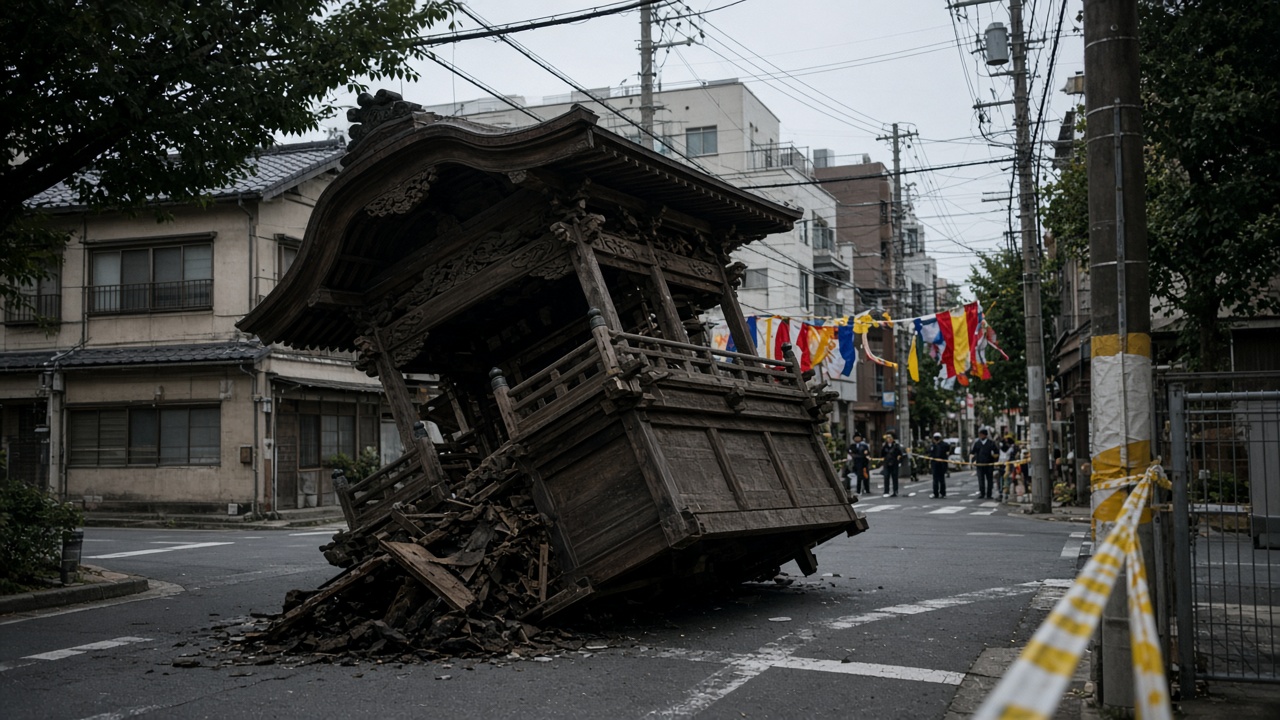
Two men died and 16 other participants were injured when traditional danjiri festival floats overturned in separate accidents in Osaka Prefecture on Saturday, police said. Both victims were crushed beneath floats that tipped during yarimawashi—the high-speed cornering that draws crowds to autumn neighborhood festivals across the Kansai region.
The Osaka Prefectural Police department said no spectators were hurt in either incident, but the back-to-back fatalities have renewed scrutiny of safety rules for crews who ride the towering wooden carts, which stand about four meters tall and weigh roughly four tons.
What happened in Izumisano
In Izumisano, a danjiri toppled while turning right at an intersection around 10:55 a.m., according to police. A 51-year-old company executive from the city died after being caught under the float. Seven other male participants were injured, some seriously.
Witness accounts collected by local media described the usual festival atmosphere—drums, shouted timing cues and a sprint through the turn—until the float’s balance failed. Investigators are examining whether speed, road camber or crew positioning contributed, but officials have not released conclusions.
A second overturn hours later in Izumiotsu
In Izumiotsu, another danjiri overturned after a right turn at an intersection around 1:20 p.m. A 48-year-old corporate worker from neighboring Izumi died. Nine male participants suffered injuries that police described as not life-threatening.
Both accidents involved men stationed on the sides of the floats to counterbalance the structure during yarimawashi. That role is considered an honor in many towns, but it places participants inches from disaster if the cart lurches.
Why yarimawashi carries outsized risk
Danjiri festivals celebrate neighborhood pride and craftsmanship, with teams spending months rebuilding and decorating floats for a single autumn run. Yarimawashi is the spectacle: crews pivot a multi-ton cart without slowing to a walk, often banking so sharply that the wheels lift.
Organizers typically mandate helmets and harnesses in some cities, but rules vary by municipality and shrine committee. After past deaths, Osaka Prefecture has urged voluntary speed limits and additional spotters, yet Saturday’s crashes show enforcement remains uneven when competitive spirit runs high.
Investigations and the festival calendar
Police said they are treating both sites as criminal investigations into professional negligence, a standard step when fatalities occur during public events. Autopsy results and mechanical inspections of the wheels and steering rigs are pending.
Other danjiri events in Osaka Prefecture are proceeding this weekend, though several neighborhood associations told broadcasters they would review cornering plans and pause yarimawashi practice until safety briefings are completed. For residents who treat the festivals as a reunion of diaspora families, canceling entirely is a last resort—but so is accepting another season without binding standards for a maneuver that looks like sport and behaves like heavy industry.