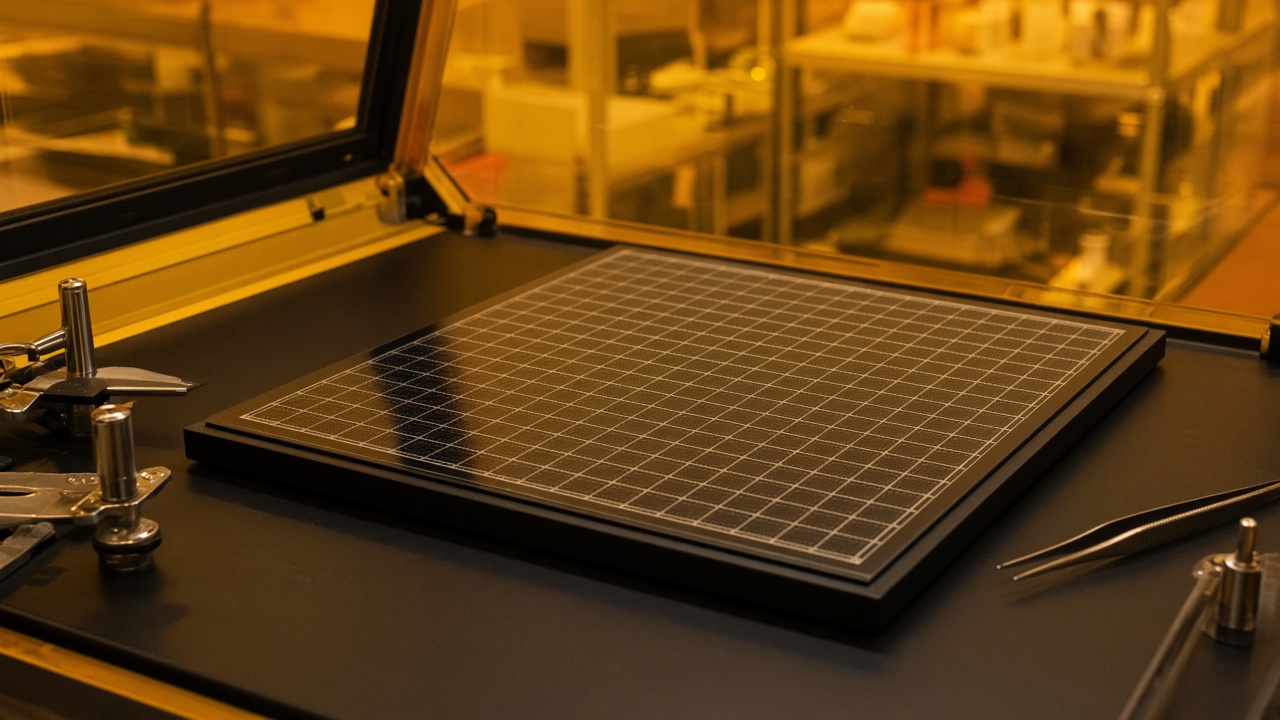
Engineers at UNSW Sydney and industry partner UtmoLight have set a certified 23.5 percent stabilised power conversion efficiency on a 676 square centimetre perovskite solar submodule, beating the previous large-area benchmark by 0.6 percentage points and narrowing the gap with small laboratory cells.
The module measures 30 by 30 centimetres—far closer to commercial panel sizes than the one-square-centimetre devices that often headline academic papers. Scientia Professor Xiaojing Hao, who leads the team at the School of Photovoltaic and Renewable Energy Engineering, said the result matters because it shows high efficiency can survive scale-up steps that usually introduce defects at module edges.
Materials breakthrough
Researchers achieved the record while removing a nickel oxide layer commonly used to block shunts in perovskite stacks. Eliminating that layer simplifies manufacturing but raises quality-control demands during lamination. UtmoLight’s production engineers co-designed the process window so roll-to-roll trials could adopt the chemistry without new exotic solvents.
Independent certification followed stabilised power measurement protocols recognised by the photovoltaic community, not a flash snapshot that decays within minutes. Stabilised figures are the metric grid operators care about when forecasting lifetime yield.
Commercial path
Perovskite tandem cells that stack on silicon are already entering pilot lines overseas. Australia’s advantage is deep university expertise and abundant test-bed sunlight, but domestic manufacturing capacity for utility-scale modules remains thin. Hao said the next step is a one-square-metre prototype to stress-test uniformity across an entire sheet.
For policymakers, the timing intersects with debates over renewable supply chains and local content in government procurement. A record efficiency does not by itself create jobs, but it strengthens the case for keeping advanced solar research funded when electricity prices and grid congestion dominate household politics.
Rivals in China, Korea and Europe will chase the mark quickly. The UNSW-UtmoLight partnership will need capital for pilot lines and for field trials in hot, humid climates typical of northern Australia. Still, for a country that once led conventional silicon research, the result is a reminder that the next photovoltaic chapter may also be written in Sydney labs.
Grid implications
Energy market analysts said even a one-point efficiency gain at module scale can shave cents per kilowatt-hour from levelised cost estimates for remote mines and hydrogen hubs that rely on behind-the-meter solar. ARENA has not announced new grants tied to the record but industry lobbyists will cite it in submissions on the Capacity Investment Scheme.