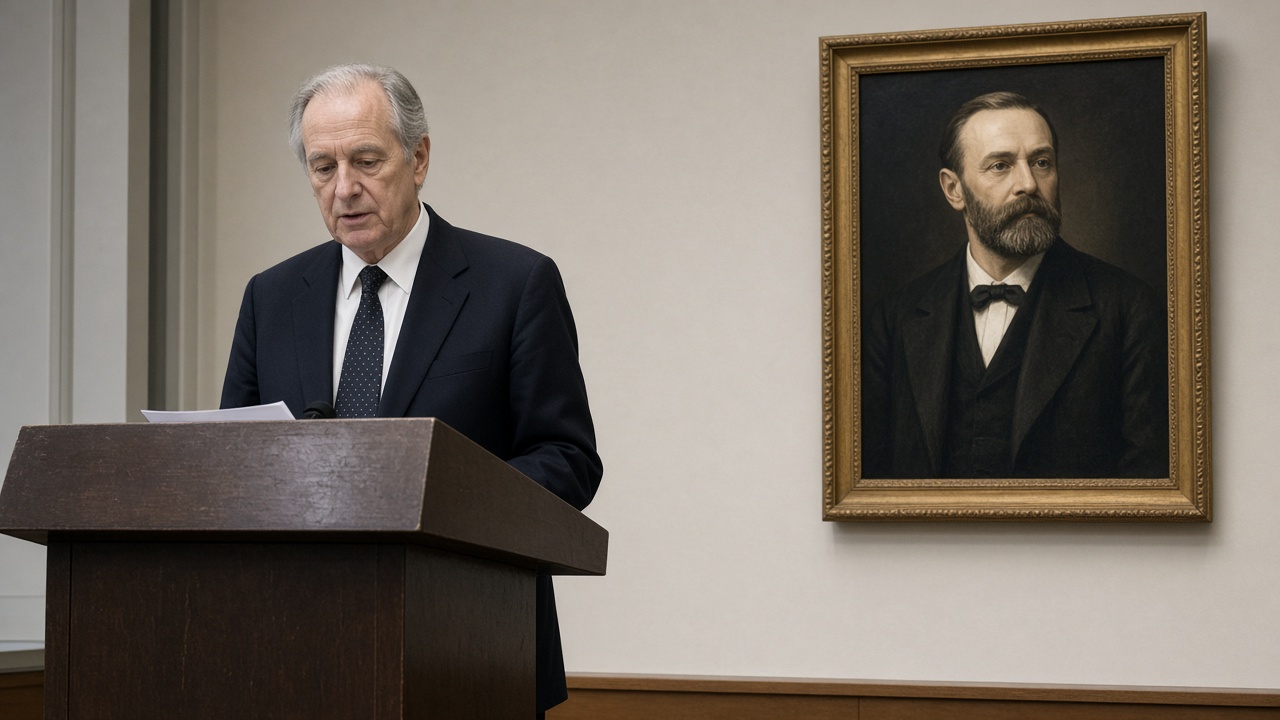
The Royal Swedish Academy of Sciences on Monday awarded the Sveriges Riksbank Prize in Economic Sciences in Memory of Alfred Nobel to Robert E. Hall of Stanford University and Michael Woodford of Columbia University, honoring work that rebuilt macroeconomic stabilisation policy on microeconomic foundations rather than statistical correlations alone.
The citation credits the pair with models that help governments and central banks time fiscal and monetary moves to smooth business cycles—frameworks that sit behind the “New Keynesian” models many finance ministries run when energy shocks, wars, or trade ruptures threaten growth and prices at the same time.
What the academy cited
In its press release, the academy said Hall and Woodford showed how to reconstruct macro models so that stabilisation policy could be “revitalised” after decades in which reduced-form relationships between inflation, output, and consumption dominated textbooks. Their approach starts with how individual households and firms behave, then aggregates those choices to explain economy-wide peaks and troughs.
The 2026 prize amount is 12 million Swedish kronor, to be shared equally. Hall, born in Palo Alto in 1943, earned his doctorate from the Massachusetts Institute of Technology in 1967 and has taught at Stanford for decades. Woodford, born in Chicopee, Massachusetts, in 1955, completed his Ph.D. at MIT in 1983 and is a professor at Columbia in New York.
Why the models still matter in 2026
Committee member Timo Boppart told Nobel outreach interviewers that this year’s award is “about rebuilding a framework that allows us to study business cycles and stabilisation policy.” That framing lands as governments argue over how aggressively to cut deficits, when to ease interest rates, and whether temporary tax credits can offset commodity price spikes without reigniting inflation.
Woodford’s 2003 treatise Interest and Prices became a standard reference for central bankers studying how forward guidance and credible inflation targets interact. Hall’s research on consumption, labor markets, and productivity has long fed into debates on whether tax changes or spending programs deliver faster stimulus. Neither laureate appeared at the Stockholm announcement; the academy streamed the decision live as the final Nobel week announcement.
Market and academic reaction
Financial television networks carried the news before U.S. equity markets opened, pairing the award with ongoing volatility in energy markets and Middle East security risks. Academic economists noted that the prize continues the academy’s recent pattern of honoring empirical and theoretical work that policy institutions can operationalize, rather than purely abstract contributions.
Hall and Woodford will travel to Stockholm in December for the formal ceremony and banquet alongside laureates in physics, chemistry, medicine, literature, and peace. Until then, their universities are expected to host campus briefings explaining how the models translate into classroom teaching and into the briefing books that graduate students carry into central-bank internships.
For readers tracking policy, the practical takeaway is narrower than a single interest-rate call: the prize ratifies the idea that credible stabilisation requires models grounded in how people and companies actually respond to prices, wages, and credit—not just in historical correlations that can break when the world changes fast.