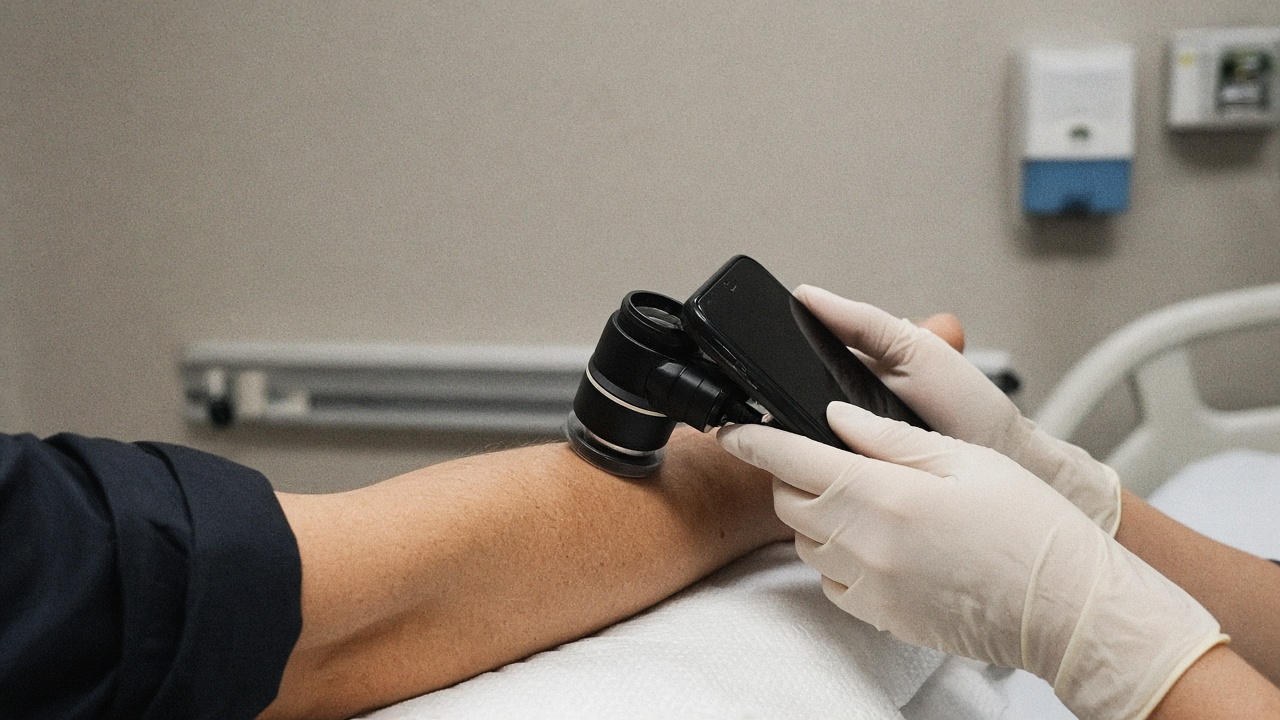
NHS England’s South East region will deploy the DERM artificial-intelligence tool across all 18 acute trusts this autumn, the largest autonomous medical-AI rollout in the health service to date.
DERM, built by Skin Analytics, reads dermoscopic images captured on smartphones, discharges patients assessed as benign and fast-tracks higher-risk lesions to specialists. Modelling for the three-year programme suggests up to one third of urgent urgent skin cancer pathway referrals could be cleared before any outpatient appointment.
Scale across nine million patients
The South East serves about nine million people. Rolling DERM to every trust in the region follows pilots at Buckinghamshire Healthcare NHS Trust, where roughly 35 percent of assessed patients were discharged with no further action required.
Skin Analytics says DERM already runs in 25 trusts and has assessed more than 250,000 patients, identifying more than 25,000 cancers. Regulators will watch false-negative rates closely; clinicians retain override power, but the workflow assumes the algorithm can safely filter the long tail of benign moles.
Workforce maths
Dermatology waiting times ballooned after Covid-19 deferrals. Automating triage does not add consultants, but it stops them spending half-day clinics on cases a photo could resolve. The 13,500-hour savings figure is an estimate, yet even half that would equate to dozens of full-time clinicians redeployed to melanomas and squamous cell cancers.
Governance and procurement
Autonomous AI in cancer pathways triggers MedTech vigilance rules and equality impact assessments—skin-tone performance must be proven across the region’s diverse population. NHS England South East said the partnership formalises a pathway already tested in peer-reviewed settings.
If the deployment succeeds, other regions will demand parity. Failure, conversely, would embolden sceptics who argue AI should stay in research labs. Autumn 2026 is the proving ground.
Patient pathway
GPs photographing lesions in community settings must still meet governance rules on image storage and consent. Trusts are training nurses to capture standardised views before uploads reach DERM, reducing retakes that slow the queue.
Patients discharged by the algorithm receive written guidance on warning signs that should trigger a return visit, a safeguard clinicians insisted upon after earlier pilots.
Funding and equity
Integrated care boards must budget for smartphone peripherals and training days, costs that do not appear in the headline AI licence. Equality reviews will test algorithm performance across skin tones before full regional coverage is declared.
If discharge rates match Buckinghamshire pilots, waiting-list statistics could improve before winter pressures peak.