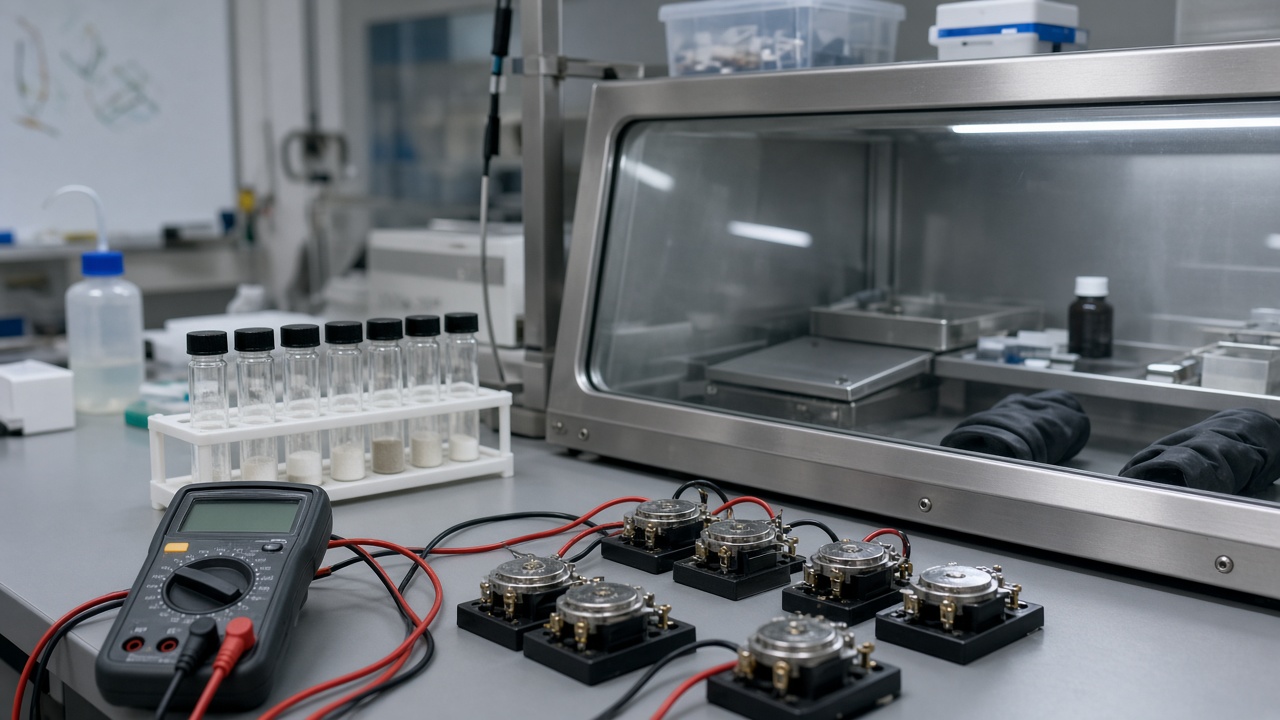
POSTECH researchers reported a sodium-ion cathode that retained 83 percent of its initial capacity after 500 charge cycles at room temperature, a lab milestone aimed at grid storage rather than passenger electric vehicles.
The team led by Prof. Lee Soo-jin published results Monday in a peer-reviewed materials journal, describing a layered oxide cathode stabilized by grain-boundary engineering that limits crack propagation during repeated sodium insertion. Coin cells tested at 25 degrees Celsius held above 120 milliamp-hours per gram through the cycle window, outperforming prior POSTECH prototypes that faded after 300 cycles.
Why sodium-ion, why now
Lithium prices have cooled from 2022 peaks, but Korean utilities still want chemistries that do not compete with EV packs for the same carbonate supply. Sodium-ion uses abundant precursors and tolerates wider temperature swings, making it attractive for four-hour grid batteries backing solar farms in Jeolla and offshore wind hubs on the west coast.
POSTECH’s work is funded partly by the Ministry of Science and ICT’s next-generation storage program, which prioritizes technologies that can be manufactured with existing lithium-ion line equipment. The cathode synthesis uses roll-to-roll-friendly slurry coating, though full pouch cells remain in development.
From coin cell to module
Coin-cell results rarely survive scale-up. POSTECH has partnered with a Pohang-based electrolyte supplier to test the cathode in single-layer pouch formats scheduled for December. Energy density is still below nickel-manganese-cobalt packs, but the team argues total cost of ownership wins for stationary projects that cycle once daily.
Competitors in China have shipped sodium-ion grid products to telecom backup sites; Korean firms worry about import dependence if domestic labs cannot cross the 500-cycle bar with local intellectual property. Lee’s group patented the boundary treatment method in Korea and filed a PCT application in August.
Industry reaction
Posco Future M and LG Energy Solution researchers attended a closed briefing last week but have not announced licensing talks. Battery analysts at Samsung Securities said sodium-ion will remain a “grid niche” until energy density climbs another 30 percent, cautioning investors against treating Monday’s paper as an immediate earnings catalyst.
Still, Korea Electric Power Corp. planners monitor academic cycle counts when drafting 2030 storage procurement specs. Crossing 500 cycles at room temperature moves POSTECH from conference posters to vendor qualification spreadsheets, even if commercial modules remain years away.
What could go wrong
Sodium-ion anodes still swell more than lithium counterparts, stressing seals in humid Korean summers. POSTECH has not published full-cell data with hard-case modules or fire-suppression packs required for substation installs. Regulators will want abuse testing beyond coin cells before certifying installations near residential neighborhoods.
For now, the result is a credible answer to a simple question: can Korean labs produce a sodium cathode that survives two years of daily cycling in a climate-controlled warehouse? Five hundred cycles at room temperature says yes in the lab. The next fight is the factory floor.