
When Taiwan's National Health Insurance Administration published a worked example for bonus withholding, it chose a mundane insured salary of NT$30,300 a month and a year-end bonus large enough to hurt: NT$200,000 in cumulative reward pay. After the employer ran the annual tally, the worker owed NT$1,663 in supplemental health insurance, calculated as 2.11% on every bonus dollar above NT$121,200. That last figure is not a tax bracket from the Ministry of Finance. It is four months of insured pay, and it is the tripwire that turns a celebration payslip into a finance lesson.
The second line on the bonus payslip
Regular National Health Insurance still shows up every month as a familiar deduction. The supplemental line looks like a mistake: another health charge, assessed at 2.11%, landing only when bonuses arrive. Colleagues call it the second-generation NHI fee. Payroll software labels it more clinically: supplemental insurance premium (補充保險費).
The rate is not arbitrary. Since 1 January 2021, the NHIA has posted the same percentage for both employers and workers, 2.11%, on income that never entered the monthly premium base. The agency's formula page states it plainly: multiply the taxable amount by 費率2.11%. For bonuses, that taxable amount is whatever has piled up above four times your monthly insured amount for the year, on each payout, with a per-payment cap of NT$10 million above that threshold.

In the NHIA's published Q&A, Worker A with NT$30,300 in insured salary hits that logic twice: first when cumulative bonuses cross NT$121,200, then when the agency applies 2.11% to the excess on a NT$200,000 total. The arithmetic is pedestrian; the policy goal is not. Lawmakers created the charge because monthly premiums were missing too much real compensation.
Withholding happens at source. The employer is the collecting agent, runs the year-to-date bonus register, and remits what it keeps by the following month. If the company skips that step, the NHIA can bill the firm penalties under the act's non-withholding rules. Workers see a net bonus; the supplemental premium is gone before the deposit lands.
That timing is why the shock arrives with the envelope, not with the January health-insurance notice. Monthly premiums already left the account all year on the insured NT$30,300 base. The supplemental charge is a reconciliation: a tally of reward pay the base ignored, priced at the rate posted on the NHIA website since 2021.
What monthly premiums actually cover
Taiwan's NHI premium is not calculated on your full paycheck. Employers declare an insured amount (投保金額) for each enrolled worker, often closer to base salary than to total cash wages, and monthly contributions scale off that declaration. Reward pay such as year-end bonuses, festival money, and profit-sharing typically sits outside the insured amount by design. NHIA guidance describes those payments as wages with a reward character that are not counted when setting insured payroll.
That gap matters. Article 34 of the National Health Insurance Act, as published on Taiwan's law database, obliges employers when monthly wage payments exceed the month's total insured amounts to pay supplemental premiums on the difference at the statutory rate. The wages that trigger the comparison are the same ones reported for income tax on codes 50, 79A, and 79B, not a shadow ledger.
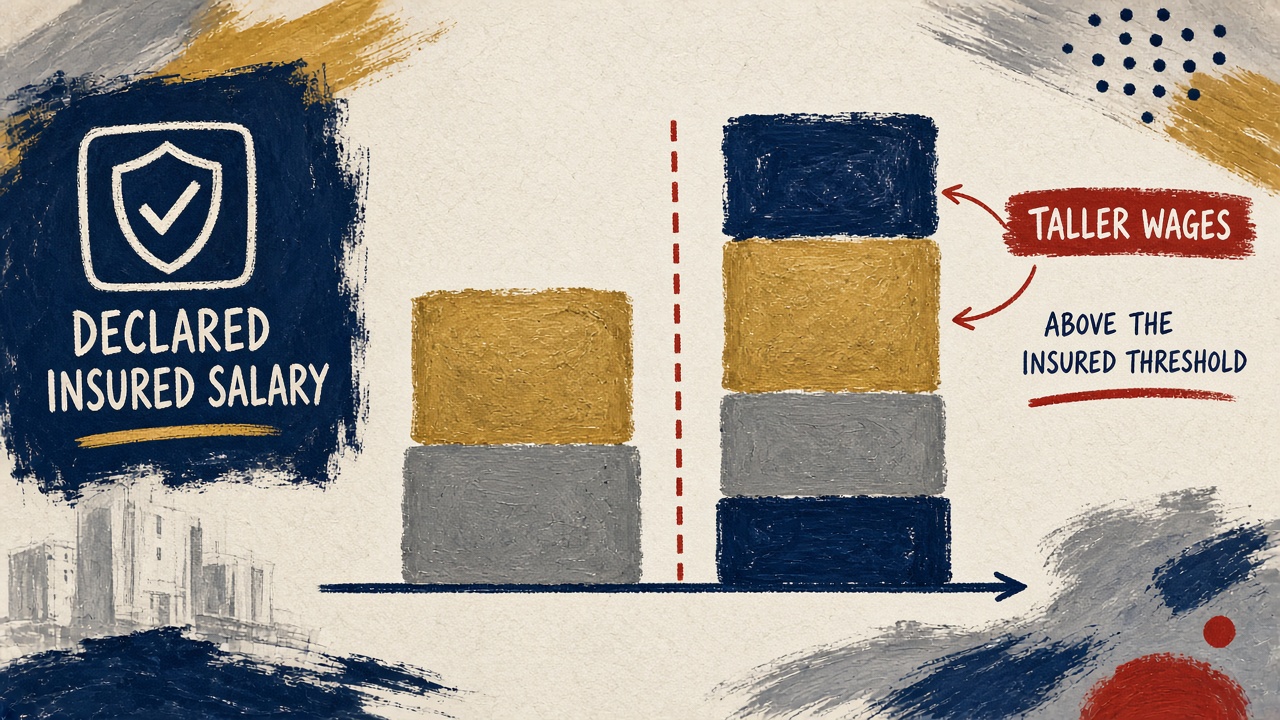
So the system has two lanes. Monthly premiums travel the insured-salary lane. Everything employers pay above that lane, plus several kinds of non-wage income, gets scanned for the 2.11% supplemental lane. Search explainers often stop at bonuses are taxed. The statutory text is tighter: bonuses were excluded from the base, so Congress taxed the exclusion.
The split is visible in aggregate data. NHIA's 2023 review counted NT$115 billion in supplemental premiums from bonuses alone, a slice of the NT$354 billion withheld from individuals that year. Dividends, rent, interest, and side jobs fill the rest of the personal column, each with its own trigger amount but the same rate once the trigger fires.
The employer bill you never see
Workers feel supplemental premiums at bonus time. Employers pay every month, whether or not anyone receives reward pay. NHIA's employer FAQ walks through Company A, a firm with 30 employees, paying NT$1,500,000 in January wages while declaring only NT$1,200,000 in combined insured amounts. The gap between those two totals is multiplied by 2.11%, producing NT$6,330 due to the NHIA by the end of February.
That invisible invoice is why HR teams negotiate insured amounts as fiercely as base pay. A company can keep monthly NHI contributions low for everyone and still face a growing supplemental bill if actual wages drift upward. NHIA's 2023 statistical review attributed NT$366 billion in supplemental premiums to employers that year, against NT$354 billion withheld from individuals. The bonus line employees notice is only part of the machine.
Payroll accountants learn to reconcile two totals every month: cash wages on the tax return and insured amounts on the NHI declaration. When the first exceeds the second, 2.11% of the difference is due even if no one received a red envelope. That is the employer-side mirror of the bonus rule. Both exist for the same reason: the monthly premium base was never meant to capture every dollar on the payslip.
Small firms feel the January crunch first. One bad month of overtime or a sudden hiring spree can widen the wage gap before anyone adjusts insured amounts. Large exporters with formal bonus pools see the worker-side charge spike instead, especially when insured salaries sit at the lower rungs of the contribution table while performance pay floats above.
Why four months of pay is the tripwire
Bonus withholding does not start on the first dollar of reward pay. NHIA rules wait until cumulative bonuses in a calendar year exceed four times the worker's insured amount for the month of payment. At NT$30,300 of insured salary, nothing happens until the running bonus total crosses NT$121,200, roughly four monthly insured amounts, not four months of take-home pay if your real wages are higher.
Once the threshold breaks, the agency charges 2.11% on the excess, not on the entire bonus pool from dollar one. The same rate applies to six other categories of income spelled out in NHIA booklets: part-time wages above the legal minimum wage in a single payment, professional fees and investment income above NT$20,000 per payment, and similar. Each category has its own floor, but the rate is shared.

The design rewards splitting income only up to a point. A NT$10 million cap per bonus payment stops a single gigantic award from generating unlimited supplemental base in one swipe. For ordinary salaried staff, though, the emotional math is simpler: the year-end envelope is where months of excluded wages finally enter the NHI system, at 2.11%, after a four-month insured buffer.
Freelancers and landlords encounter the same rate through different doors. A NT$20,000 minimum on dividends, interest, rent, and professional fees replaced an older NT$5,000 floor in 2016, a change MOHW estimated would shave about NT$42 billion a year from collections. Bonus rules did not move. Salaried workers still meet the four-times test on insured pay, not on gross wages.
From fiscal patch to NT$713 billion
Taiwan did not launch supplemental premiums quietly. They began on 1 January 2013, when the second-generation NHI finance rules took effect at a 2% rate authorized by the 2011 NHI Act amendment. Collections started near NT$404 billion in that first year, according to NHIA's consolidated Table 10. The rate stepped down to 1.91% between 2016 and 2020, then returned to 2.11% on 1 January 2021 as part of a broader premium rebalance tied to the program's income and expenditure linkage mechanism.
The revenue line is now load-bearing. NHIA reported NT$713 billion in supplemental premiums for 2024, against NT$6,300 billion in receivable general premiums, about one-ninth of the ordinary premium stack. A pandemic-year dip to NT$473 billion in 2020, which NHIA linked to conservative dividend policies, proved how sensitive the charge is to capital income. When markets recovered, collections surged to NT$724 billion in 2021.
The chart's slope is not a steady climb. Collections hovered near NT$450 billion for several mid-decade years, jumped when the rate returned to 2.11%, then peaked at NT$724 billion in 2021 before settling at NT$713 billion in 2024 even as headline medical costs kept rising. Supplemental premiums are no longer a side fund; they are part of the reason NHIA could report NT$234 billion in net surplus on an accrual basis in 2024 while still building safety reserves.
Early critics worried the design would chase capital offshore. A decade later the NHIA still publishes worked examples for salaried workers, not just for investors. That is the political bargain in miniature: keep monthly insured amounts stable enough for employers to budget, then use supplemental lines to sweep up what the base missed. Whether that bargain feels fair on a January bonus slip depends on which side of the NT$30,300 declaration you stand.
Not everyone cheered the tweaks that softened investment-income withholding. When the Ministry of Health and Welfare prepared to raise the per-payment floor from NT$5,000 to NT$20,000 in 2016, trimming collections by an estimated NT$42 billion a year, the National Health Insurance Board pushed back. Its 2015 annual report argued that adjusting thresholds without widening insured payroll was a one-sided change that violated fairness. The ministry proceeded anyway; the four-times bonus rule and employer wage-gap charge remained untouched.
保險費率之調整,應併同費基進行整體性規劃與考量,爰對「衛生福利部宣布放寬利息、股利、租金及執行業務收入等之補充保險費,單筆扣費下限一律由5千元提高到2萬元」乙項片面式調整,認為有違公平性、合理性,爰表達一致反對之立場
Back at the payslip window
Worker A's NT$1,663 is small against a NT$200,000 bonus, but it encodes the whole architecture. Monthly NHI still rests on NT$30,300 of insured salary. The supplemental line collects 2.11% on reward pay that was deliberately kept out of that base, starting only after four insured months of bonuses accumulate, capped per payment, mirrored by a separate employer charge on everyday wage gaps.
Stand at the payslip printer in January and you can read all three layers on one sheet: the insured amount that set this year's monthly deductions, the bonus that finally crossed four times that base, and the 2.11% slice the NHIA insisted on once the exclusion ran out of runway. The charge is not a duplicate premium for the same month. It is the price of a base that was always smaller than the paycheck, now settled in public arithmetic anyone can look up.