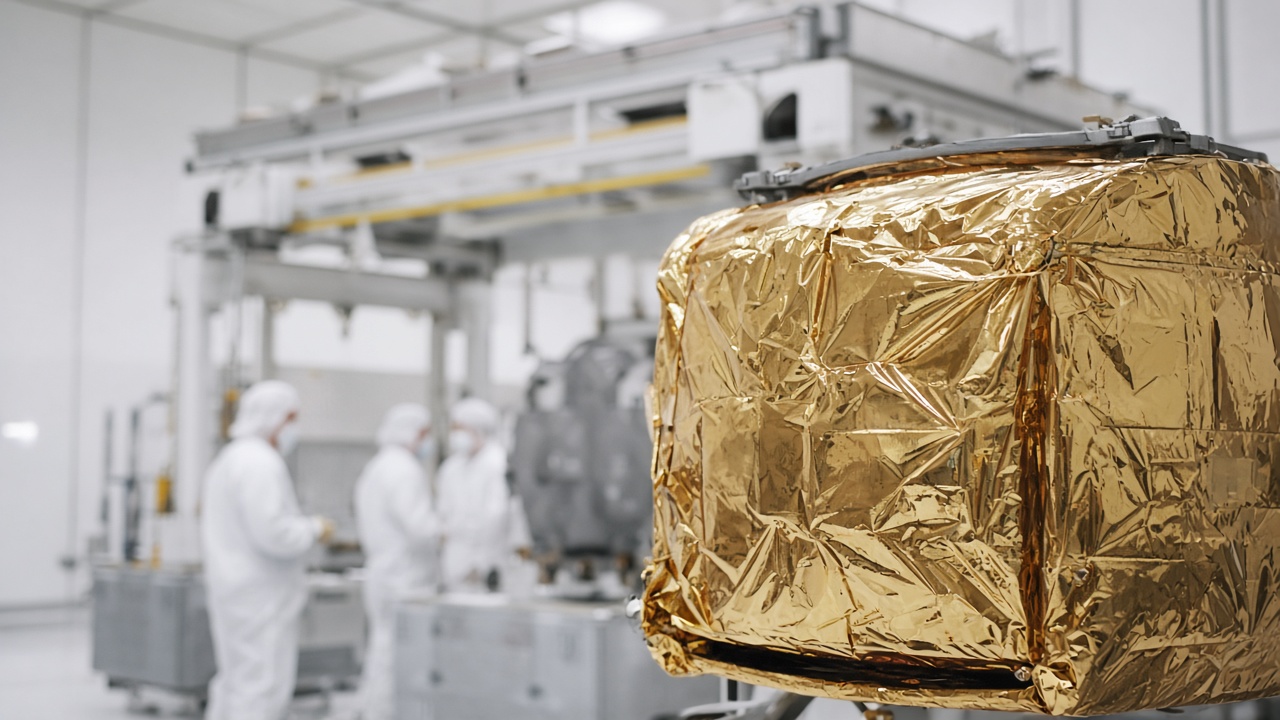
India’s next major Indo-French Earth observation mission is moving from slide decks to integration bays, with space officials targeting a Polar Satellite Launch Vehicle ride in roughly a year.
Jasvinder Singh Khoral, director of projects at the U.R. Rao Satellite Centre, told a TRISHNA “Water for Tomorrow” workshop in Bengaluru on 11 October that the spacecraft should launch within 12 to 16 months, The Hindu reported. TRISHNA—short for Thermal infra-Red Imaging Satellite for High-resolution Natural resource Assessment—is the third joint satellite after Megha-Tropiques and SARAL.
What the satellite will measure
ISRO and France’s CNES are building TRISHNA to monitor land-surface temperature, emissivity, and water-related variables at high spatial and temporal resolution. CNES is supplying the thermal infrared payload; ISRO’s URSC is integrating the bus and a visible-near-infrared shortwave instrument developed in India. Processed data will be shared between French and Indian ground stations, giving agronomists and hydrologists a common reference during drought and heat-stress seasons.
The mission arrives as climate planners push for finer-grained evapotranspiration maps to allocate irrigation water in Punjab, Maharashtra, and Karnataka. State governments showcased pilot algorithms at the workshop, linking satellite feeds to reservoir release decisions. None of those pilots replace on-ground gauging, but they can flag anomalies faster than monthly manual surveys.
Launch stack
PSLV has carried earlier Indo-French platforms and remains the default launcher for Earth observation spacecraft that do not require a geosynchronous transfer orbit. ISRO did not announce a firm launch date; integration milestones will determine whether the spacecraft meets the 2027 window or slips into late calendar year.
Separately, ISRO engineers continue preparatory work on navigation and imaging missions, including NVS-03 for the NavIC constellation. TRISHNA’s schedule does not depend on that launch, but both programmes compete for the same integration halls at Sriharikota during peak campaign season.
Why it matters domestically
For Indian scientists, TRISHNA is a test of sustaining long bilateral programmes beyond one-off grants. For farmers facing erratic monsoon tails—the same weather pattern that keeps mosquito breeding sites active in western cities—better surface-temperature data can improve crop-stress advisories sent over SMS and WhatsApp.
The spacecraft still has to clear environmental tests, fueling, and fairing integration. Thermal-vacuum campaigns will stress the CNES infrared sensor while ISRO verifies the bus power budget. Until ISRO posts a launch notice, treat the 12–16 month guidance as an engineering target, not a public holiday.
University teams attending the Bengaluru workshop said they would use TRISHNA products to refine crop-water models tied to PM-KUSUM solar pump data. That cross-ministry link shows how Earth observation budgets are judged on downstream adoption, not launch applause alone.