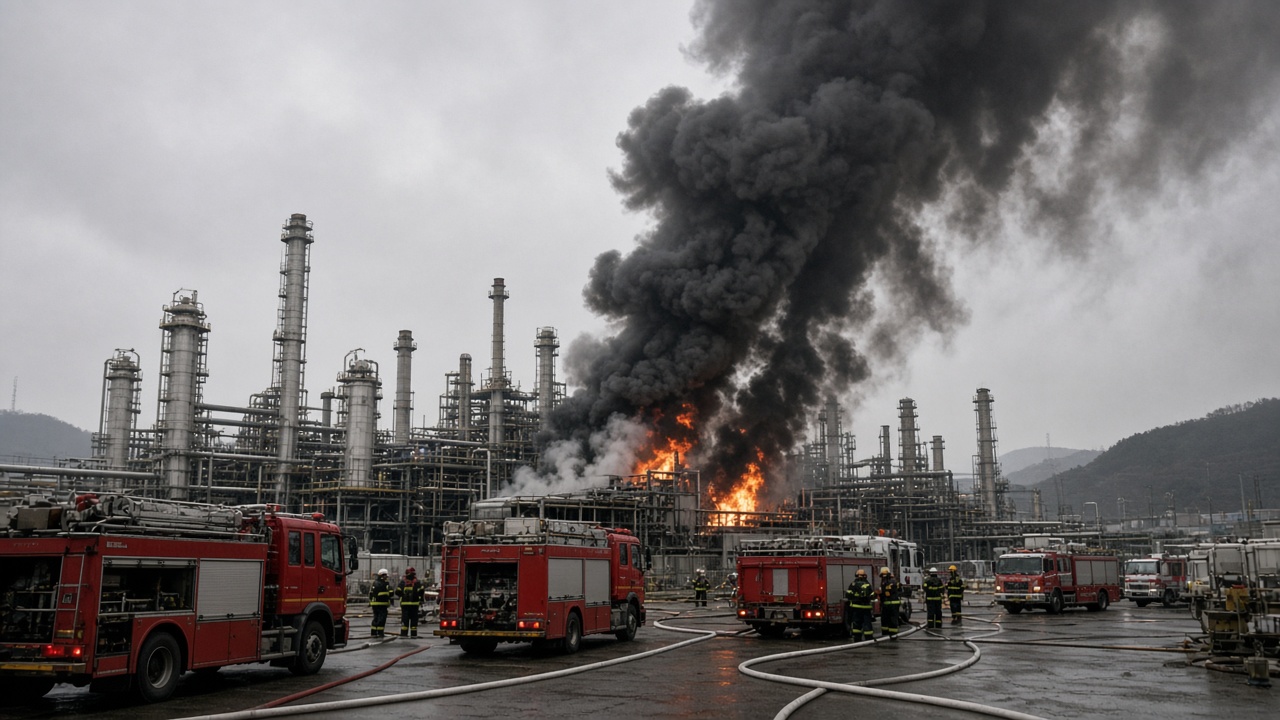
A fire at an outdoor chemical storage site in Ulsan on Wednesday morning escalated into a national emergency response, with South Korea's fire commissioner ordering two stages of nationwide mobilization before crews extinguished the blaze about four hours after the first alarm.
The Ulsan Fire Headquarters said the blaze began at 9:41 a.m. at a chemical manufacturer in Ulju County. Twelve workers at the company evacuated immediately, and no casualties had been reported by late afternoon. Black smoke visible across the industrial belt nevertheless forced a partial shutdown at a nearby S-OIL Shaheen petrochemical construction project, sending roughly 7,000 workers to safer ground.
Why a local tank fire triggered a national call-up
Officials said flames erupted while workers transferred toluene into drum containers, then spread to tanks holding other solvents including acetone and ethanol. Because the facility sits inside one of the country's densest petrochemical corridors, commanders worried that heat could reach larger inventories or interrupt fuel and resin production across the southeast.
The National Fire Agency issued a first-stage nationwide mobilization order at 10:17 a.m., pulling high-performance chemical trucks and an unmanned water cannon from Busan, Daegu and South Gyeongsang Province. A second-stage order followed at 11:18 a.m., adding recovery support vehicles and a high-capacity foam system from the National 119 Rescue Headquarters. Interior Minister Yun Ho-jung directed agencies to deploy every available resource and to search for anyone who might still be inside the perimeter.
Industrial stakes around Onsan and Shaheen
Ulsan hosts major refiners and specialty chemical makers roughly 310 kilometers southeast of Seoul. S-OIL's decision to pause parts of the Shaheen project underscored how quickly a localized ignition can ripple through supply chains: contractors working on the expansion cleared the site even though the fire was not inside the refinery itself.
Fire authorities ultimately committed 201 personnel and 49 pieces of equipment to the scene, according to the Ulsan headquarters. Helicopters joined ground crews as commanders tried to keep the fire from jumping secondary containment. By 1:50 p.m., officials said the main flames were out, though monitoring continued for hotspots in adjacent tanks.
Investigation and accountability questions
Police and fire investigators said they would determine whether procedural failures during the toluene transfer contributed to the ignition and whether containment rules for hazardous outdoor storage were followed. Chemical manufacturers in Korea face strict reporting requirements when flammable liquids are moved between tanks, and any breach could draw regulatory penalties as well as civil claims from neighboring plants.
For residents and shift workers who have seen periodic leaks and fires along the Onsan industrial belt, Wednesday's mobilization was a reminder that national disaster protocols are wired for exactly this kind of cross-city risk. The absence of reported injuries will not end scrutiny: lawmakers frequently demand after-action reviews when nationwide orders are used, and investigators will be expected to show whether the escalation was proportional or whether earlier local resources should have contained the blaze without calling in half the country’s specialized foam fleet.