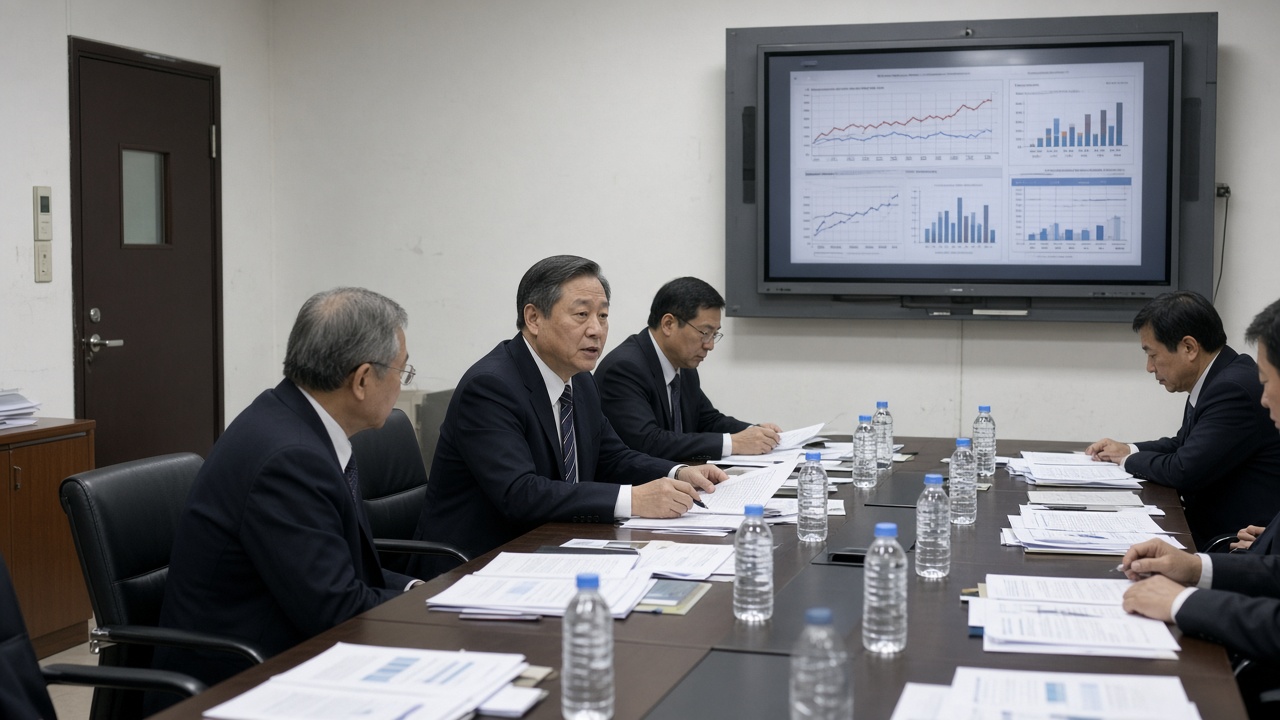
Financial Services Commission Chairman Lee Eok-hwon called an emergency stock-market review on Thursday afternoon after South Korea's Kospi closed down 7.57 percent, extending a seven-session slide that erased months of chip-led gains.
The meeting at the Government Complex Seoul in Jongno brought together the Financial Supervisory Service, Korea Exchange, Korea Securities Depository, Korea Securities Finance Corporation, and research heads from KB Securities and Shin Young Securities. Participants reviewed foreign and institutional flows after U.S. inflation data revived rate-hike bets and hammered AI-linked semiconductor names overnight.
What regulators concluded
Officials said the selloff reflected a cluster of external shocks — firmer U.S. consumer prices, doubts about AI infrastructure payoffs, and higher oil — but agreed that the speed of the decline looked stretched relative to fundamentals. They cited continued strength in shipbuilding, defense exports, and current-account surpluses, and noted that financial institutions remain well capitalized.
Lee urged market participants to avoid panic-driven herding and told brokerages and banks to tighten risk controls rather than chase volume with easy credit. "Investing on excessive debt and credit is dangerous, and risk management matters most at times like this," he said, according to the commission's statement.
Monitoring and enforcement
The FSC said agencies will keep a joint watch on rumor-driven trading, illegal short selling, and other disruptive activity, with contingency plans ready if volatility spreads to the won or credit markets. The commission did not announce new short-selling bans or a pension-buying program on Thursday, framing the session as coordination rather than an immediate market intervention.
For corporate treasurers and retail investors waking up in Seoul, the message was stabilization without guarantees: authorities are on alert, but the next sessions will still track global chip sentiment and U.S. rate expectations as much as local policy.
Market context heading into Friday
Thursday's plunge followed a seventh straight down day for the Kospi, the longest losing streak since September 2024. Local broadcasters noted that combined market capitalization on the main board fell to about 4,581 trillion won, a one-day contraction of roughly 375 trillion won. Kosdaq shares fell in tandem, and both boards triggered level-one circuit breakers as algorithms and retail stop orders stacked up in the opening hour.
Chipmakers were not the only losers. Hyundai Motor slid about 7 percent as investors rotated out of cyclical exporters, and battery suppliers tracked U.S. futures lower. Still, the narrative in Yeouido was dominated by Samsung Electronics and SK Hynix, which together represent nearly half of the index's weighting and therefore magnify any global semiconductor wobble.
Analysts at Mirae Asset Securities told Reuters clients that the market is testing whether AI capital expenditures will produce cash flows, not just revenue lines on cloud providers' income statements. Until U.S. rate expectations settle, Korean equities will likely continue to trade as a high-beta expression of the Philadelphia semiconductor complex.
The FSC's statement emphasized coordination rather than immediate liquidity injections. That leaves room for follow-up measures if Friday's session opens weak again, but it also signals that policymakers want to avoid rewarding highly debt-funded dip-buying with explicit put options.