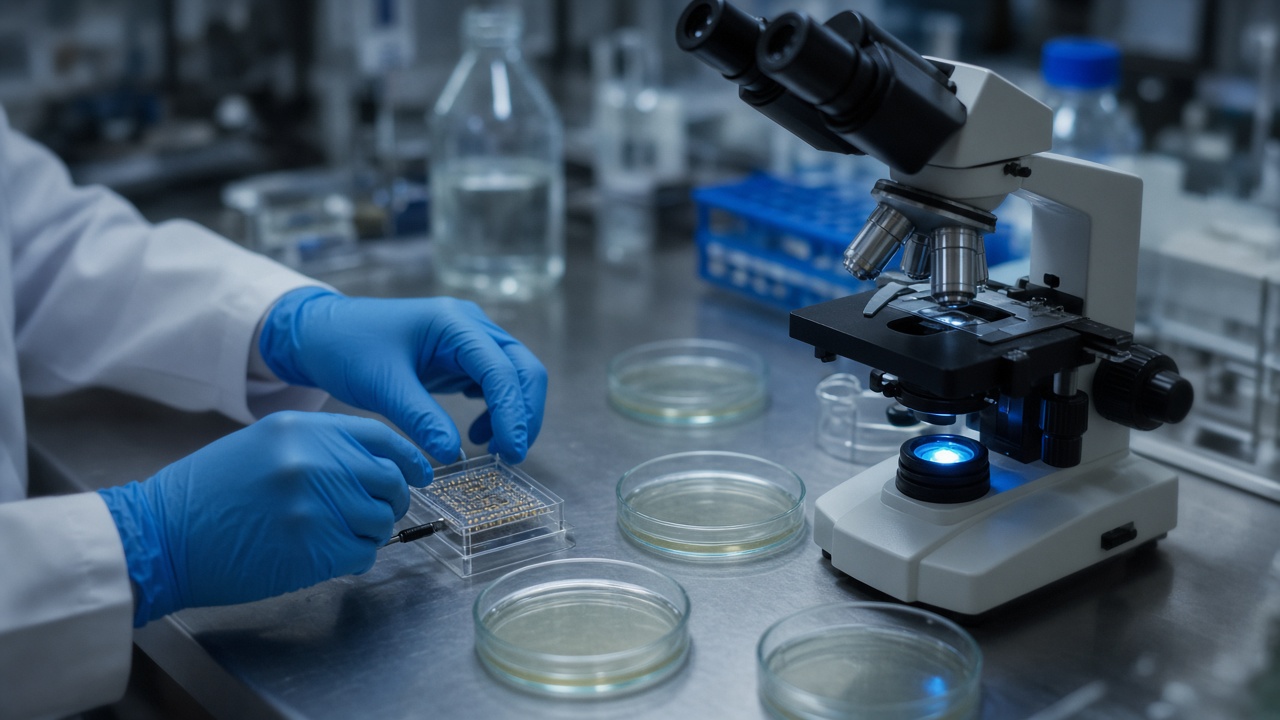
University of Bristol engineers showed that lab-grown brain organoids can translate tactile Braille patterns into distinct neural signals, hitting 83% letter-decoding accuracy when three organoids teamed up—an early step toward biohybrid computers that sip energy compared with silicon alone.
The study, published 16 October in Frontiers in Artificial Intelligence, fed organoids signals from a sensor detecting raised-dot patterns. A support-vector machine classifier read the organoids’ activity. Single organoids reached about 61% accuracy; the trio improved discrimination and filtered artificial noise better than algorithms working on raw sensor data alone.
Why organoids instead of chips
Lead author Tianyi Liu, a PhD student in Bristol’s School of Engineering Mathematics and Technology, framed the work as exploring energy-efficient computing by pairing living tissue with electronics. Organoids are not miniature brains with consciousness; they are structured cell cultures that exhibit coordinated electrical activity. Researchers hope such hybrids could someday handle pattern-recognition tasks with far lower power draw than massive GPU clusters.
The Braille task is deliberately concrete. Tactile letters produce reproducible input patterns, making it possible to score decoding accuracy the way handwriting recognition benchmarks work in machine learning. Success does not mean organoids will replace keyboards next year—it means biological components can perform a structured classification job in the loop.
Ethics and scalability questions
Biohybrid research triggers oversight on tissue sourcing, consent and long-term culture conditions. Bristol’s release emphasises engineering metrics, but regulators will ask how cultures scale beyond petri dishes and what happens when organoids vary batch to batch. Consistency is the hurdle between a striking paper and a deployable component.
Still, the noise-filtering result matters: organoids improved robustness versus direct decoding of corrupted sensor streams. That suggests biological layers could stabilise messy real-world inputs in future prosthetics or sensory-replacement devices—far from today’s experiment, but aligned with UK strengths in neuroengineering.
UK science context
The work lands amid wider UKRI investments in biosecurity and AI, but it is fundamentally a hardware story about novel compute substrates. For readers tracking British science policy, it is a reminder that “AI” in 2026 is not only large language models—it is also wet-lab systems learning patterns with living neurons on a chip.
Next engineering steps
Co-author Benjamin Ward-Cherrier’s team will explore larger electrode arrays and longer culture periods to see whether accuracy plateaus or keeps climbing. Industrial partners may care about power budgets: if organoid arrays beat silicon on joules per classification, niche edge devices could follow—even if mass-market servers never will.
Open publication in Frontiers allows other UK labs to replicate protocols, a priority for UKRI credibility after foreign replication scares in other fields.