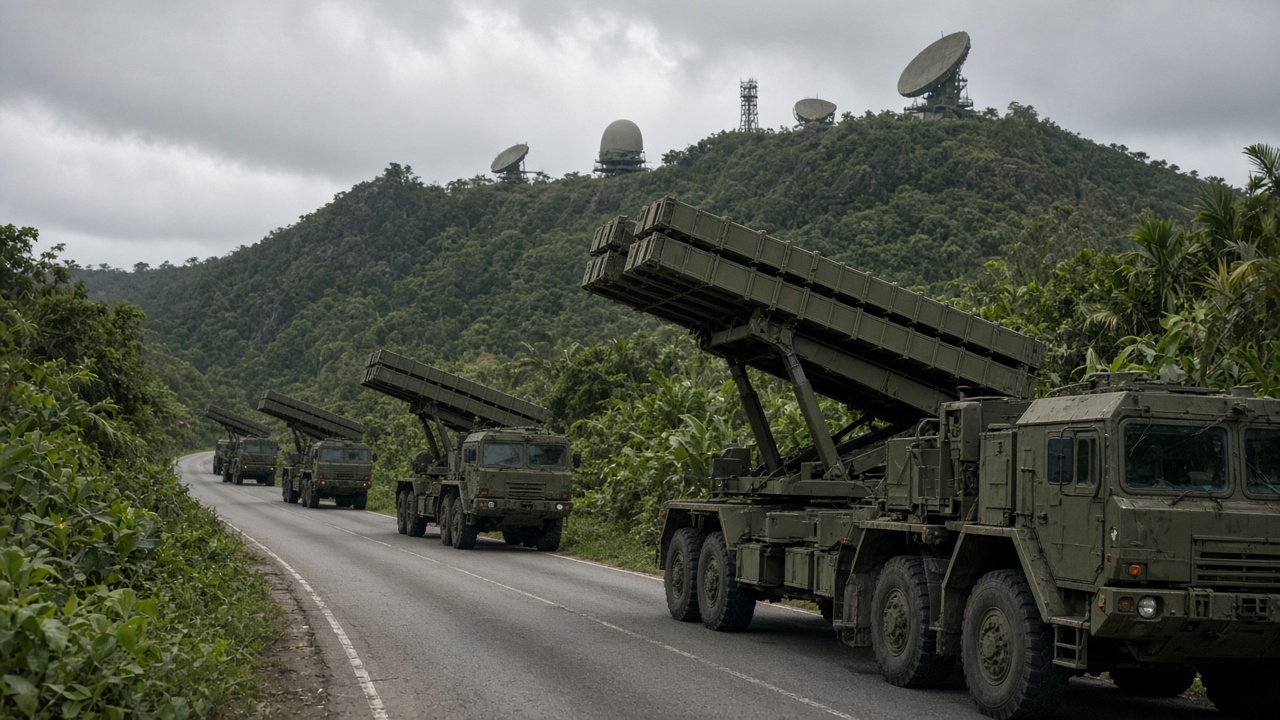
Japan and the United States will station ground-based anti-ship weapons on Yonaguni Island later this month during the Keen Sword exercise, moving American NMESIS launchers onto the country’s westernmost inhabited territory for the first time, according to defense planning documents and local officials.
The Okinawa Defense Bureau posted deployment plans showing that about 60 troops from the U.S. Army and the 12th Marine Littoral Regiment will operate the Navy-Marine Expeditionary Ship Interdiction System and the Marine Air Defense Integrated System on Yonaguni between Oct. 19 and Oct. 29. Japanese Ground Self-Defense Force units will bring Type-88 surface-to-ship missile launchers, medium-range air-defense systems, and transport helicopters to the same island garrison.
Why Yonaguni matters
Yonaguni sits about 110 kilometers east of Taiwan’s coast and hosts a coastal observation unit, electronic warfare troops, and a runway that Tokyo has expanded as China sends more coast-guard and navy vessels through nearby waters. Placing NMESIS there during an exercise — rather than on larger bases in Okinawa — signals that both governments want to practice distributing launchers across the Nansei chain instead of concentrating them on a few hardened sites.
NMESIS pairs Naval Strike Missiles with unmanned joint light tactical vehicle launchers; the Marine Corps declared the system operational in June after years of testing focused on denying adversary ships access to narrow straits. MADIS, which will deploy alongside it, is designed to counter low-flying aircraft and drones with Stinger missiles and cannon.
What the drills will — and will not — do
The Nikkei newspaper reported that neither NMESIS nor MADIS will fire live rounds on Yonaguni; crews will conduct functional checks only. That limitation is common for politically sensitive islands where residents have protested base noise, yet even a dry run requires road movements, radar emissions, and coordination with Japan Air Self-Defense Force C-2 and C-130 transports that will shuttle equipment onto the strip.
Keen Sword will also feature HIMARS rocket artillery on Ishigaki and additional missile rehearsals across the southwest islands, USNI News reported, as Japan fields newer Type-25 ship-killer missiles with ranges out to 1,000 kilometers. Stars and Stripes noted that NMESIS and MADIS trained on Ishigaki during last year’s Resolute Dragon exercise but had never been trucked onto Yonaguni itself.
Reactions in Tokyo and Beijing
Defense Minister Gen Nakatani has framed southwest island reinforcement as an “urgent task,” citing record Chinese incursions near the Senkaku Islands and Taiwan contingency planning. Chief Cabinet Secretary Yoshimasa Hayashi told reporters this week that Keen Sword is defensive and transparent, inviting media to observe portions of the schedule.
Chinese foreign ministry spokespeople have not yet commented on the Yonaguni deployment plans, but state media routinely criticize U.S.-Japan exercises that touch Taiwan-adjacent territory. For residents of Yonaguni, the exercise means closed roads and extra aircraft noise, yet town officials told Stars and Stripes they were notified through the defense bureau’s standard consultation process.
What comes after Keen Sword
Exercise equipment will return to Okinawa and mainland bases once Keen Sword ends, but planners on both sides have made clear that rotational deployments — not permanent garrisons — are the template for NMESIS in Japan. The longer-term question is whether future iterations keep pushing launchers westward as Japan budgets new ammunition depots and hardened shelters on Amami Oshima and Miyako.
For Prime Minister Sanae Takaichi’s government, the drill is a chance to show domestic audiences that revised defense guidelines are producing visible hardware on remote islands, not just slide decks in Ichigaya. For U.S. Indo-Pacific Command, it is a rehearsal of the distributed maritime campaign both militaries say they would need if a Taiwan crisis blocked sea lanes through the Miyako Strait.