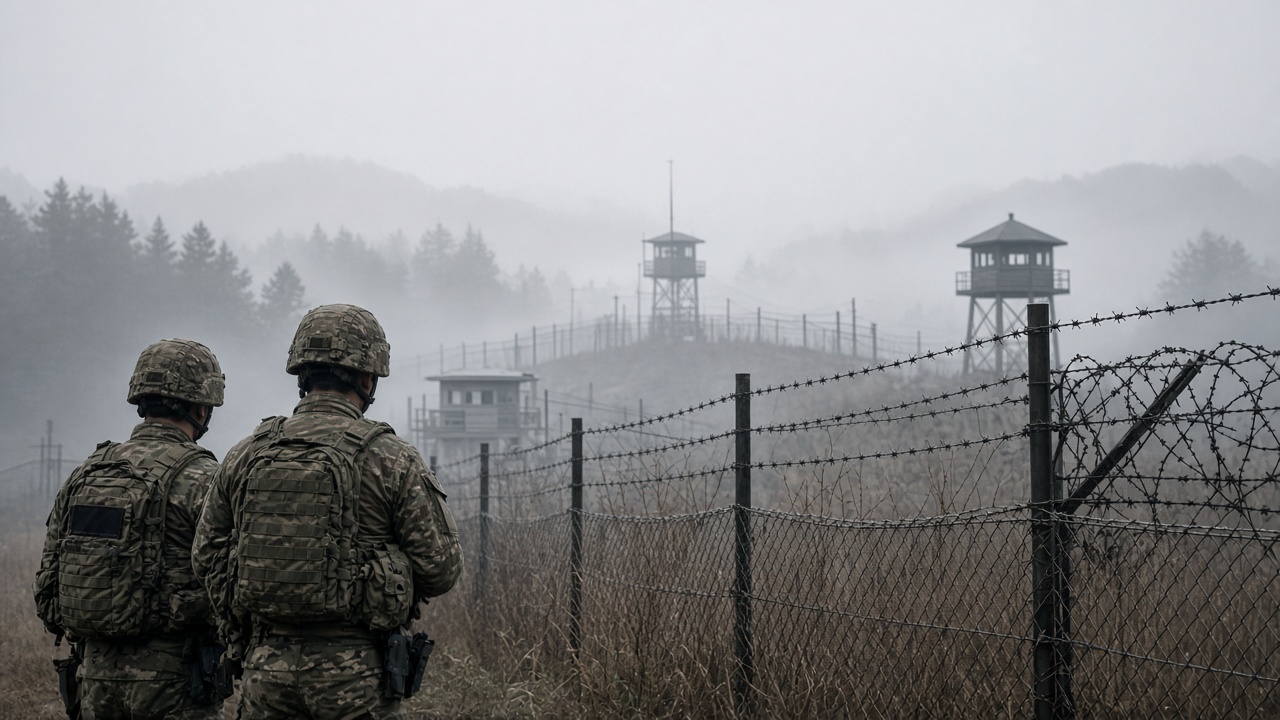
South Korean ruling-party lawmakers escalated a diplomatic protest on Saturday against Gen. Xavier Brunson, demanding that the commander of U.S. Forces Korea and the United Nations Command withdraw recent comments about where the Republic of Korea’s territory begins along the Demilitarized Zone.
Rep. Kim Byung-joo of the Democratic Party of Korea, a retired four-star army general who serves on the National Assembly’s National Defense Committee, said Brunson should retract the remarks and apologize to the South Korean public. Kim argued that describing South Korea as starting at the southern fence of the DMZ infringed on territorial sovereignty guaranteed by Seoul’s constitution.
What Brunson said in Washington
The dispute stems from comments Brunson made on 14 October at a seminar hosted by the Gold Institute for International Strategy in Washington. South Korean media reported that he described fences standing roughly two kilometres north and south of the Military Demarcation Line and said that, from the UNC’s perspective, “the Republic of Korea starts at the southern fence.”
The southern fence marks the boundary of the DMZ buffer on the South Korean side, while the MDL runs through the centre of the zone. Kim said the 1953 Armistice Agreement gives the UNC authority over DMZ access and certain administrative tasks, but not the power to define where South Korean sovereignty begins. National Defense Committee chair Jin Sung-joon said Friday that the language could create a “serious misunderstanding” about the extent of Seoul’s control.
UNC pushes back on sovereignty fears
A UNC spokesperson told South Korean outlets that Brunson was explaining responsibilities assigned under the armistice for the DMZ and Joint Security Area, and that there is “no question” about South Korea’s sovereignty. Critics in Seoul nonetheless said the phrasing echoed past friction over UNC gatekeeping of parliamentary visits to the zone and civilian areas such as Daeseong-dong village inside the buffer.
Defense analysts quoted in Korean press linked the controversy to wider unease about wartime operational control transfer. Brunson has recently suggested conditions for handing OPCON back to South Korea have shifted, comments the ruling party said Saturday do not change its position that Seoul should meet agreed milestones as quickly as possible.
Political stakes for the alliance
With about 28,500 U.S. troops stationed in South Korea and large-scale exercises such as Keen Sword scheduled on the horizon, symbolic disputes over language can quickly spill into parliamentary hearings. Kim’s demand for a public apology is aimed as much at domestic audiences ahead of defense budget debates as at the U.S. chain of command.
Washington and Seoul have spent years aligning on North Korean missile tests, extended deterrence and industrial cooperation; a perceived slight over the DMZ touches constitutional language that defines the country’s territory as the Korean Peninsula and its adjacent islands. How Brunson’s headquarters responds — whether with a clarifying statement or quiet diplomacy — will signal whether the alliance can contain another armistice-era quarrel without slowing operational planning.
What to watch
Lawmakers are likely to summon defense officials when the National Assembly returns to session, seeking a formal government readout of Brunson’s remarks and any U.S. clarification delivered through diplomatic channels. Until then, the argument remains a war of statements: Seoul insisting that DMZ administration is delegated, not donated, and Brunson’s critics insisting that allied commanders must speak as if South Korean sovereignty starts at the Yellow Sea coast, not at a fence two kilometres south of the MDL.