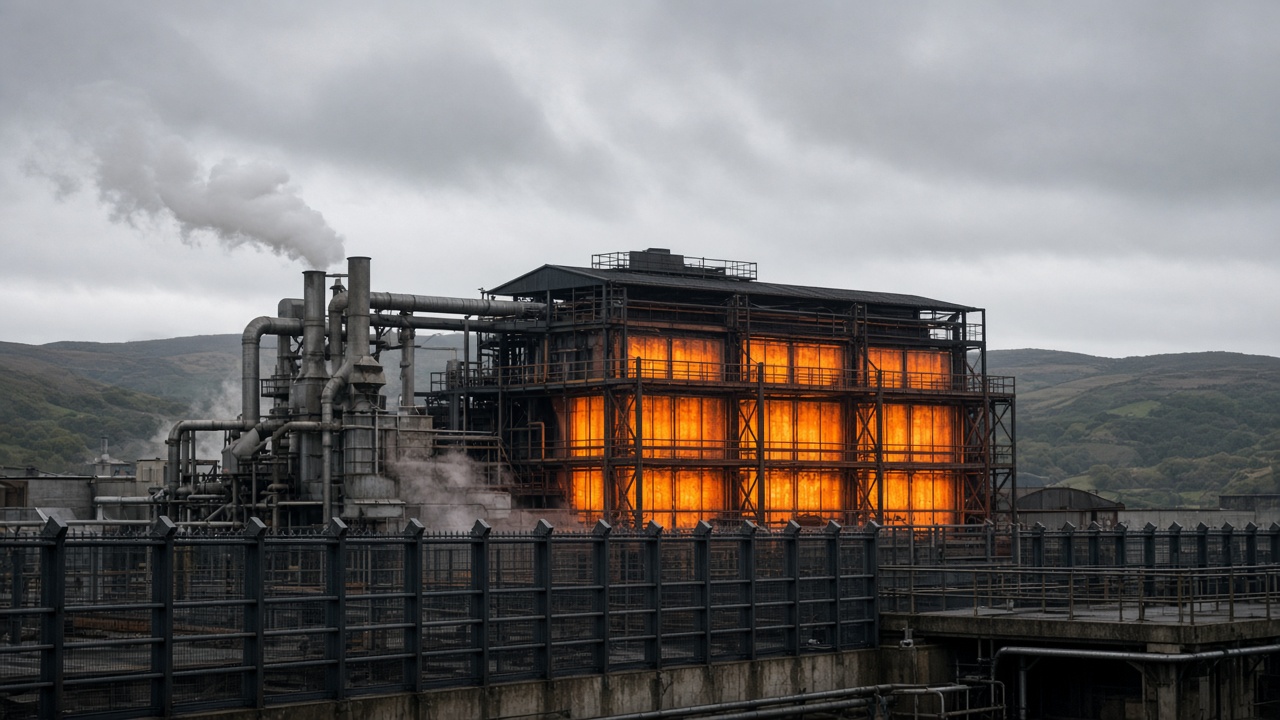
A family-owned glassworks near Redruth has taken the first steady megawatt-hours of process heat piped from the United Downs geothermal project, operators said, showing how Cornwall’s deep-hot brine can feed factories as well as Octopus Energy’s grid contract.
Geothermal Engineering Ltd switched on the UK’s inaugural commercial geothermal power plant on 26 February, generating roughly 3 MW of continuous electricity from water above 190°C drawn from a 5 km well. While headlines focused on Octopus buying the power for about 10,000 homes, engineers always planned to cascade lower-grade heat to local industry before reinjecting fluid underground.
Glass furnaces need constant heat
Glass production consumes enormous thermal energy to keep melt tanks near 1,500°C. Even a modest pre-heat from 90°C geothermal brine can trim gas burners and stabilise fuel bills that have whipsawed since Russia’s invasion of Ukraine. The Redruth site linked a heat exchanger to its annealing lehr, capturing waste heat that previously vented to the atmosphere.
Factory managers said the first week delivered just under two megawatt-hours per day of useful thermal input—small relative to furnace demand, but enough to prove pipeline integrity. GEL aims to scale industrial offtake before lithium extraction ramps, using the same closed loop that already yields battery-grade carbonate.
United Downs context
The £50 million United Downs scheme pairs Exergy’s organic Rankine cycle turbines with GEL’s deepest onshore UK well. Electricity sales provide baseline revenue, while lithium co-production could eventually reach 100 tonnes per year from the current pilot, with far larger tonnage planned if brine chemistry holds.
Two additional Cornwall projects targeting another 10 MW by 2030 are in development, according to company disclosures. British Geological Survey estimates suggest far larger theoretical resources, though drilling costs remain the barrier the glassworks pilot is meant to help amortise.
Local politics and jobs
Cornwall Council backed early feasibility grants, seeing geothermal as a rare 24/7 renewable that does not depend on North Sea wind patterns. Trade unions want apprenticeship pipelines into drilling and plant operations, especially as china clay mining employment has shrunk.
Environmental groups asked for continued seismic monitoring after test phases recorded minor tremors. GEL said reinjection controls pressure, and regulators signed off before commercial flows began.
Why it matters nationally
Whitehall’s industrial decarbonisation strategy leans on electrification, yet many factories cannot switch overnight. Cascaded geothermal heat offers a middle path: not zero carbon by itself, but a dependable baseload that displaces methane burners.
If the glassworks trial survives a full winter, other energy-hungry plants along the A30 corridor may sign heat purchase agreements, giving United Downs a second revenue leg beyond the Octopus power deal. For now, the milestone is measured in megawatt-hours rather than press releases—actual flame offset inside a working factory.
Planning the next offtakers
GEL is surveying other factories along the Redruth corridor for heat purchase interest, including food processors that need steady drying temperatures. Planning officers said industrial symbiosis was always part of the United Downs vision, but electricity dominated headlines until the glassworks pipe went live.