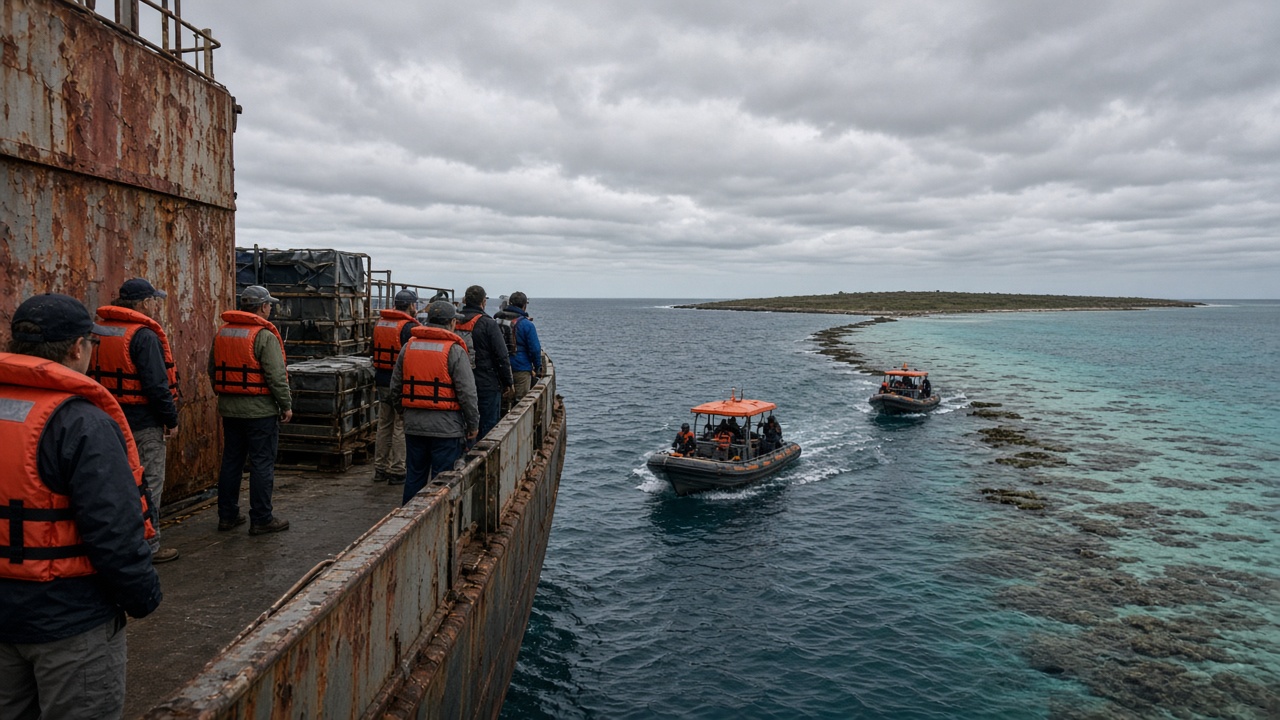
Fieldwork on Nikumaroro resumed on Sunday after Pacific squalls kept a 17-person expedition off the beach for three straight days, Purdue University and the Archaeological Legacy Institute said. Crew members finally boarded small boats from the Marin Mainiku cargo ship to reach the uninhabited Kiribati atoll, where sonar and magnetometer surveys have targeted a lagoon anomaly known as the Taraia Object since 14 October.
Weather had blocked the blasted channel
The team’s daily route runs through a narrow reef gap the British blasted in 1963—the last time anyone lived on the island. Expedition updates described prevailing winds near 20 knots and gusts up to 27 knots, enough to risk slamming transport boats into the reef. Technology specialist Sirisha Bandla said in a deck video that the crew was "really excited" to land again and push through the second of three planned investigation phases.
That phase calls for a hydroprobe and water-injection dredge to touch the submerged shape and strip sediment for a visual read. Marine archaeologists from RECON Offshore finished an initial lagoon survey on 14 October; identification still requires at least two more days of shore and underwater work, Purdue cautioned before the latest delay.
What the Taraia Object is—and is not
Satellite imagery first flagged the Taraia Object in 2020, and Purdue says similar shapes appear in aerial photography from 1938. Proponents of the castaway theory argue Amelia Earhart and navigator Fred Noonan missed Howland Island in July 1937, reached Nikumaroro—then called Gardner Island—and died there. Skeptics note prior Nikumaroro hunts found no confirmed Electra wreckage and that the lagoon feature could be natural debris.
Interest in this voyage led New Zealand’s Air Force Museum to release reconnaissance slides from 1938 on Friday. The black-and-white frames show the beached wreck of the SS Norwich City, a merchant ship lost in 1929 with 11 dead—evidence, the university argues, of how dangerous the reef remains. Castaway theorists also cite a Florida teenager’s shortwave report of hearing Earhart say something like "New York City," which they interpret as a garbled reference to the Norwich City wreck.
Clock is running on fuel and global attention
Because of the lost shore days, the expedition extended its stay; Purdue said the Marin Mainiku carries enough food and fuel for the longer schedule. Archaeological Legacy Institute executive director Rick Pettigrew acknowledged intense public interest and promised results "as soon as we are able," while stressing that science—not headlines—would drive any announcement.
Earlier high-profile searches have fizzled. Sonar near Howland Island in 2024 initially looked promising before analysts judged the target a rock formation. A 2019 dive near Nikumaroro based on a possible landing-gear photo also came up empty. Even if metal consistent with a Lockheed Electra 10-E emerges, confirming Earhart’s plane would require further study and permission from Kiribati, which administers the atoll.
For now the team is racing the calendar and the Pacific: El Niño conditions are amplifying the swell that already makes Nikumaroro one of the harder places on Earth to work. Whether the Taraia Object is aviation history or another red herring should become clearer once dredging and probing resume in earnest.