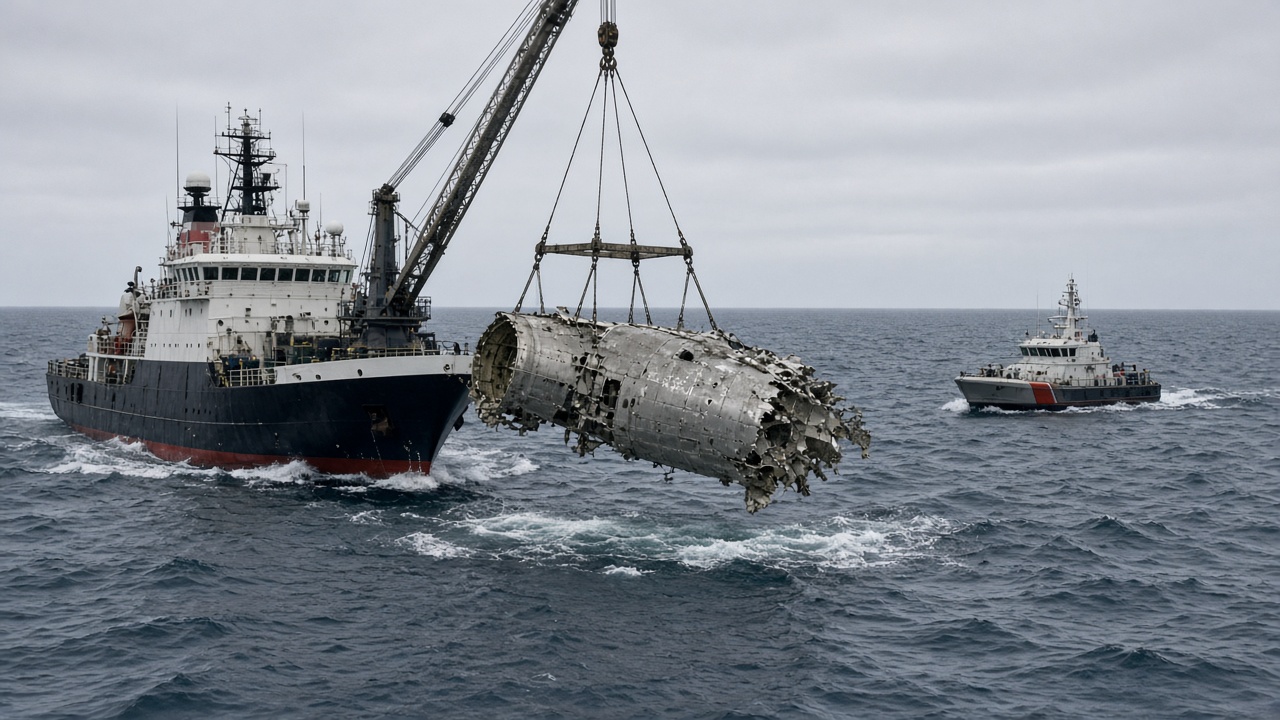
Salvage teams working for Japan’s air force raised a large piece of wreckage believed to be part of an RQ-4B Global Hawk surveillance drone from the seabed off Tottori Prefecture, more than a month after contact with the uncrewed aircraft was lost over the Sea of Japan.
NHK reported that lifting operations continued on Sunday, with helicopter footage showing a work vessel handling material hoisted from the crash zone. The Japan Air Self-Defense Force said Saturday that it had recovered part of the fuselage from waters roughly 50 kilometers off Tottori City at depths of about 200 to 300 meters.
Timeline since the September loss
Radar contact with the drone vanished on 15 September while it was flying a mission over the high seas north of the Tottori coast, according to ASDF briefings summarized by NHK World and Japanese broadcasters. Searchers later mapped debris on the seabed and along shorelines in Tottori and neighboring Shimane prefectures.
Wreckage has also washed ashore. The air force recovered a fragment near Izumo, Shimane, on 11 October, and FNN reported that residents had alerted authorities to material along the coast days earlier. Those finds widened the geographic puzzle investigators must reconstruct from scattered pieces.
How recovery is being run
The ASDF contracted a private salvage company and deployed a specialized recovery ship that began full-scale lifting on 13 October, broadcasters said. The force plans to transport recovered sections to Misawa Air Base in Aomori Prefecture, home to Japan’s three-aircraft Global Hawk fleet, for detailed analysis aimed at determining why the drone went down.
Officials have not announced a definitive cause. NHK said analysts will examine the airframe fragments for structural or systems failures once they reach Misawa. The service has indicated it intends to keep searching surrounding waters and coasts, with some reports saying the goal is to finish raising major components by early November.
Stakes for Japan’s surveillance posture
Tokyo began acquiring the high-altitude, long-endurance drones in fiscal 2015 to maintain persistent reconnaissance over wide maritime approaches. The third aircraft arrived at Misawa in June 2023, completing the originally planned trio. ASDF public materials describe endurance of about 36 hours and operating altitudes near 60,000 feet.
Industry estimates cited in Japanese media put the unit cost at roughly 17 billion yen (about $107 million). Losing one of three airframes therefore carries both a financial and an operational sting at a moment when Japan and the United States are expanding joint exercises in the southwestern island chain.
What commanders want answered
Lawmakers and defense watchers will press for clarity on whether the crash reflected maintenance issues, weather, human control links or a manufacturing defect. Until the Misawa engineering review progresses, commanders must schedule remaining Global Hawk sorties around the gap left by the destroyed aircraft.
For residents along the San’in coast, the weekend’s crane lifts were a visible reminder that a classified surveillance platform can still scatter debris across fishing grounds and beaches when something goes wrong far from the runway.