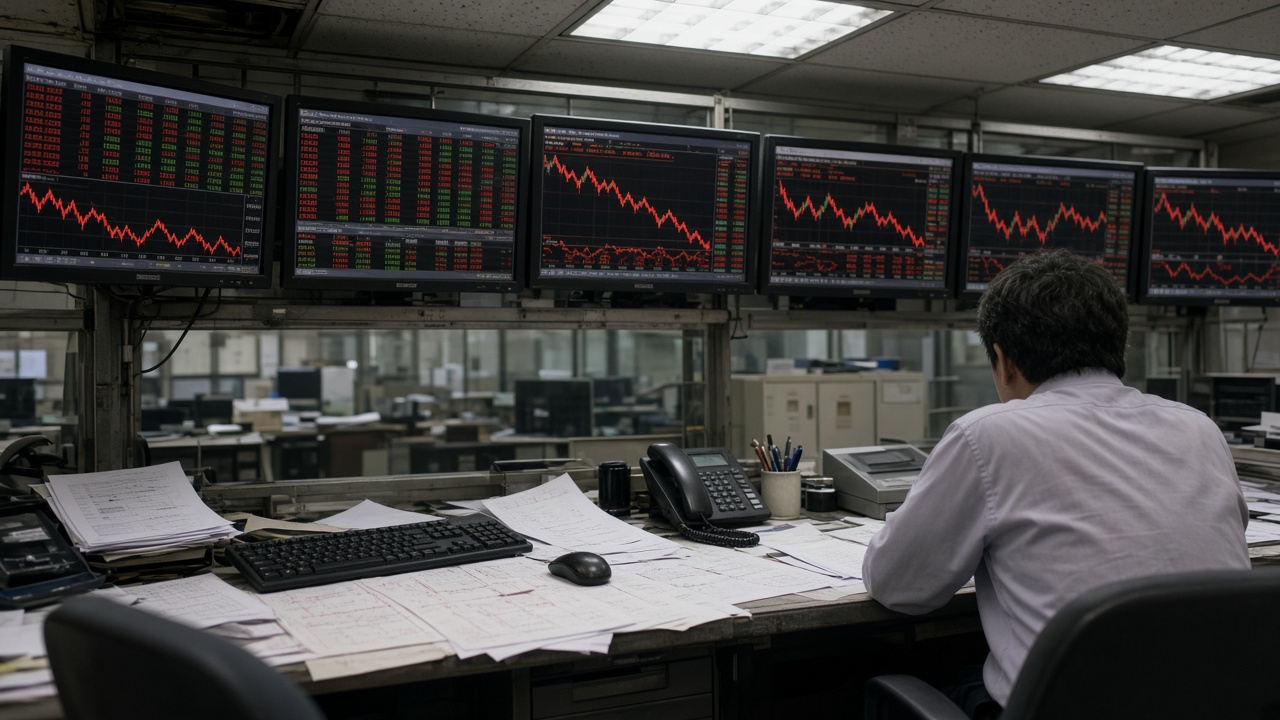
Taipei brokerage research chiefs told clients Monday that this week’s U.S. earnings calendar and Nvidia’s Berlin developer conference could cushion Taiwan’s market after Taiwan futures fell 1,144 points in the overnight session and the Philadelphia Semiconductor Index dropped 3.8 percent on Friday.
What shook the weekend tape
U.S. indexes finished lower on Friday as investors questioned whether AI-related capital spending can keep outpacing borrowing costs. The slide hit Taiwan-linked names through ADRs: Taiwan Semiconductor Manufacturing Co.’s U.S. listing fell about 2.2 percent, amplifying concerns that high-multiple hardware would lead any correction.
On the currency side, the New Taiwan dollar weakened 4.63 percent last week to NT$32.338 per U.S. dollar, its largest weekly decline since August 2025, according to United Daily News market tables. Foreign investors sold a net NT$98.7 billion of Taiwan equities in the five sessions through Friday, Taiwan Stock Exchange data show, adding pressure as funds converted proceeds into dollars.
Why desks still talk about earnings
Despite the risk-off tone, domestic strategists highlighted that TSMC had already reported third-quarter revenue up 14 percent quarter on quarter, with several global houses lifting fourth-quarter earnings-per-share estimates into the low NT$30s per share. Sinopac Securities research head Chiang Hao-nung and Fubon Securities chairman Chen Yi-kuang both argued in weekend notes that the print sets the tone for Taiwan’s AI supply chain as U.S. cloud giants begin reporting from Wednesday.
Everbright Securities general manager Chiang Hao-nung added that IBM and Texas Instruments report on Tuesday, Tesla on Wednesday, and Intel on Thursday, while Alphabet, Amazon and Microsoft follow the week after. FactSet consensus cited by local desks still implies roughly 24.5 percent year-on-year U.S. corporate profit growth in the third quarter and close to 28 percent in the fourth, with technology earnings growth expected above 50 percent.
GTC Berlin on the calendar
Nvidia’s GPU Technology Conference in Berlin runs Tuesday through Thursday, with chief executive Jensen Huang scheduled to speak on Wednesday. Taiwan desks view the keynote as a sentiment checkpoint after questions surfaced about AI financing and return on infrastructure spending. Several Taipei server assemblers told Commercial Times reporters they are not canceling rack orders but want clearer guidance on next-year accelerator shipments.
Mega Securities chairman Liu Cheng-yu said a constructive message on sovereign AI and robotics workloads could help Taiwan’s high-beta names recover faster than broader Asia ex-Japan benchmarks, which fell more than 2 percent on Friday.
Positioning into the open
With the weighted index having lost 4.47 percent last week and closed below its 20-day moving average, strategists expect choppy two-sided trade rather than a straight-line rebound. Sinopac’s note suggested investors focus on companies with third-quarter revenue growth and net institutional buying, while trimming leveraged positions if margin debt continues to rise.
Investment trusts and government-linked funds remained net buyers through last week, a pattern Everbright and Fubon said helped Taiwan outperform other semiconductor-heavy markets during the drawdown. They cautioned, however, that further U.S. inflation prints before the Federal Reserve’s late-October meeting could keep foreign funds defensive regardless of single-company beats.
What to watch this week
Beyond U.S. results, local investors will parse Ministry of Finance trade data and any central bank commentary on orderly foreign-exchange markets after last week’s NT dollar move. Brokerages said they will update sector models after TSMC suppliers hold earnings calls, but for Monday the immediate question is whether futures losses fully translate to the cash session or whether dip buyers step in around the quarterly moving average.
For now, the house view in Taipei is that fundamentals have not broken even if positioning has. The week’s U.S. earnings and Huang’s stage time will determine whether that gap closes through higher prices or through continued volatility.