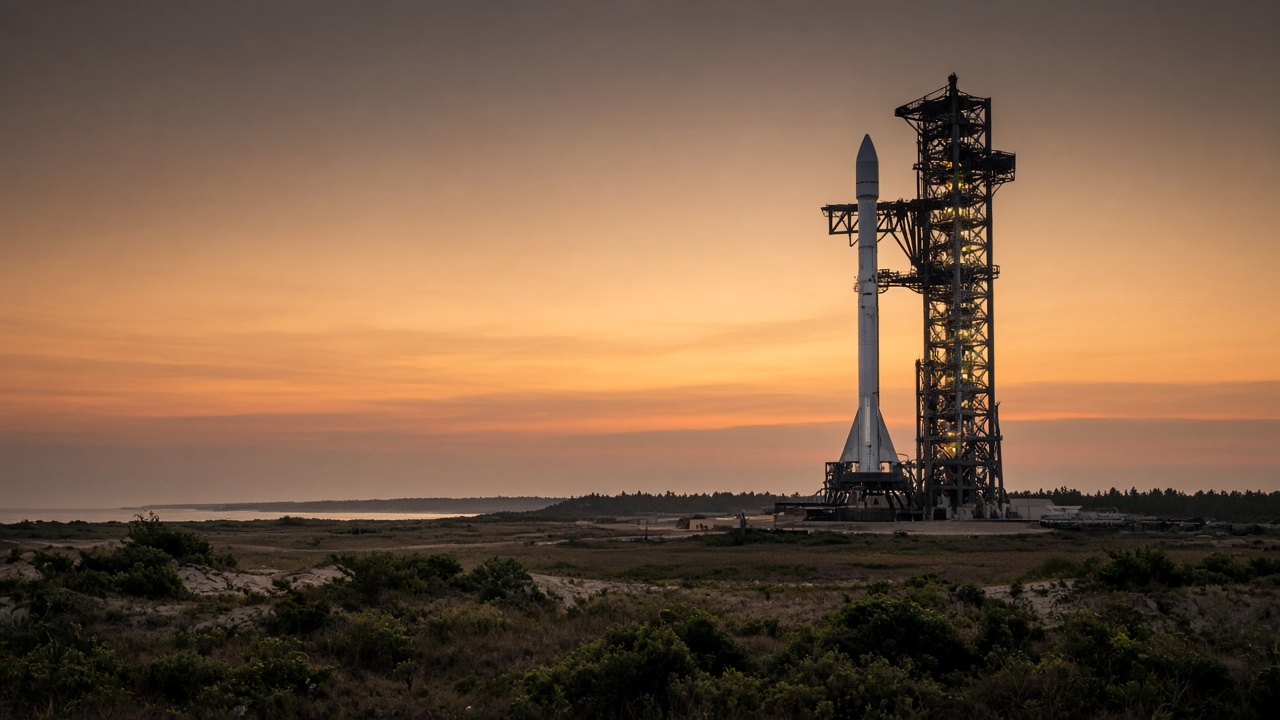
Indian Space Research Organisation teams at Satish Dhawan Space Centre are in the final campaign to fly GSLV-F18 with the NVS-03 navigation payload, a mission officials have been targeting for late October to restore minimum operational strength in the country’s NavIC regional positioning network.
Mission profile
NVS-03 is the third spacecraft in the second-generation NavIC series meant to replace ageing IRNSS satellites with improved rubidium clocks and longer service life. The satellite has been at Sriharikota for months awaiting final government clearance alongside GISAT-1A, and stacking of the GSLV’s first stage was completed by mid-September, The Times of India reported citing agency sources.
A successful flight would follow EOS-05 on GSLV-F17 in early September, giving ISRO back-to-back geostationary launches after a slow first half of 2026. Launch trackers list the window as no earlier than October, with industry publications discussing a pyro-valve configuration review that could shift the exact date by a few days.
Why navigation independence matters
NavIC underpins public alerts, fisheries safety applications and military-grade timing where operators do not want to rely solely on the U.S. Global Positioning System. The NVS-02 spacecraft launched in January 2025 but suffered an on-orbit anomaly, heightening pressure on NVS-03 to perform.
A fully operational constellation also supports smartphone chipsets that now ship with NavIC support mandated for Indian markets, linking space policy to consumer electronics supply chains.
Ground segment readiness
Beyond the rocket, ISRO must confirm ranging stations in the Andaman and Nicobar Islands and mainland telemetry hubs are calibrated for the new bus. International users watching India’s frequency filings will parse injection parameters to see whether the satellite settles in the planned geosynchronous slot without drift.
If GSLV-F18 lifts off before month-end, 2026 will end with four ISRO orbital missions, a modest cadence but one that keeps critical strategic assets on schedule while heavier LVM3 commercial flights continue separately.
Industry spillovers
Private space startups in Chennai and Hyderabad watch NavIC launches because chipset makers need predictable signal health before integrating dual-frequency support in handsets. A failure would delay procurement cycles for defence-grade receivers as well, given tri-service interest in assured positioning during border standoffs.
ISRO has not published a webcast time, but local authorities typically restrict beach access near Sriharikota twelve hours before ignition. Tourism operators in Puducherry already advertise launch-viewing packages, a small but telling sign of public enthusiasm when the agency returns to flight rhythm after the NVS-02 disappointment.