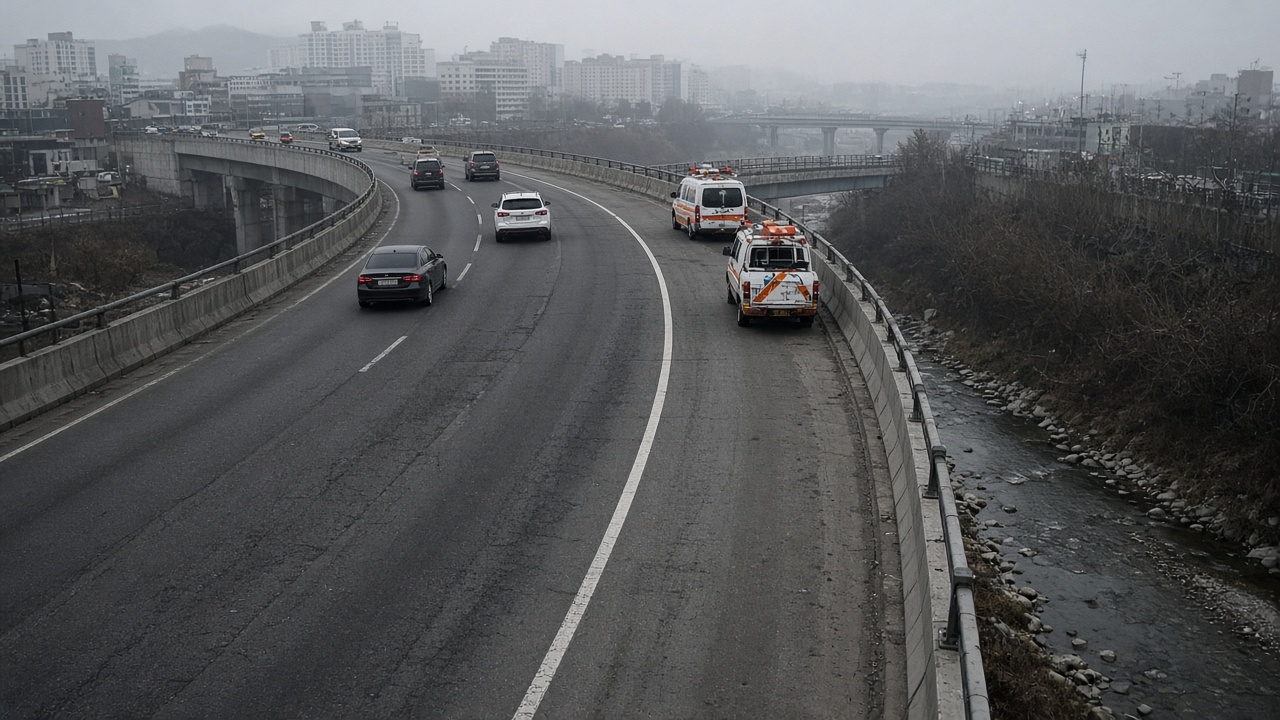
A third snapped suspension cable on Seoul's Jungnyeongcheon viaduct has reopened a safety fight in the National Assembly just as the city restored traffic on a long-closed stretch of the inner ring road, leaving commuters to weigh fresh political accusations against the engineers who keep the deck open.
Democratic Party lawmaker Hwang Hee told the land and transport committee on Monday that tendons—steel cables that prestress the concrete deck—failed in 2016, again in 2024 and once more in 2026 on the elevated roadway that funnels more than 100,000 vehicles a day around northern Seoul. Hwang released Seoul Metropolitan Government and Korea Infrastructure Safety Corporation records showing inspectors still rated the structure a "good" B grade after precision checks that ended in March 2026, even though a 2024 survey flagged 25 damaged tendons that have not yet been swapped out.
What broke and what Seoul promised
Tendons are not decorative: they pull the concrete into compression so the deck can carry rush-hour loads. When strands snap, engineers must decide whether to close lanes, shore the span or accelerate replacement work. Seoul replaced 32 cables after the 2016 failure and scheduled another 35—including the 25 corroded units—for completion by June 2027 at a budget of 72 billion won, according to briefing materials Hwang circulated.
City officials told reporters that later inspections relied on non-destructive drilling to find corrosion inside the ducts and that external breaks in 2024 and 2026 were visible only after strands sagged. They cited a 2017 Korea Concrete Institute study commissioned by the city that concluded up to four broken tendons could be repaired without a full traffic shutdown—a standard Hwang argues is obsolete after repeated failures.
Commuter impact this week
Seoul had closed 7.5 kilometers of the Jungnyeongcheon elevated section for maintenance and reopened it two days ahead of schedule at midnight on Monday, steering drivers back onto the inner loop after weekend detours. Monday's hearing did not order a new closure, but navigation apps still showed lingering delays as drivers rerouted around committee-hour press coverage and police message boards warning of inspections near Seongbuk and Gangbuk.
For travelers, the practical risk is uncertainty: the viaduct remains open while politicians demand a full re-rating under national bridge guidelines that classify corroded cables with section loss as "D"-grade defects requiring urgent work. Hwang accused Mayor Oh Se-hoon's administration of downgrading those defects to an internal "C3" corrosion label to delay spending, a charge city engineers denied by saying C3 describes corrosion depth rather than overall bridge class.
What riders should watch
Seoul says it will publish the replacement schedule for the 35 tendons and continue quarterly monitoring on 14 other prestressed concrete bridges. Until those cables are changed, drivers using the inner ring road will be relying on the same inspection regime that missed two breaks in the past two years—a fact opposition lawmakers are likely to keep highlighting as budget hearings continue this week.