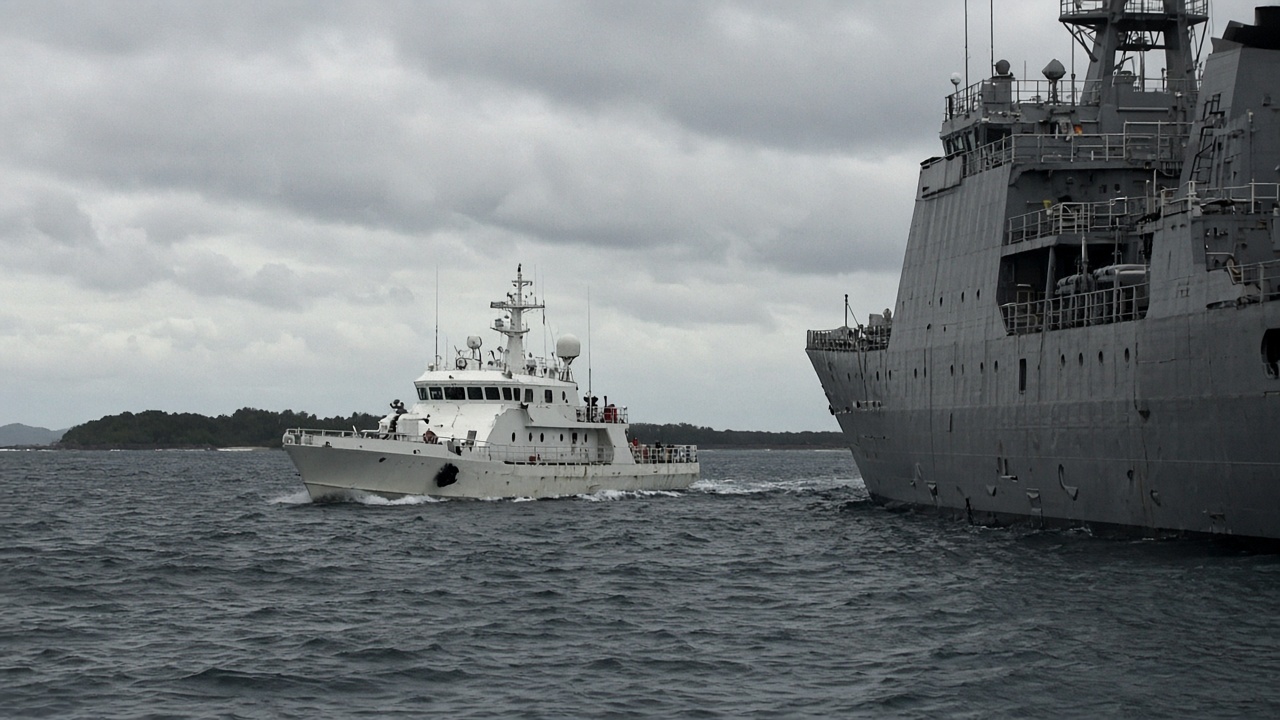
Taiwan’s Coast Guard Administration said a Chinese law-enforcement ship entered restricted waters near Dongsha Atoll on Tuesday after sailing “dark” without an automatic identification system signal, then used marine radio to challenge Taipei’s sovereignty before being shadowed out of the zone.
According to the administration’s Dongsha command, radar operators detected China Coast Guard vessel 3102 around 05:00 heading toward Taiwan’s restricted waters southeast of the atoll. The patrol ship Taichung was dispatched and, by 08:00, was sailing alongside the intruder inside the northeastern limit, broadcasting orders in Chinese and English to leave immediately.
Radio duel at sea
During the encounter, coast guard officials said, the Chinese crew transmitted propaganda over the radio, claiming that the Republic of China “does not exist” and addressing the Taiwanese ship as if it belonged to “China’s Taiwan Taichung vessel.” The Taichung responded that “the Republic of China Taiwan is a sovereign and independent country” that is “mutually not subordinate” to the People’s Republic of China, and that the Chinese ship was violating international rules by entering without permission.
The administration said the stand-off was still under monitoring as of its midday statement, part of a pattern it condemned as “fake law enforcement, real expansion” designed to create a veneer of jurisdiction. Taipei has counted 12 expulsions involving 15 Chinese coast guard hulls in Dongsha waters so far in 2026, it added.
Parallel air and sea pressure
The maritime confrontation unfolded on the same day Taiwan’s Ministry of National Defense reported a large-scale Chinese air manoeuvre. Starting around 10:43, the ministry said, it tracked 27 PLA aircraft—including J-10, J-11, J-16 and JH-7 fighters, H-6 bombers and KJ-500 early-warning planes—plus drones operating east of the median line and into the Western Pacific under the label of a “joint combat readiness patrol” and “far-sea long voyage.” Twenty-one sorties crossed the median line or its extension into northern, central, southwestern and Pacific airspace, the ministry said, and Taiwan’s military responded with its own aircraft, ships and shore-based missile systems.
Defence officials did not link the Dongsha incident directly to the air activity, but analysts in Taipei often treat simultaneous grey-zone moves as coordinated pressure ahead of typhoon season and U.S. election-year diplomacy.
Why Dongsha matters
Dongsha, also known as Pratas, sits roughly 450 kilometres southwest of Kaohsiung and hosts a small Taiwanese garrison and airstrip. Because it lies far from Taiwan’s main island, resupply and rapid reinforcement are difficult, making each coast guard confrontation a test of how quickly Taipei can assert control without escalating to naval warfare.
Turning off AIS transponders—sometimes called “going dark”—complicates tracking by commercial satellites and neighbouring militaries, increasing the risk of miscalculation. Taiwan’s statement Tuesday framed the tactic as deliberate concealment before the incursion, not a navigational glitch.
With Typhoon Champi forecast to brush Taiwan later in the week, coast guard and navy planners must juggle storm preparations with sustained Chinese presence around the atoll. For now, the administration’s message is unchanged: it will “not yield a single inch of sea” and will keep broadcasting that Taiwan’s government—not Beijing—controls the waters around Dongsha.