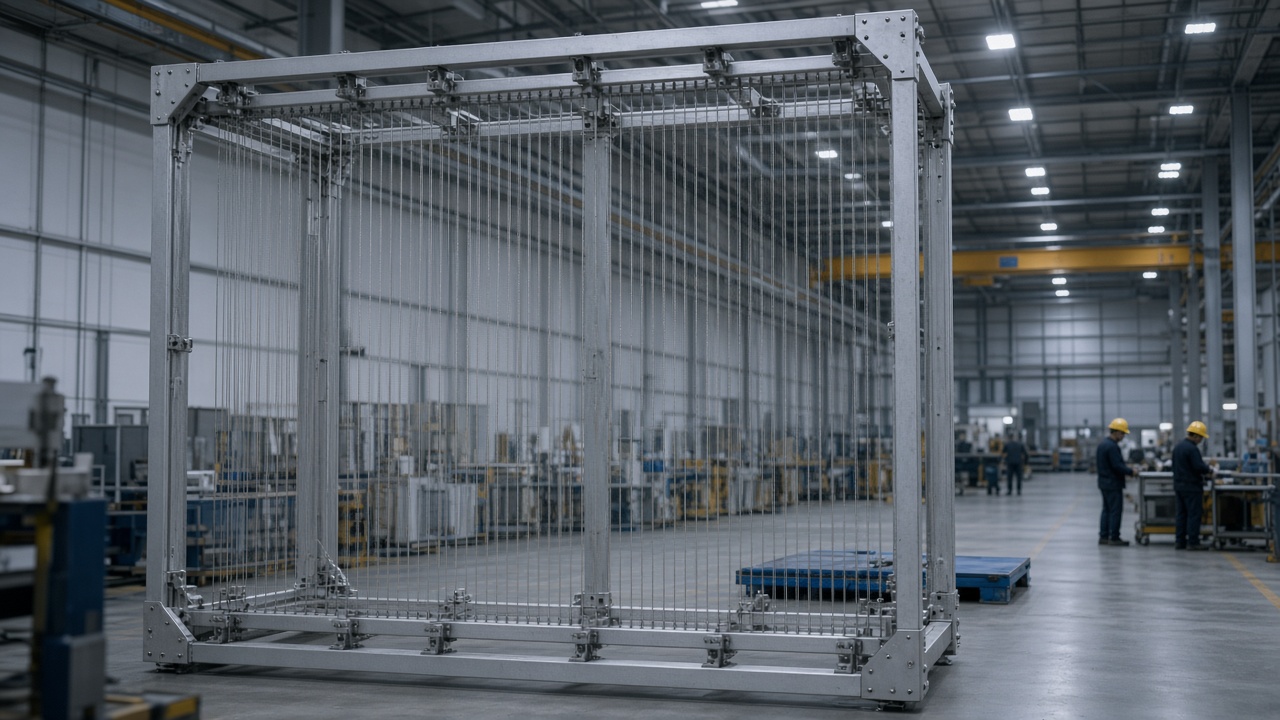
UK engineers have completed half of the giant neutrino sensors they are building for the Deep Underground Neutrino Experiment, marking the midpoint of a manufacturing programme that will ship 137 anode plane assemblies from Cheshire to South Dakota.
The Science and Technology Facilities Council said on 19 October that teams at Daresbury Laboratory had finished 69 of the assemblies, each about 6.3 metres tall and 2.3 metres wide, for installation nearly a mile underground at the Sanford Underground Research Facility.
Why the UK build matters
DUNE will fire a neutrino beam 1,300 kilometres from Fermilab in Illinois to the far detector, searching for differences between neutrinos and antineutrinos that could explain why the universe contains matter rather than annihilating itself. The UK is responsible for 137 of the 150 assemblies in the first far detector module, making the programme one of Britain's largest contributions to particle physics this decade.
Each assembly carries roughly 24 kilometres of wire to detect faint electrical signals when neutrinos interact with liquid argon. Universities including Lancaster, Liverpool, Imperial College London, Manchester, Sheffield and Sussex supply components and quality assurance, coordinated through the DUNE-UK collaboration spanning 14 universities and two national laboratories.
Engineering challenges
Technicians must tension thousands of precision connections across each frame without damaging fragile wires. Any defect discovered after shipment to the United States would delay a project already tied to international funding cycles and US underground construction schedules.
Neutrinos rarely interact with matter, so detectors must be enormous and exquisitely sensitive. Cosmic rays would overwhelm readings at the surface, which is why the far detector sits deep underground, shielded by rock.
Beyond fundamental physics
Skills honed on DUNE feed into UK industry: precision wiring, cryogenic engineering and large-scale project management translate to sectors from aerospace to medical imaging. Ministers have cited fundamental science as part of the growth agenda, even as day-to-day headlines focus on budgets and banks.
When the remaining assemblies leave Daresbury, UK scientists will continue contributing software, computing and accelerator upgrades. For now, reaching the halfway mark gives Fermilab planners confidence that the far detector's electronic heart will arrive on schedule, keeping one of the world's most ambitious physics experiments on track for the 2030s science programme.
Education pipeline
Daresbury technicians apprentice local college students into wiring roles, addressing a skills gap that would otherwise force the UK to import assembly labour. STFC leaders said the DUNE order book underpins a decade of stable employment at the Sci-Tech Daresbury campus.
When assemblies ship to South Dakota, UK physicists will travel to support installation, maintaining knowledge transfer that keeps British teams competitive for the next generation of neutrino and dark-matter experiments.
Public engagement teams at UKRI plan school visits to Daresbury so students can see wire-tensioning robots in action, part of a wider effort to refill physics A-level cohorts that dipped after pandemic disruptions. Ministers touring the site last month linked the project to the National Space Strategy, arguing that precision manufacturing for physics underpins satellite servicing ambitions as well.
When the far detector begins commissioning in the United States, UK scientists will staff control rooms remotely from Harwell and Edinburgh, using fibre links to monitor argon purity and high-voltage systems. That operations model keeps British expertise embedded in the experiment long after the last APA container leaves Liverpool docks.
Shipping logistics teams are rehearsing customs paperwork for transatlantic moves of the oversized frames, a process that tripped up earlier physics experiments when pandemic port delays collided with narrow installation windows in South Dakota. UK Export Finance has been briefed on timelines in case insurance wrappers are needed for the most valuable modules.