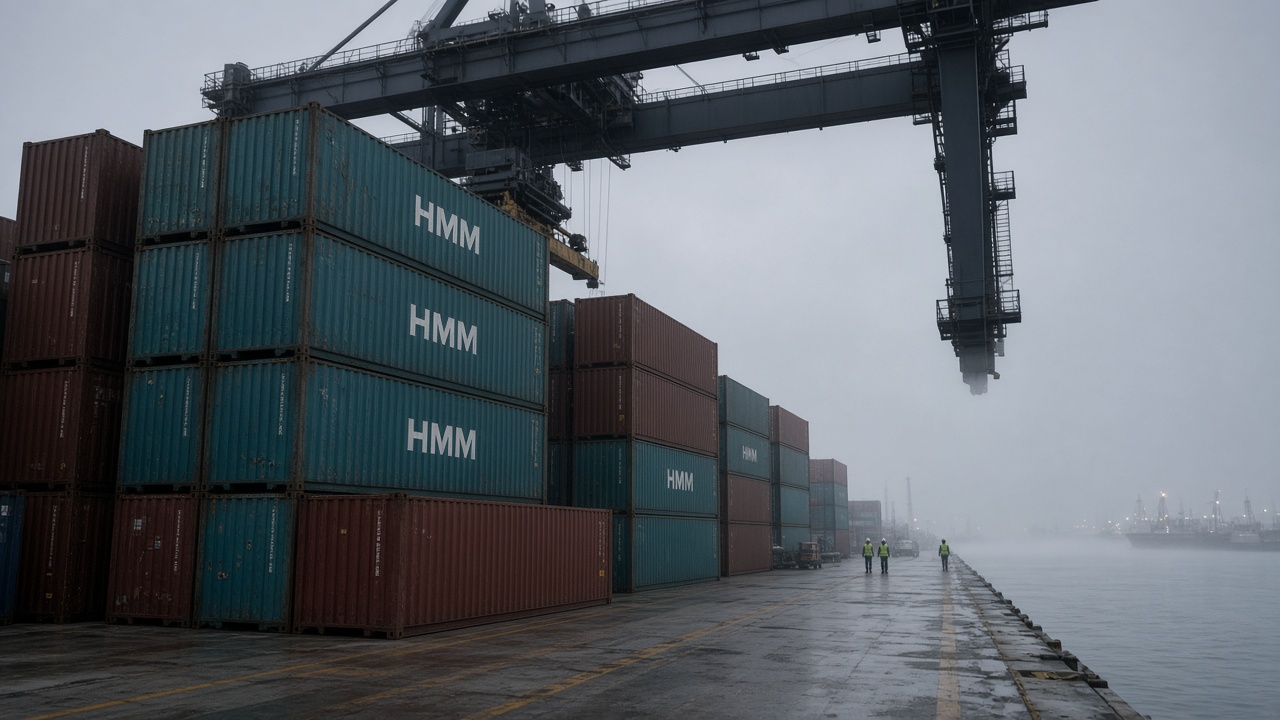
HMM signed a five-year slot charter with Mediterranean Shipping Co. on Wednesday, locking weekly capacity on the trans-Pacific lane that Korean appliance and auto-parts shippers rely on when Red Sea diversions keep squeezing Asia–Europe strings.
The deal covers two 8,000-TEU-equivalent strings between Busan and Los Angeles, with MSC providing slots HMM can market under its own bill of lading while sharing terminal windows at both ends. HMM said the arrangement starts in January and runs through 2030, giving export planners a fixed sailing calendar after a year in which spot rates on the Pacific swung by more than 40 percent between March and September.
Why exporters wanted a calendar
Korean customs data show containerized exports to the United States rose 6.2 percent year on year in the first nine months of 2026, but transit times through the Panama Canal and U.S. West Coast berthing delays added an average of four days to Los Angeles arrivals compared with 2024. Small and midsize shippers without their own vessel contracts bore most of that volatility, paying premiums when peak-season equipment tightened.
Under the charter, HMM will contribute two owned vessels on alternating weeks while MSC backfills with its own tonnage when HMM ships undergo dry-dock work. Neither carrier disclosed rate levels, but people briefed on the talks said the contract uses a hybrid index formula tied to the Shanghai Containerized Freight Index with a floor that prevents HMM from sailing below cash break-even on the lane.
Busan hub stakes
Busan Port Authority has pressed national carriers to keep transshipment cargo in Busan rather than relaying through Singapore or Kaohsiung as MSC expands its intra-Asia feeder network. HMM’s chief executive told reporters at the Busan headquarters that the charter “anchors” roughly 180,000 TEU a year of export volume that might otherwise leak to foreign-flag services.
MSC, for its part, gains deeper access to Korean automotive parts moving to Mexico after several Hyundai Motor and Kia suppliers opened Monterrey-area plants. The Swiss-Italian line already calls Busan with its Gemini cooperation partner Maersk on some strings; the HMM charter adds independent capacity MSC can flex without renegotiating the Gemini schedule.
Regulatory and labor backdrop
Korea’s Fair Trade Commission said it will review the charter under the shipping collaboration guidelines updated in May, though HMM argued the deal is a conventional slot swap rather than a shared-services alliance. The Ministry of Trade, Industry and Energy welcomed the contract in a statement, saying predictable sailings support small exporters waiting on U.S. customs refund rules tied to the Korea–United States trade implementation bill still before the National Assembly.
HMM shares closed up 2.1 percent in Seoul, outperforming the Kospi’s 0.6 percent decline, as investors treated the charter as a revenue visibility win. Analysts at Korea Investment & Securities said the arrangement should lift 2027 trans-Pacific utilization above 92 percent if MSC honors the minimum slot guarantee.
The carriers plan a joint operations center in Busan to coordinate blank sailings and equipment repositioning, with a go-live target of mid-December. HMM said it will publish the sailing schedule for shippers by November 10, giving freight forwarders time to lock year-end contracts before the Lunar New Year factory slowdown.
Equipment and emissions
HMM said both strings will deploy vessels scrubber-fitted for IMO 2020 fuel rules, with MSC providing EU ETS compliance data for shippers reporting scope 3 emissions. Environmental groups asked the oceans ministry to verify that faster Pacific sailings do not simply shift bunker burn from the Suez diversion onto transpacific legs without net savings.
Industry groups and regulators said they will publish follow-up guidance within two weeks, giving banks, shippers, and clinics time to adjust internal checklists before year-end audits. Consumer advocates asked for plain-language summaries on issuer websites so cardholders and patients understand what changes on their next statement or visit.
Analysts covering the sector said the announcement fits a broader pattern of tighter operational rules after a string of high-profile compliance and safety cases this autumn. Whether the move shifts fundamentals or simply clears near-term compliance backlogs will depend on enforcement data due out in January.