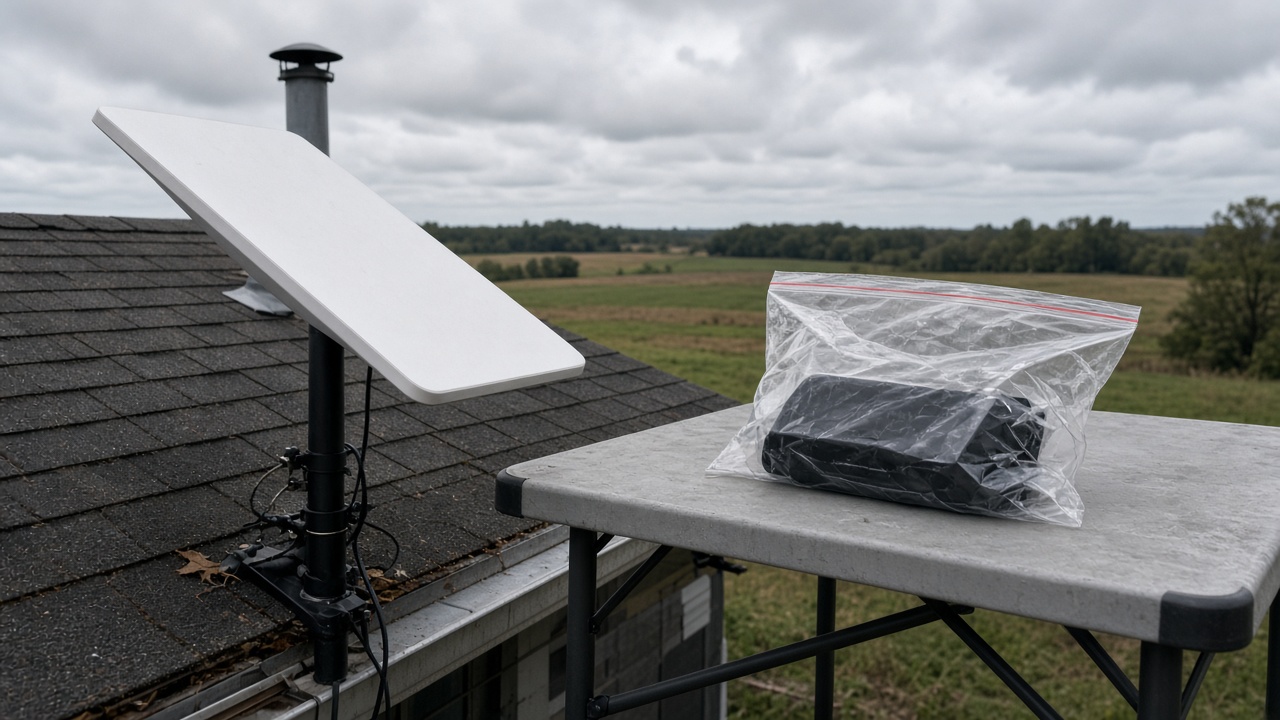
Gyeonggi Provincial Police arrested six suspects Wednesday who allegedly rented rooftop space for Starlink dishes that routed voice-phishing calls to victims nationwide, masking the scammers’ true location from Korean telecom traceback systems.
Detectives said the ring collected 1.9 billion won over eight months by impersonating prosecutors and card fraud desks, a familiar script that still works because callers spoof domestic numbers. Starlink’s satellite backhaul let overseas operators speak through Korean IP addresses, delaying the Korea Internet & Security Agency’s ability to flag originating carriers.
How the relay worked
According to the warrant affidavit, organizers paid landlords in Paju and Yangju 300,000 won a month to host compact Starlink units. Calls entered through encrypted VoIP apps, exited through the satellite link, and hit victims’ phones as ordinary mobile numbers purchased on the black market.
Police seized 14 dishes, 22 routers, and ledgers showing daily payouts to money mules who withdrew cash from ATMs in Incheon and Daejeon. The bust follows a record week KISA logged for AI-generated voice calls mimicking bank fraud desks—a separate trend that does not require satellite gear but shares the same social engineering playbook.
Regulatory response
The Financial Supervisory Service urged card issuers to tighten outbound call verification after the arrests, while the science ministry said it would talk with SpaceX’s Korean distributor about subscriber identity checks for business accounts. SpaceX did not comment Wednesday; its public terms prohibit illegal use but enforcement depends on local partners.
KISA plans to publish guidance for property owners on spotting suspicious rooftop installations, similar to advisories issued when illegal LTE repeaters proliferated a decade ago. Telecom engineers note that satellite latency is higher than fiber, but scammers tolerated a half-second lag to reach Korean retirees who still answer unknown numbers.
Victim recovery
Prosecutors froze 410 million won in mule accounts and will seek restitution orders, though full recovery is rare once cash is laundered through cryptocurrency mixers. Police reminded households that no legitimate agency demands immediate transfers to “safe accounts,” regardless of how local the caller ID appears.
The case is a reminder that fraud infrastructure chases whatever connectivity is newest. Starlink brought broadband to Korean farms; this ring tried to turn that reach into a hideout.
Cross-border cooperation
Police said they shared terminal serial numbers with Interpol and U.S. Homeland Security attachés in Seoul, because some VoIP switches reportedly sat in Southeast Asian data halls. No extradition requests are public yet, but prosecutors opened a parallel asset-tracing case for cryptocurrency wallets tied to the ring.
Industry groups and regulators said they will publish follow-up guidance within two weeks, giving banks, shippers, and clinics time to adjust internal checklists before year-end audits. Consumer advocates asked for plain-language summaries on issuer websites so cardholders and patients understand what changes on their next statement or visit.
Analysts covering the sector said the announcement fits a broader pattern of tighter operational rules after a string of high-profile compliance and safety cases this autumn. Whether the move shifts fundamentals or simply clears near-term compliance backlogs will depend on enforcement data due out in January.