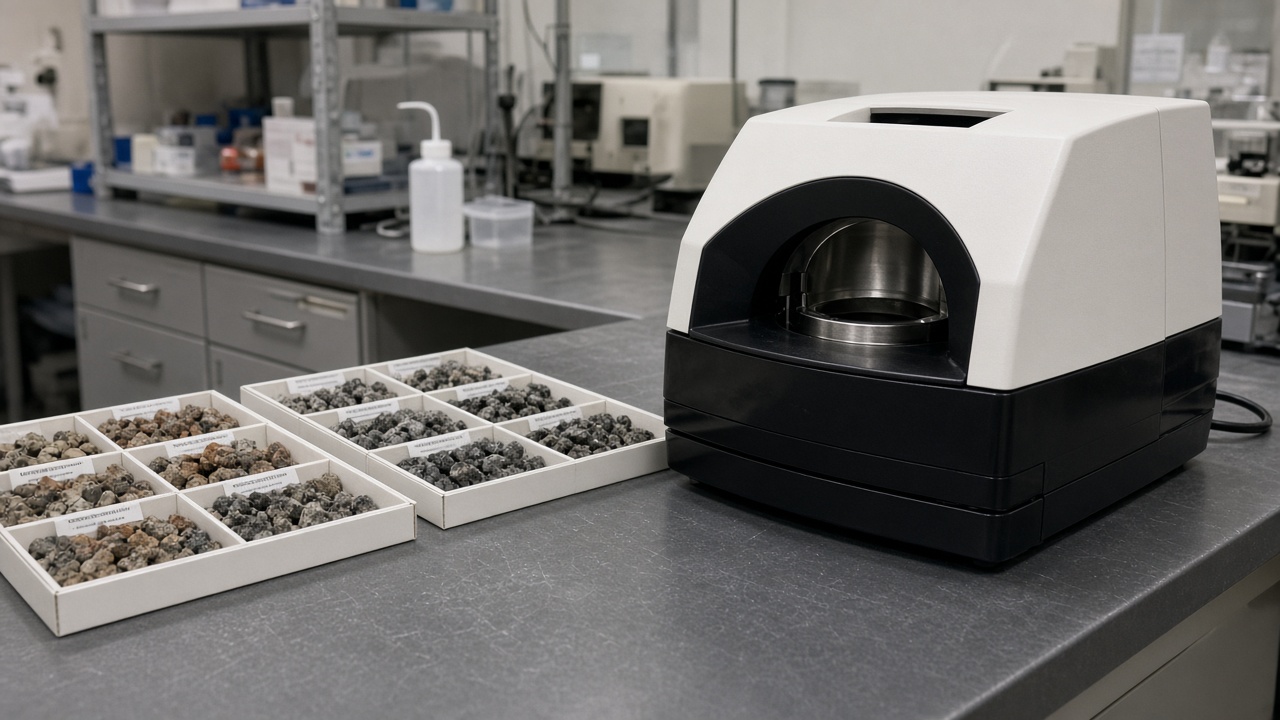
The Japan Aerospace Exploration Agency published an open catalog Thursday of minerals collected during analog recovery drills at Australia's Woomera Prohibited Area, giving planetary scientists baseline spectra to compare with Hayabusa2 extended-mission samples when they arrive in Japanese labs in 2027. The dataset includes 312 powdered grains spanning carbonaceous chondrite analogs and shocked basalt fragments meant to mimic asteroid regolith disturbed by impactors.
Why Woomera analogs matter
Hayabusa2's primary Ryugu samples already rewrote theories on early solar system water delivery, but the follow-on mission targets a second near-Earth object with a different spectral class. Ground teams rehearsed sample handling in South Australia's arid terrain because its dust chemistry complicates sealing protocols similar to those JAXA engineers expect in deep space.
Publishing the catalog now lets university labs in Hokkaido and Kyushu begin instrument calibration before precious return capsules land. Each entry lists X-ray diffraction peaks, Raman shifts, and isotopic ratios measured at JAXA's Sagamihara campus.
International collaboration
The Australian Space Agency co-signed data-use terms allowing noncommercial redistribution with attribution. NASA's OSIRIS-REx team contributed crosswalk tables mapping catalog minerals to Bennu grains, aiding joint papers on volatile content.
Industrial partners supplying vacuum gloves and micro-tweezers used the drills to certify clean-room consumables under red dust loads, a mundane but mission-critical outcome for private suppliers in Osaka's precision tooling cluster.
Public outreach
JAXA's education office bundled middle-school lesson plans showing how analog spectra differ from classroom rock kits. Planetariums in Sendai and Fukuoka will host live demos comparing catalog images with Hayabusa2 public thumbnails already online.
Open data also reduces duplication: researchers need not request fresh Woomera field trips for every hypothesis, lowering environmental impact on Indigenous-managed lands where access permits are tightly rationed.
Timeline to sample science
Capsule re-entry rehearsals continue in Japan through 2026, while the catalog underpins peer review of methods papers slated before sample intake. If spectral libraries align, first results on the extended mission could publish faster than Ryugu's initial papers did—giving taxpayers a quicker look at what their yen funded in deep space.
Instrument cross-checks
Teams at Tohoku University compared catalog Raman peaks with Ryugu archive samples and found three minerals whose signatures overlap within instrument error, suggesting the extended mission target may host familiar phyllosilicates. That hypothesis still requires in situ confirmation because orbital spectra lack the catalog's ground-truth resolution.
Engineers testing sample canisters in Sagamihara used catalog dust to calibrate vibration tables, ensuring seals survive launch loads when fine grains wedge into O-rings—a lesson learned from earlier asteroid missions.
Museum curators in Chofu plan a traveling exhibit pairing catalog micrographs with Hayabusa2 capsule mockups, funded by a science ministry outreach grant announced alongside the data release.
Graduate students at Kyushu Institute of Technology downloaded the catalog overnight to test machine-learning classifiers that separate terrestrial contamination from asteroid-like spectra, a classroom exercise JAXA encouraged in its release FAQ.