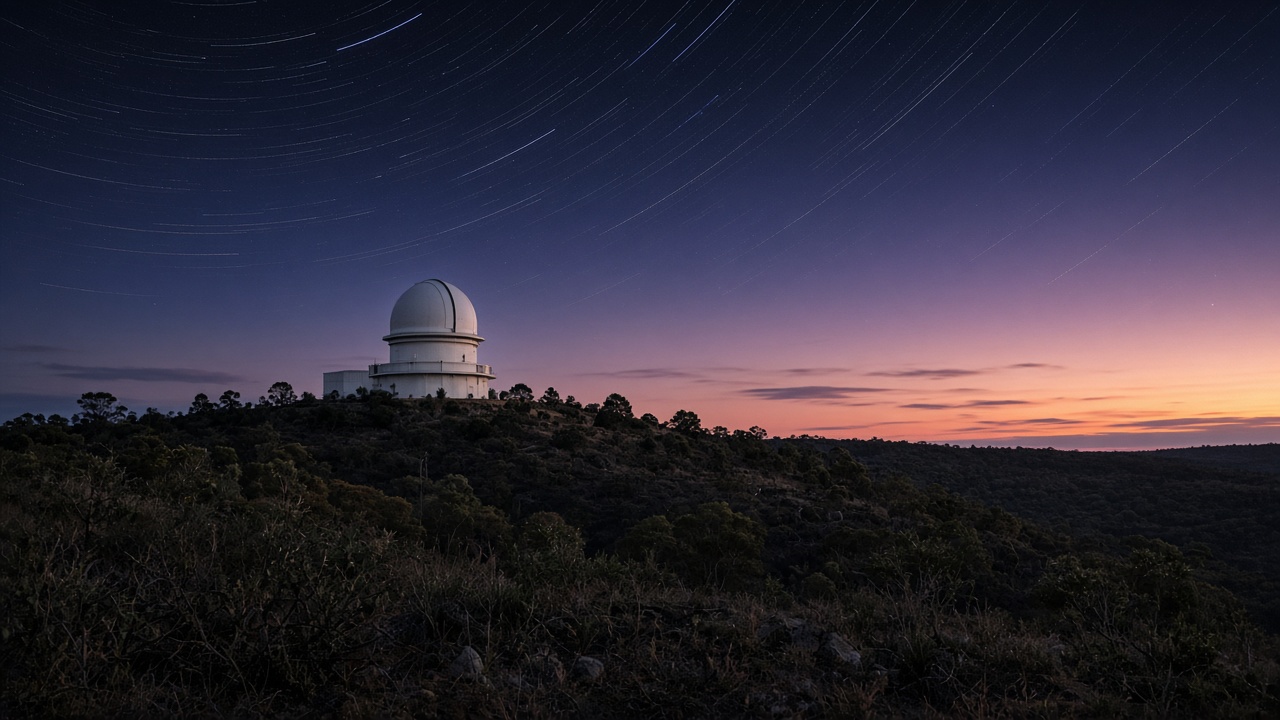
Astronomers at ANU’s Siding Spring Observatory tracked a stadium-sized asteroid on Thursday as it passed 1.2 million kilometres from Earth, broadcasting a live feed to classrooms from the Warrumbungle dark-sky site north of Dubbo.
The flyby
The object, provisionally labeled 2026 TK14, poses no impact risk, according to NASA’s Center for Near Earth Object Studies. Its orbit crosses Mars and Earth every 14 months, making it a useful target for testing how quickly Australian telescopes can refine trajectory models.
Researchers used the 2.3-metre ANU telescope and a smaller wide-field camera to capture brightness changes as the asteroid rotated. Those measurements help infer shape and composition without radar, which is reserved for closer passes.
Why stream it
Project scientist Brad Tucker said schools in New South Wales and Victoria joined the YouTube stream because live astronomy still beats pre-recorded clips for engagement. The feed included narration on how survey telescopes in Chile discover objects that Southern Hemisphere sites then follow up.
Planetary defence context
Australia is expanding its role in NASA’s planetary defence network after the DART mission proved kinetic impact can shift an asteroid’s path. Siding Spring’s location offers long nights with low light pollution, critical for faint near-Earth objects.
Defence planners also monitor space weather from the same ridge, linking civilian science with satellite resilience work.
Public viewing
Amateur astronomers with eight-inch telescopes could spot the asteroid as a moving star in eastern skies after 9 p.m. AEDT. The observatory posted star maps and exposure settings on its site for beginners.
Harmless flybys still matter: each observation tightens orbital calculations that decide whether future passes deserve closer scrutiny.
Instrument details
The 2.3-metre telescope has tracked comets and exoplanets for decades. Engineers upgraded its autoguider this year to follow fast-moving near-Earth objects without manual corrections every few minutes.
Data will be archived in the ANU Data Commons for students to practice orbit-fitting code in Python notebooks.
Education partners
Catholic Education Diocese of Parramatta booked the stream for Year 10 physics classes. Teachers received worksheets on kinetic impact energy scales compared with everyday explosives, a lesson plan tied to the DART mission results.
Weather contingencies
Cloud cover threatened to cancel the broadcast, but a narrow clearing window after 10 p.m. allowed 40 minutes of live imaging. Backup footage from a Chilean partner observatory was on standby if Warrumbungle skies closed.
Community open night
Siding Spring Observatory will host a public open night on Saturday with solar telescopes before sunset and the archived asteroid loop on screens in the visitor centre.
Research outputs
Graduate students will publish refined orbital elements in the Minor Planet Center database next week, contributing to global impact-risk catalogues used by NASA planners.
Local Wiradjuri elders were consulted on how to frame the broadcast for schools, ensuring cultural stories about night skies precede technical explanations.
Cloud cover forecasts for the Warrumbungle region will be updated hourly on the observatory website for visitors driving from Coonabarabran.