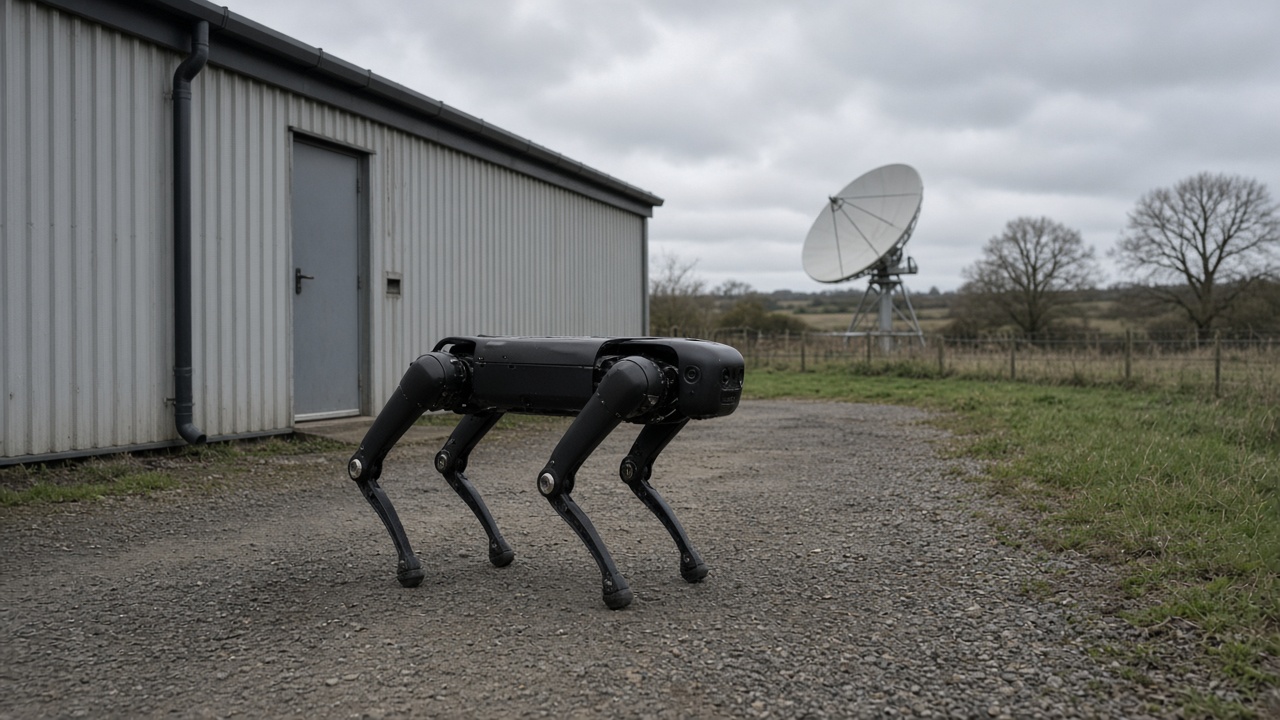
The European Space Agency has teamed with UK firm Autodiscovery and the Oxford Robotics Institute to field coordinated robot dogs and a scouting drone at its Harwell campus, using hybrid 5G and satellite links when terrestrial coverage drops.
The project, run from ESA’s European Centre for Space Applications and Telecommunications in Oxfordshire, will test whether edge AI on multiple quadrupeds can map sites three to five times faster than human patrols while cutting operator workload by as much as 85%.
Hardware and software stack
Four robotic dogs and one aerial scout will share LiDAR, RGB-D, thermal and air-quality sensors, fusing data into real-time 3D maps without sending raw video to the cloud. Software is being built in the UK on an open-source framework emphasising auditability for safety regulators.
Communications experiments will blend terrestrial 5G/6G with direct satellite feeds so teams stay connected across large or remote facilities—patterns ESA wants for disaster response and critical infrastructure such as airports and power plants.
Industry interest
Commercial partners including CORPS Security and Johnson Controls have expressed interest in outcomes, according to ESA’s announcement. A dedicated AI Hub opening at ECSAT will host demonstrations alongside the existing 5G/6G Hub, giving vendors a neutral testbed before bidding on UK government security contracts.
The UK Space Agency’s October blog separately promoted naming the country’s first active debris-removal mission, signalling that Harwell remains the government’s preferred campus for high-visibility space programmes despite Brexit friction on EU programmes.
What success would mean
If patrol robots prove reliable in Oxfordshire’s rain and gravel, expect pilot tenders at MOD logistics sites and nuclear licenced estates where human rounds are costly and hazardous. Failure modes—GPS denial, mud, vandalism—will be as instructive as success for insurers pricing autonomous security.
Safety and ethics
Deploying quadrupeds on public campuses raises questions about filming bystanders and storing biometric data. ESA said open-source software choices allow external auditors to review retention policies before robots patrol outside fenced areas.
Autodiscovery’s prior work on industrial inspection gives the consortium experience with fall detection and emergency stop standards, but security patrols introduce confrontational scenarios with trespassers that lab tests may not capture.
Satellite backhaul adds latency that could delay human operator takeover; the project will benchmark acceptable delays for alarm verification versus autonomous pursuit policies.
UK Export Finance has backed other Harwell ventures; if patrol robots succeed, export credit could support sales to allied governments seeking perimeter security without expanding human guard counts.
Timeline and milestones
ESA expects the first outdoor patrol demonstrations in early 2027 after indoor mapping exercises conclude at ECSAT. Oxford Robotics Institute graduate students will publish open datasets from the trials, allowing other European universities to benchmark navigation algorithms without duplicating hardware costs.
Harwell’s campus bus routes and shared canteens mean demo robots will interact with civilian foot traffic, giving ESA a realistic test of human-robot coexistence policies before exporting the kit overseas.