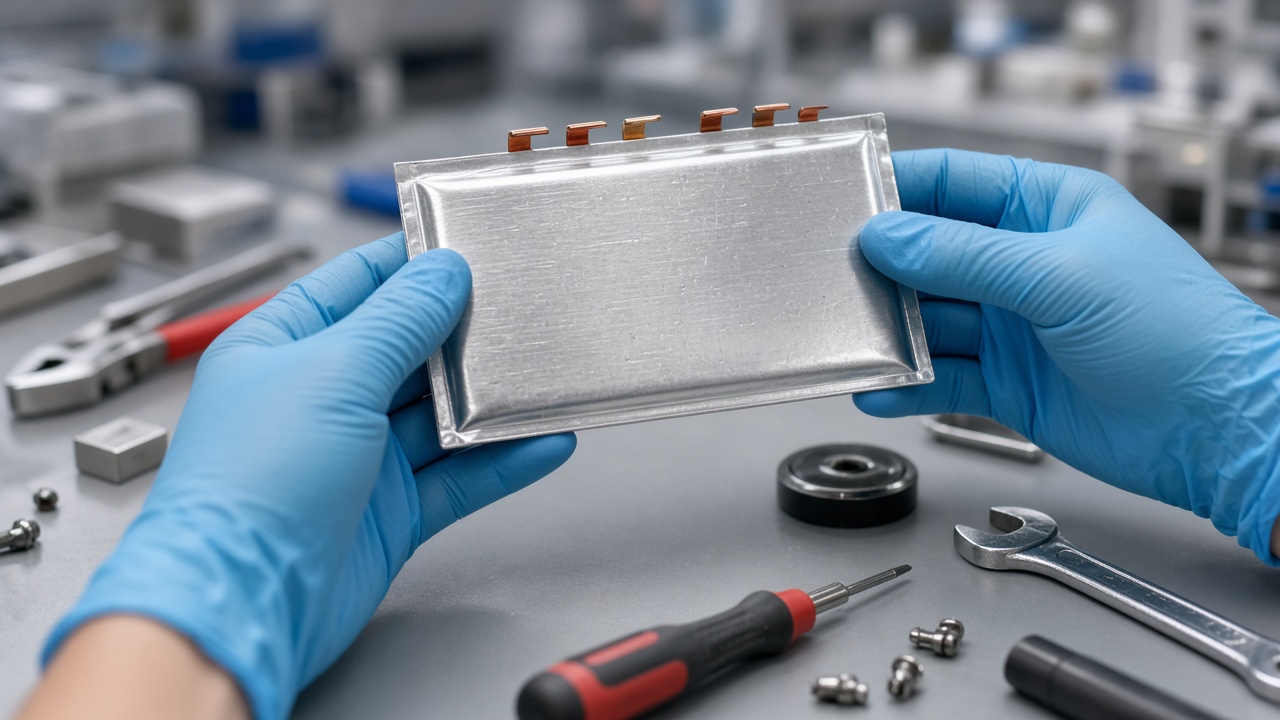
A POSTECH research team said Friday it built a sodium-ion pouch prototype that delivered 300 watt-hours per kilogram at room temperature in independent lab tests, publishing the results in Nature Energy and handing Korean policymakers a potential path to cheaper mid-range electric vehicles.
Why sodium matters
Sodium-ion batteries trade some energy density for abundance: sodium salts are cheaper and more geographically distributed than lithium carbonate, which Korea imports in large volumes for current EV lines. Domestic automakers have funded sodium research, but prior prototypes struggled to exceed 200 Wh/kg without heating packs.
Lead author Professor Kim Sung-soo said the team used a hard-carbon anode paired with a layered oxide cathode stabilized by a localized high-concentration electrolyte. The design suppressed dendrite growth during fast charging tests up to 4C, though cycle life beyond 800 charges remains under study.
Independent verification
Korea Electrotechnology Research Institute technicians witnessed pulse tests cited in the paper. The 300 Wh/kg figure refers to cell-level gravimetric density, not pack-level numbers that include cooling plates and busbars.
Commercial horizon
Industry partners including a midsize cathode supplier have signed evaluation agreements, but mass production is years away. Sodium-ion cells still lag lithium iron phosphate on volumetric density, making them better suited to compact sedans and urban delivery vans than long-range SUVs.
The Ministry of Trade, Industry and Energy said it will fold the results into a December roadmap on next-generation batteries, which already earmarks funding for solid-state and lithium-sulfur lines.
Environmental angle
Environmental groups welcomed sodium research as a way to reduce mining pressure, while cautioning that recycling networks for new chemistries must be planned early. POSTECH said it is working with a Pohang recycler on shred-test protocols.
Policy and funding
Parliament’s industry committee added 80 billion won to next year’s budget for sodium-ion pilot lines after Friday’s publication. Opposition members asked whether funds should instead flow to lithium recycling, sparking a debate about resource security versus chemistry diversification.
Automakers Hyundai and Kia sent materials scientists to POSTECH’s briefing but stopped short of public commitments. They said sodium packs must pass nail-penetration and thermal runaway tests under UN standards before entering concept vehicles.
Global race
Chinese and European labs have reported similar density milestones in preprints, but POSTECH’s peer-reviewed paper gives Korean suppliers a credibility boost when pitching carmakers wary of unverified social media claims.
Supply chain
Korean chemical firms that produce sodium carbonate welcomed the result, hoping cathode orders will diversify revenue away from lithium hydroxide. Mining advocates said sodium does not eliminate need for critical minerals in other vehicle components.
Graduate students involved in the project said scaling from coin cells to pouch format required redesigning separator films to handle sodium ion volume changes during cycling.