University of New South Wales engineers said they sustained error-corrected logical qubit operations at the national quantum facility in Randwick long enough to pursue scaled superconducting processors, a threshold the team argues moves Australia from single-qubit demos toward machines that could tackle chemistry simulations.
The result
In a paper posted to the arXiv preprint server Friday, researchers led by Professor Andrea Morello reported a logical qubit lifetime exceeding one millisecond while active error correction ran—a modest number by classical standards but a step up from prior Australian records where physical qubits decohereed faster than correction cycles could fire.
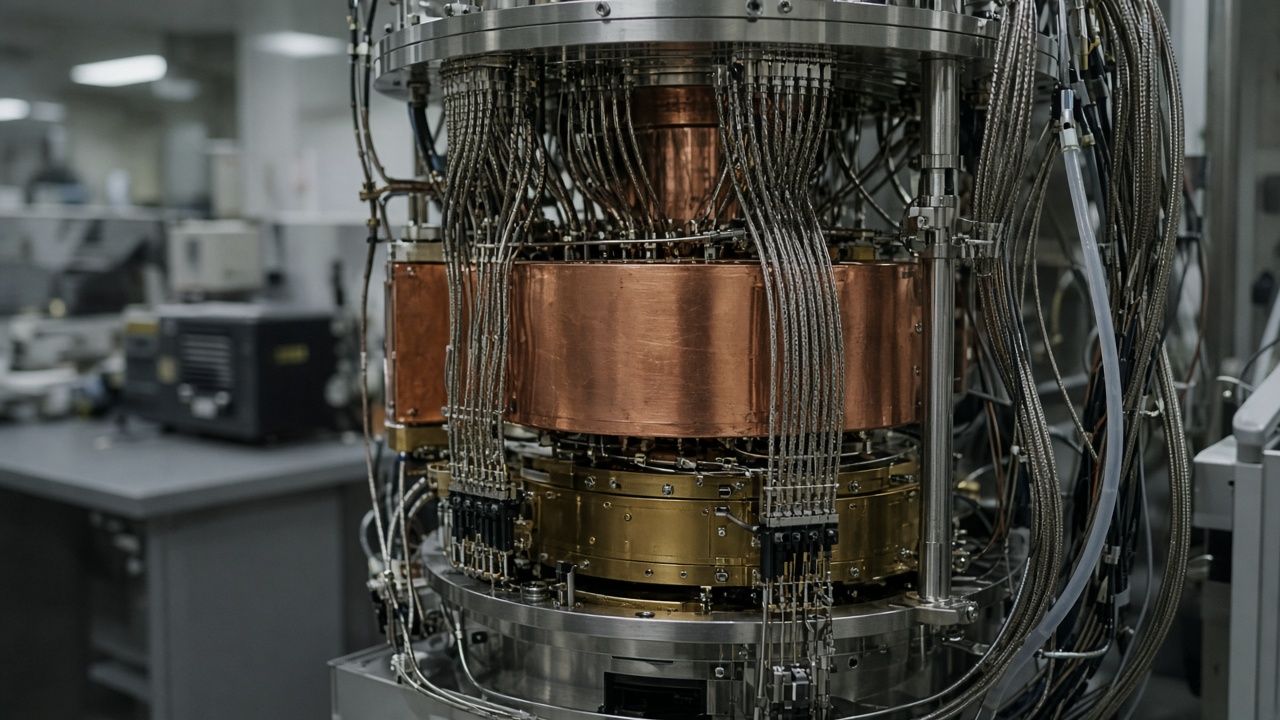
The experiment used a surface code on a three-by-three array of superconducting transmons cooled to 15 millikelvin. Real-time feedback from a nearby classical controller corrected bit-flip and phase-flip errors without halting the computation, a requirement any scalable architecture must meet.
Why it matters locally
Canberra’s national quantum strategy funds shared infrastructure at UNSW and CSIRO so startups do not each build cryogenic labs. A correction milestone attracts talent and venture capital to Sydney’s Tech Central corridor, where banks already pilot quantum-resistant cryptography on payment rails.
Commercial distance
Morello cautioned that thousands of physical qubits per logical qubit remain necessary for fault-tolerant chemistry breaks. Silicon Quantum Computing, the ASX-listed spinout, said the result complements its own dot-based approach rather than competing with it.
International context
Google and IBM publish longer logical lifetimes on larger arrays, but UNSW’s integration with Australian fabrication partners keeps supply chains onshore—a priority after export controls tightened on advanced cryo-electronics.
Peer review is pending at Nature Physics. Even if numbers shift slightly, Friday’s announcement gives policymakers a concrete talking point: public labs can still land frontier metrics without waiting for a hyperscaler branch office.
Facility details
The Randwick national facility opened in 2024 with federal and state co-funding, housing multiple cryostats shared between universities and startups. Morello’s team booked six weeks of uninterrupted runtime—a luxury in a lab where maintenance windows usually fragment experiments.
Engineers credit a new pulse amplifier designed in Sydney that reduces heating in control lines, extending the window during which correction pulses can fire before thermal noise overwhelms the qubit.
Education pipeline
UNSW enrolled record PhD intakes in quantum engineering this year, partly because undergraduates saw local hardware milestones rather than only reading about IBM’s roadmaps. Scholarship programs tied to the national facility require students to spend a semester in industry, feeding banks and telcos hungry for quantum-literate graduates.
Next experiments
The group will attempt a five-by-five surface code next, requiring additional physical qubits and a larger dilution refrigerator on order from Finland. Delivery slots remain competitive globally; Australian customs exemptions for cryogenic equipment were streamlined in 2025 to avoid the delays that plagued early imports.