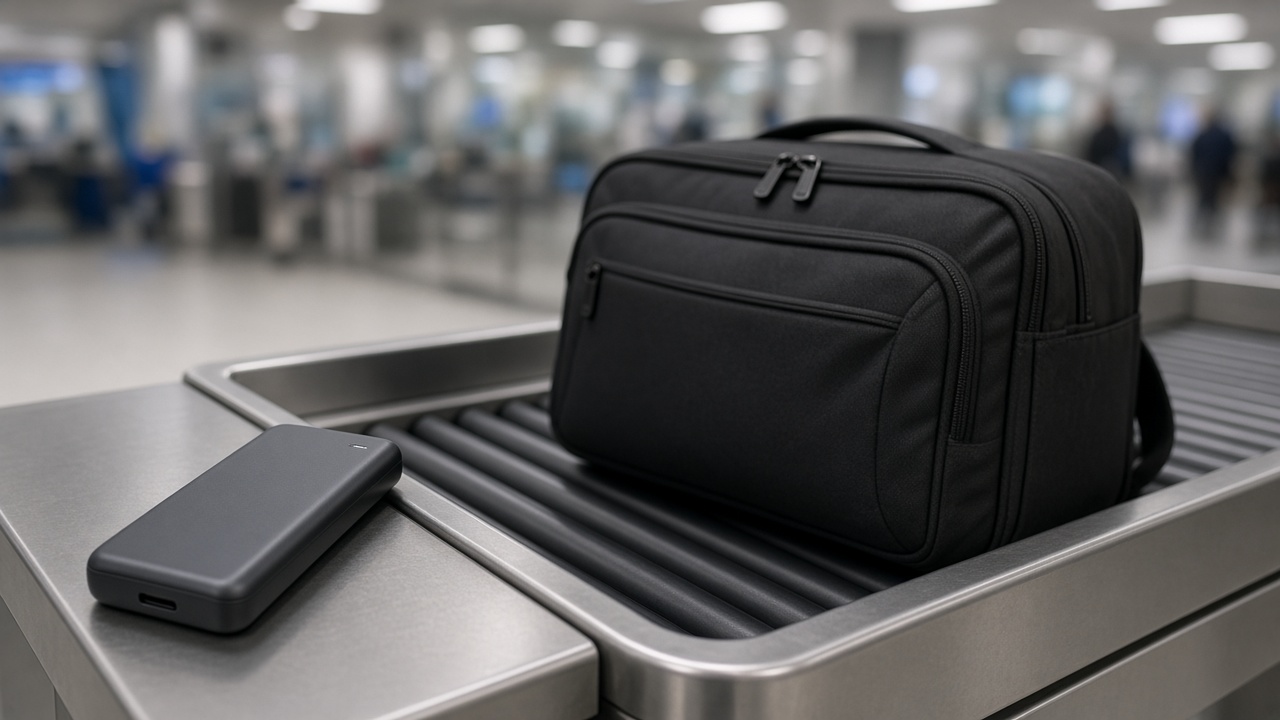
South Korea’s transport ministry published draft carry-on rules on Monday that would require visible watt-hour labels on power banks, responding to a Jeju-bound flight fire that burned a passenger before landing and renewed debate over lithium devices in cabins.
The proposed amendment mirrors International Civil Aviation Organization guidance that limits spare batteries to 100 watt-hours without airline approval. Vendors would have to print the rating on the device body, not only on packaging, and airport security would gain authority to confiscate unmarked packs at domestic checkpoints.
What changed after the Jeju flight
On Saturday, a power bank overheated in an overhead bin on a Hong Kong–Jeju route operated by a Korean budget carrier, according to the Jeju fire department. Crew used extinguishers and diverted to Jeju International Airport; one passenger received second-degree burns on a forearm. The ministry opened an urgent review on Sunday and circulated the draft label rule to airlines before markets opened Monday.
Korean Air and Asiana said they will retrain gate agents to spot aftermarket batteries missing certification marks. Low-cost carriers, which operate dense Jeju leisure routes, asked for a 30-day grace period to update passenger notices and mobile check-in warnings.
Retail and manufacturer response
Electronics retailers Lotte Hi-Mart and Electro Mart said they will pull non-compliant SKUs from shelves if the rule takes effect in November as drafted. Domestic brands Anker Korea and Xiaomi Korea distributors pledged to ship only labeled inventory starting next week, though gray-market sellers on open-market platforms may lag.
The Korea Battery Industry Association warned that counterfeit packs often print fake watt-hour numbers. The ministry said it will pair labeling requirements with spot tests using handheld impedance meters at Incheon and Gimpo security lanes during the year-end travel peak.
Passenger checklist
Travelers should keep power banks in carry-on bags, separate from metal clutter that can short terminals. Spare packs must be individually wrapped or placed in plastic bags, and passengers may carry no more than two rated under 100 watt-hours without carrier consent. Medical-device batteries follow a separate declaration process that the draft leaves unchanged.
Public comment on the rule runs through Nov. 8, after which the ministry will finalize enforcement dates with the Office for Government Policy Coordination. Violations would carry fines up to 2 million won for repeat offenders who attempt to board with deliberately obscured labels.
International alignment
Korean carriers fly dense routes to Japan, China, and Southeast Asia, where security agencies have tightened lithium rules after several cabin smoke incidents this year. The transport ministry coordinated with Japan’s civil aviation bureau to align watt-hour thresholds, reducing confusion for connecting passengers at Incheon.
Manufacturers must submit lab certification documents to the Korea Consumer Agency before labeling new models. The agency will maintain a public lookup table of approved packs, similar to the registry used for infant car seats.
Travel agencies asked for clearer pre-departure emails because many leisure passengers buy power banks at duty-free shops that may still stock older inventory. The ministry said duty-free operators must segregate compliant units by Nov. 15 or face administrative warnings.
Insurance underwriters for Korean carriers asked for incident logs from the Jeju flight to update cabin-risk models, another push toward standardized labeling that airlines can cite in renewal negotiations.
Market participants said follow-up disclosures later this week will matter more than opening headlines, and that investors should read footnotes on guidance rather than relying on single-session moves alone.
Regulators reiterated that consumer protections and export competitiveness must be balanced, promising additional guidance if conditions shift before the next policy meeting.
Analysts and officials both cautioned that single-day indicators can mislead, urging market participants to compare year-on-year trends and to verify figures against audited filings when available.
Company spokespeople declined further comment beyond written statements, and ministry briefings are scheduled later in the week when additional data may be released to the public.