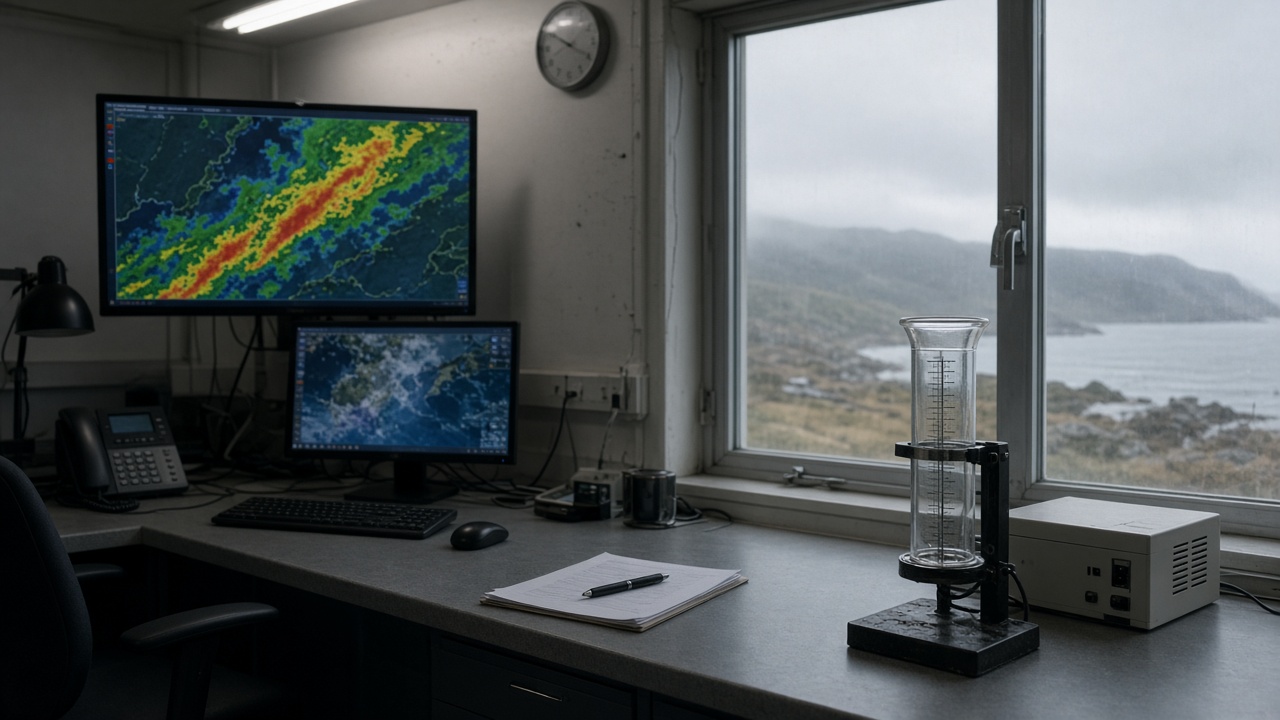
RIKEN Center for Computational Science researchers said a short-range rainfall ensemble highlighted Tsushima Island’s extreme totals about six hours before Japan Meteorological Agency warnings reached peak severity during Champi’s approach, reviving questions about whether municipalities should plug academic nowcasts into evacuation workflows. Sora Matsumoto’s science desk treats the lead time as experimental—not a replacement for JMA authority—but as evidence that kilometer-scale models can sharpen local decisions when fronts stall.
Ensemble method
The team ran multiple micro-physics perturbations on a nested grid covering the Tsushima Strait, initializing from JMA mesoscale analyses. Ensemble members that captured moist onshore flow predicted localized rainfall exceeding 150 millimeters in 12 hours; the median beat climatology baselines used in generic apps.
Researchers published verification scores comparing ensemble timing with JMA’s official warning timeline, emphasizing collaboration rather than competition with forecasters.
Why six hours matter
Island municipalities activate elderly evacuations and ferry suspensions on cascading alerts; six hours can shift bus sorties if officials trust the signal. Tsushima’s geography funnels moisture along ridges prone to landslides—generic prefecture-wide warnings sometimes understate micro-climates.
During this event, heavy rain already fell before the ensemble run completed; the claim is about incremental lead on peak intensity, not first raindrops.
Operational barriers
JMA maintains statutory warning authority; academic nowcasts lack liability frameworks if cities act early and storms veer. Integrating ensembles requires IT pipes, training, and clear protocols on who signs evacuation orders when models disagree.
RIKEN proposes shared visualization portals with JMA meteorologists in the loop—human forecasters interpreting machine spreads, not autonomous triggers.
Compute and data policy
Runs used RIKEN’s Fugaku successor allocation hours granted for disaster-science demos; routine operations would need sustained compute budgets and faster data assimilation from radar networks. MEXT disaster research grants may expand if verification continues across typhoon seasons.
Open-data advocates want anonymized ensemble outputs published for civic hackers; privacy and misuse concerns slow release.
Climate adaptation angle
Warmer seas lengthen heavy-rain tails on approaching cyclones; kilometer models become more valuable as generic climatology fails. Insurance and infrastructure planners watch verification metrics to price landslide retrofits on vulnerable slopes.
Falsifiers include ensembles that false-alarm repeatedly, eroding official trust—science teams must publish skill scores transparently.
Bottom line
RIKEN’s Tsushima ensemble beat peak warning timing by hours in post-analysis—a promising nowcast slice, not yet a civil-defense default. JMA collaboration and liability rules will decide if academic rain spreads reach ward offices before the next front stalls.