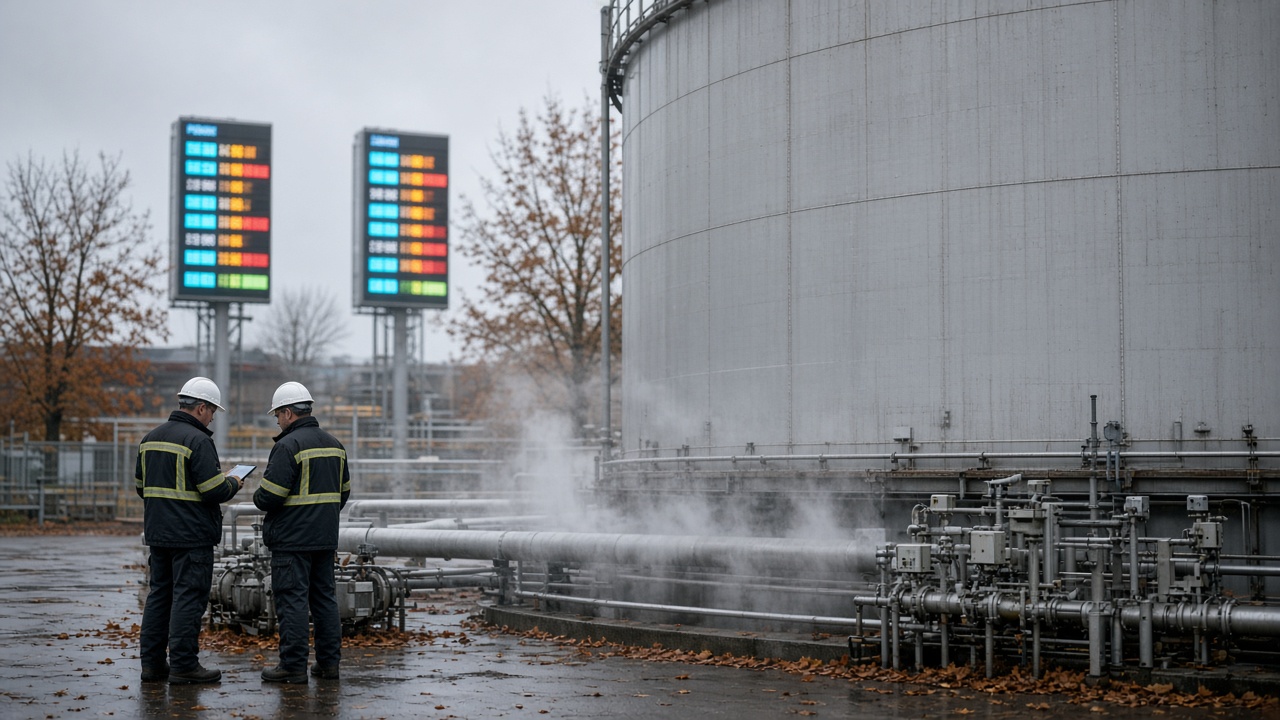
European wholesale natural gas prices surged to their highest level since late 2022 on Monday, with the Dutch Title Transfer Facility front-month contract trading above €97 per megawatt-hour as traders priced in both a colder start to the heating season and another round of Middle East supply risk.
The move extends a rally that has taken benchmark gas from roughly €32 per megawatt-hour before the Iran war intensified in late February to levels last seen during the winter after Russia slashed pipeline exports to the continent. Britain’s month-ahead contract also climbed, rising about 4 percent to around 240 pence a therm, its strongest print since December 2022.
What pushed prices on Monday
Analysts pointed to a cluster of drivers rather than a single headline. Forecasters turned cooler across much of northwest Europe over the weekend, lifting expected heating demand just as utilities would normally be topping up storage ahead of winter. At the same time, traders remain wary that liquefied natural gas cargoes through the Strait of Hormuz could face further delays while the U.S.–Iran conflict grinds on and commercial shipping attacks remain elevated.
ICE data cited by industry outlets showed the TTF contract up more than 3 percent in early European trading after briefly touching €97.50. The Wall Street Journal reported a session high above €97, while Belgium’s Belga news agency described the strongest Amsterdam exchange prices since the 2022 energy crisis.
Lauren Almeida of the Guardian noted that the rally also reflects market chatter about possible U.S. and Israeli strike planning against Iran after American midterm elections, a fear that can move gas even when crude is the first market to react.
Storage, LNG bills, and a tighter 2027
Europe’s gas storage filling appears to have plateaued near 74.6 percent, according to Gas Infrastructure Europe data summarized by Gas Processing & LNG — well below the comfort levels policymakers wanted after the 2022 shock. Norway export constraints and the need to withdraw from storage after a recent injection lull added pressure, LSEG analyst Wayne Bryan told the trade publication.
Rystad Energy estimated that global LNG portfolio costs could reach $256 billion in 2026, up 18 percent from pre-war assumptions, with Europe facing at least a $12 billion bill increase even as demand falls by about 24 million tonnes. International Energy Agency chief Fatih Birol said on Monday that energy markets are likely to stay tighter than pre-war levels into 2027.
What policymakers and buyers watch next
Industrial users and household suppliers will pass through higher wholesale costs on different timelines, but Monday’s spike already revives political debate over price caps, demand curbs, and how much LNG infrastructure Europe still needs. Governments that spent two years diversifying away from Russian pipeline gas now face a second winter where the bottleneck is seaborne fuel and the security of Hormuz transit.
Traders said the immediate focus is weather: a mild November could ease pressure, while an early cold snap would force faster storage draws and raise the odds of government intervention. Until shipping insurers and naval escorts restore confidence in Gulf LNG routes, any diplomatic flare-up in the Middle East is likely to keep a premium baked into European gas — even though today’s prices remain far below the €340 peaks seen at the height of the 2022 crisis.