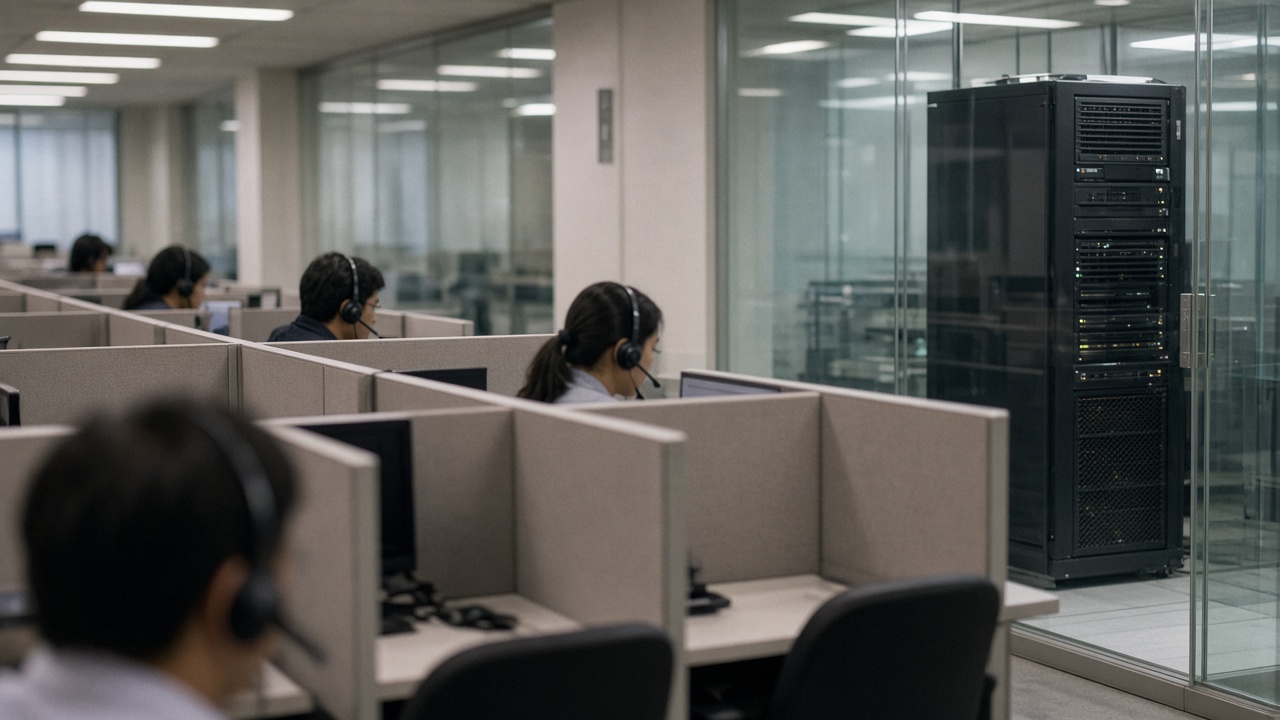
Naver Cloud installed a HyperCLOVA X triage model at a Ministry of Health and Welfare call center in Sejong City, producing live summaries of benefits inquiries on local servers so callers' voices never leave the government rack, officials said Monday.
Privacy-by-architecture
Agents still hear callers in real time, but the model transcribes and tags issues—housing allowance, disability certification, pension delays—inside an air-gapped partition. Supervisors see suggested form numbers on side monitors without accessing raw audio unless a caller requests escalation.
The Personal Information Protection Commission praised the layout as a template for agencies that rejected overseas-hosted transcription after Mirae Asset Life's breach dominated headlines last week. Naver said the deployment uses the same 32-billion-parameter variant it sells to banks, trimmed for Korean dialects common among elderly applicants.
Capacity and accuracy
During a 10-day shadow mode, the system cut average handle time by 42 seconds per call on routine questions, according to ministry data. Complex appeals still route to senior staff, and agents can override any auto-filled field before submission to the National Pension Service portal.
Procurement path
The 2.8 billion won contract runs through March, with an option for four regional satellite offices. Opposition lawmakers asked whether a single vendor lock-in risks higher renewal prices, but the ministry said it benchmarked against KT's Mi:dm and SK Telecom's A.X models before selection.
What's next
Naver plans to add outbound SMS drafts that cite the exact legal article cited in each summary, pending PIPC review of automated citizen communications. If metrics hold, Health and Welfare will pitch a shared GPU cluster for the Employment and Labor Ministry's unemployment hotline.
Union and agent perspectives
The Korean Public Service and Transport Workers' Union said on-device processing eases fears that outsourced transcribers might leak sensitive health data, but it demanded limits on automated performance scoring tied to handle times. Ministry managers agreed not to use model outputs as the sole metric in annual reviews, a concession announced at Monday's briefing.
Callers in a focus group reported shorter hold music loops when triage tags routed them to the correct desk on first transfer. Elderly participants still preferred human repetition of benefit amounts, prompting the ministry to add a read-aloud button that plays the summary in a slower cadence.
Scaling considerations
If regional offices adopt the stack, Naver Cloud estimates rack power draw at 180 kilowatts per site, within Sejong government-campus limits. Energy officials are studying whether waste heat can warm adjacent office wings during winter, a sustainability pitch Naver included in its renewal bid documents.
Data retention rules
Summaries auto-delete after 30 days unless tied to an open appeal, a retention window the Personal Information Protection Commission signed off on after reviewing deletion logs during the pilot. Auditors will revisit the policy in February if call volumes double during spring benefit renewals.
Opposition health committee members requested an independent audit of training data sources to ensure summaries do not inherit biases from past call logs. Naver responded that human reviewers redacted sensitive anecdotes before fine-tuning and that no private citizen names appear in the corpus.
Budget oversight
National Assembly health committee members asked for a line-item comparison between on-premise GPU costs and a hypothetical public cloud contract, numbers Naver pledged to submit before renewal talks. Cloud rivals argue the ministry left cheaper bids on the table, but officials counter that data residency rules would have required expensive private links anyway.