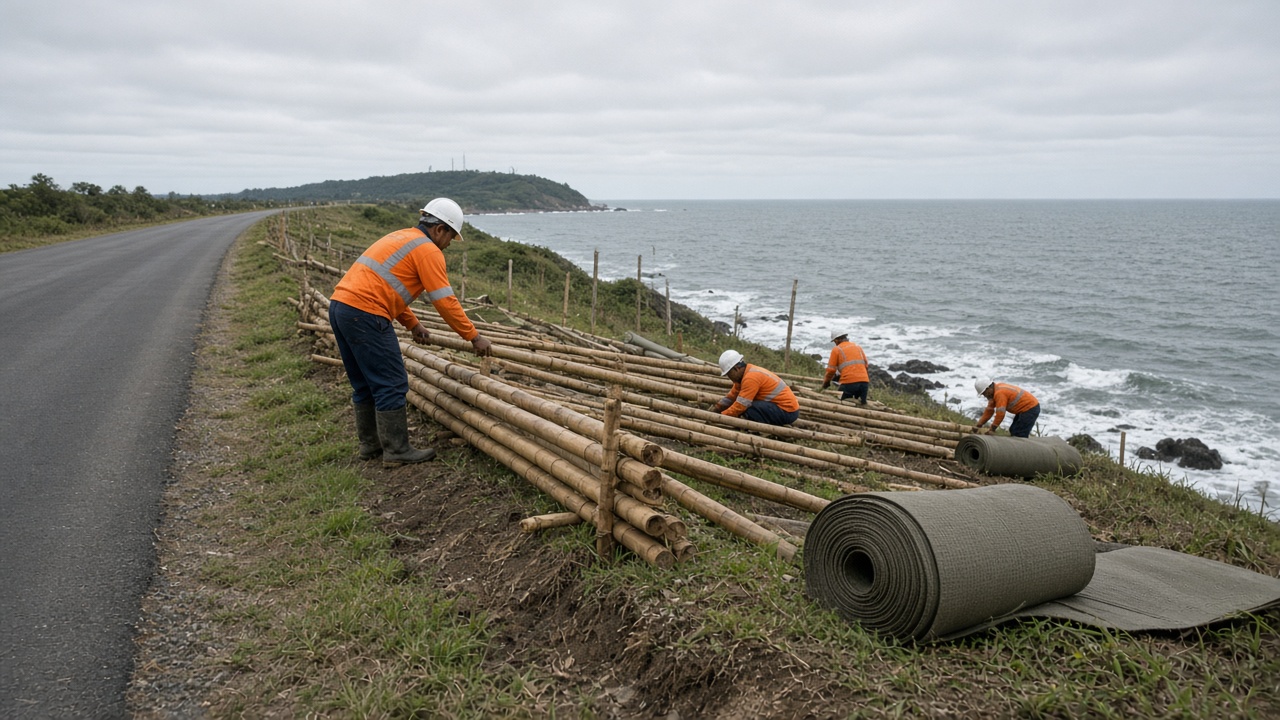
National Cheng Kung University civil engineers started field trials Monday on Orchid Island of bamboo-reinforced berms designed to channel storm runoff away from the airport landing strip after Champi scoured vegetation from slopes that previously slowed sheet flow toward the runway safety area.
Design choices
The berms combine locally sourced bamboo frames with geotextile liners and crushed coral fill, materials island crews can repair without waiting for mainland concrete plants. Researchers said bamboo’s flex helps berms absorb debris impacts without shattering, a lesson from 2024 trials on Taitung’s coastal highways. Sensors embedded at the toe measure pore pressure during rain, streaming data to a laptop in the airport fire station because satellite backhaul remains fragile after fiber cuts.
Aviation safety angle
The Civil Aeronautics Administration limited turboprop payloads last week when inspectors found muddy flow within 60 meters of strip edge markings. Pilots on the Taipei–Orchid route reported reduced braking margin during wet approaches. Airport managers hope berms plus reseeded grasses restore normal ops before peak tourism weeks, though CAA officials stressed they will not lift restrictions until instrumentation shows stable drainage through at least one heavy rain event.
Community participation
Indigenous Tao community members joined the trial crew, insisting that bamboo harvests follow seasonal rules and that ceremonial sites near the slope remain undisturbed. NCKU teams agreed to train local maintenance clubs to patch berms after future storms, reducing reliance on fly-in consultants. County officials framed the project as a template for other offshore islands with short runways and limited heavy equipment.
Scientific limits
Peer reviewers noted bamboo biodegrades within five to seven years in salt air; the trial includes UV-resistant coatings and replaceable outer layers. If coral fill migrates, engineers may switch to recycled glass aggregate shipped from Taitung port. None of that nuance blocks the immediate goal: keep runoff out of the strip zone while longer harbor repairs continue on the mainland-facing coast.
Funding and timeline
The National Science and Technology Council granted a six-month rapid-response award, with option years if pressure sensors validate design assumptions. Results will feed into CAA guidance on green infrastructure near rural airstrips—a niche problem until climate change makes typhoon tails routine for airports that never needed mainland-scale drainage. For island residents, success means fewer canceled flights carrying medical supplies, not just tourism revenue.
Weather windows
Crews must finish berm tie-ins before the next monsoon surge forecast for late week; CAA waived curfew rules for construction lighting so teams could work past sunset when winds drop below 15 knots. Ferry operators agreed to carry bamboo bundles on Tuesday sailings if deck space allows, reducing reliance on expensive helicopter lifts.