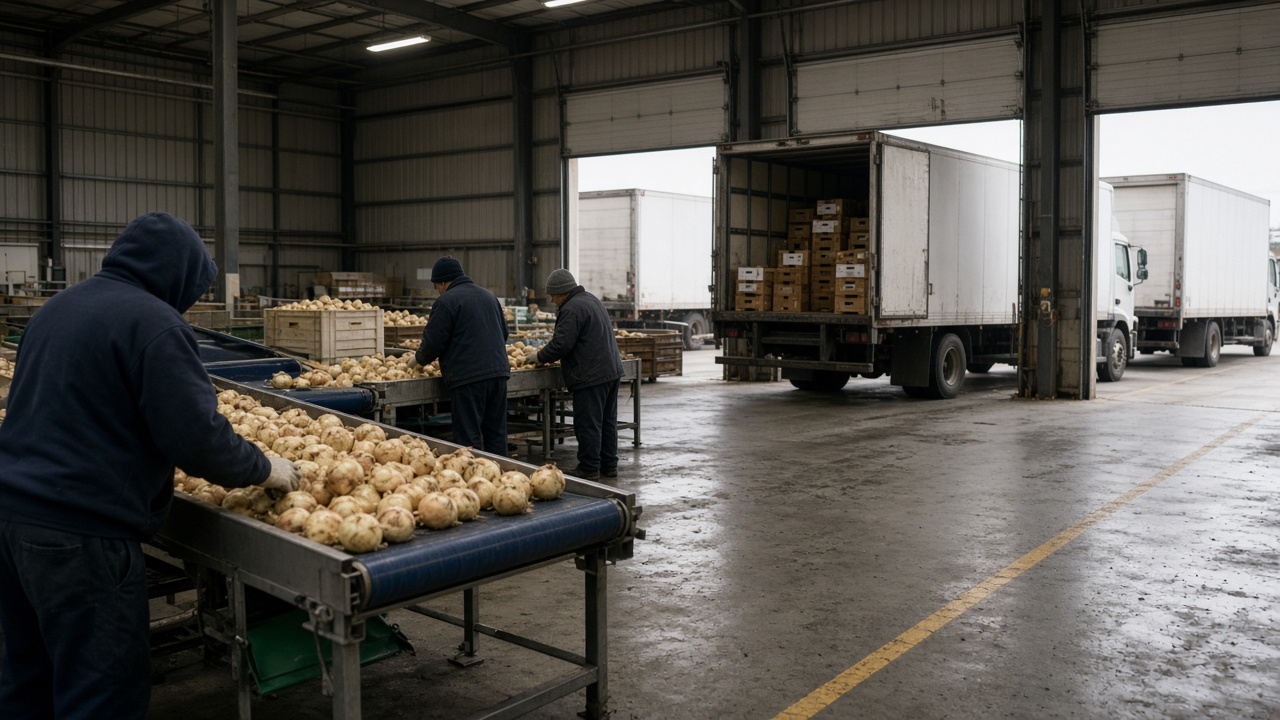
Yunlin County onion cooperatives sent the first post-storm refrigerated convoys down Highway 17 on Monday morning, reloading cold-chain capacity that Champi’s rains had idled for nearly a week and giving Taipei wholesale buyers their first steady supply of graded bulbs since county officials reopened the coastal corridor to heavy trucks.
What restarted on the highway
The Directorate General of Highways lifted the overnight escort requirement on the Huwei–Beimen segment after crews patched subsidence near a flood channel culvert, allowing 12-ton reefers to run without pilot cars for the first time since Oct. 22. Packers at Mailiao and Tuku said they cleared a backlog of roughly 420 metric tons sitting in farm cold rooms, prioritizing export-grade sizes bound for Japan before domestic restaurant contracts. County agriculture bureau staff logged 86 outbound manifests by noon, a figure they said would have been impossible while the escort rule forced daylight-only windows.
Price action in Taipei
Traders at the Taipei First Agricultural Products Marketing Corp. reported medium-grade Yunlin onions opening near NT$38 per kilogram, up about NT$4 from the last pre-storm session as buyers competed for intact skins and uniform diameters. Damaged lots—those with sprouting or soft necks from prolonged humidity—still moved at steep discounts through secondary lanes, but packers said the share of rejections fell once dryers returned to full shift. Restaurant groups that had substituted imported storage onions told brokers they would revert to Yunlin supply if Monday’s quotes held through Wednesday’s auction.
Farm-level losses still on the books
Cooperative managers cautioned that the highway reopening does not erase field losses Premier Cho’s cabinet tallied last week. Early-harvest rows in low-lying parcels near the Zhuoshui River mouth remain unharvestable, and some growers are filing crop insurance claims rather than paying pick wages. The Council of Agriculture’s disaster desk said it would cross-check manifest volumes against satellite damage maps before releasing the next tranche of low-interest loans announced for Yunlin and Chiayi growers.
Cold-chain bottlenecks
Reefer operators said diesel and driver overtime—not highway pavement—were the binding constraints Monday. Two logistics firms diverted trucks from poultry runs to cover onion contracts, and one cooperative rented portable generators to keep pre-cooling units alive during brief grid blips that Taipower attributed to eastern feeder repairs. Packers asked the agriculture ministry to extend hours at the Mailiao inspection station so night loads could reach Taipei before the 4 a.m. auction cutoff.
What buyers watch next
Wholesale prices typically soften when convoys normalize, but traders said any second tropical disturbance in the Philippine Sea could re-tighten supply before the Lunar New Year pick window. Japan importers, meanwhile, are auditing moisture readings on arriving lots; a failed container could push more medium grades into the domestic market and cap upside. For Yunlin growers, Monday’s trucks were less a victory lap than proof that the county’s export identity still depends on a single coastal road staying passable after every typhoon season.
Insurance and paperwork
Cooperative accountants spent Sunday reconciling storm certificates with insurer forms that require GPS-tagged photos of field damage. Several growers missed the first filing window because county offices were closed; the agriculture ministry said it would accept late submissions if manifests prove shipments resumed. Export brokers asked for moisture certificates at the packing shed door, adding an hour to loading but reducing reject risk at Yokohama cold stores. Packers who skipped the step last season absorbed six-figure yen write-offs when inspectors condemned whole pallets.
Labor and harvest crews
Migrant harvest teams returned from central Taiwan orchards where they had temporarily worked during the highway closure. County labor bureaus matched 120 workers to onion lines through a text hotline that listed bus pickup points on Highway 1 inland routes. Wages held at pre-storm piece rates, though some crews negotiated storm bonuses after owners received advance payments from restaurant chains desperate for stable supply.