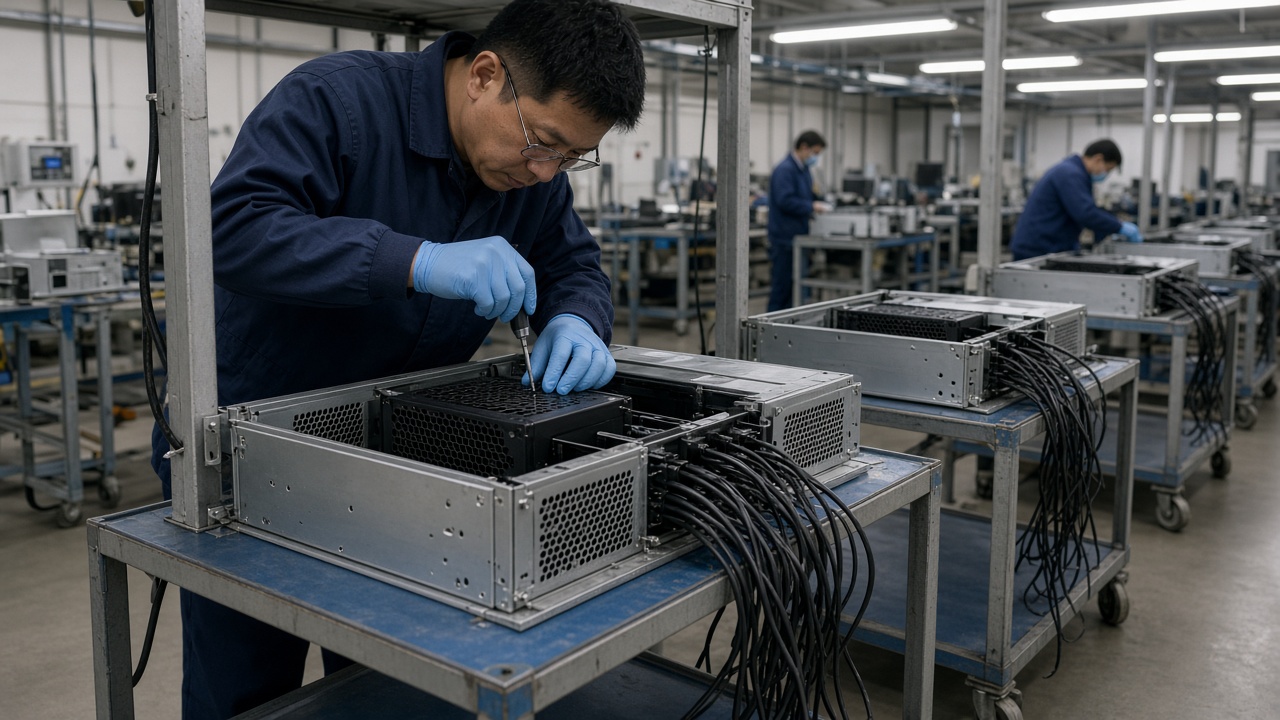
Taiwan executives feeding hyperscaler data centers said Oct. 28’s U.S. tech rally—and fresh detail from a prominent AI safety company’s securities filing—renewed customer conversations about 2027 rack shipments, even as local investors demand proof that cloud capital spending converts to profit. ODM planners from Taoyuan to Taichung report backlog checks on power shelves, busbars and custom chassis rather than new speculative programs, a distinction they stress to equity analysts wary of another cycle overshoot.
What changed in the narrative
The filing highlighted operating cash generation at a U.S. AI lab investors treat as a sentiment leader, not a direct Taiwan customer, yet Taipei traders still bid supply-chain names because hyperscalers anchor their own capex plans to AI demand signals. Economic Daily commentary on Oct. 29 noted North American cloud providers already raised 2026 spending forecasts and may lift 2027 budgets again if December earnings confirm monetization. Taiwan power-supply leaders such as Delta Electronics scheduled afternoon briefings Oct. 29 where investors expect server-segment order comments.
Where Taiwan fits
Contract manufacturers assemble white-box servers for U.S. brands and Chinese cloud firms under strict configuration rules, while foundries and OSAT houses supply accelerators, networking silicon and advanced packaging. AI racks need more power density per unit, benefiting Taiwan vendors specializing in high-efficiency PSUs, liquid-cooling manifolds and busbar trays. Assemblers said lead times for key power components remain stretched into mid-2027, mirroring memory shortages SK Hynix executives described as lasting toward 2030.
Skepticism on the desk
Concord Securities and onshore fund managers repeated Oct. 28 warnings that TAIEX turnover thinned even as the index jumped 939 points—a sign many portfolios await Microsoft, Alphabet and Amazon results before adding exposure. AI-supply chain bulls counter that Taiwan orders lag U.S. headlines by a quarter, meaning current backlog surveys already embed earlier capex hikes. Bears note inventory corrections hit server chains in 2023 and could recur if GPU allocation shifts.
Policy and power
Taiwan’s grid and land debates still constrain the largest domestic data-center builds, pushing hyperscalers to import more finished racks from Taiwan fabs and plants instead of expanding island colocation. Electricity tariffs and renewable procurement rules appear in vendor RFPs, nudging suppliers to certify efficiency metrics customers can disclose in sustainability reports. None of that blunts near-term demand for power components, planners said, because U.S. and Middle East sites absorb most incremental racks.
Private market signals
Venture arms tied to Taiwan tech groups continue seeding cooling and optical startups, treating hyperscaler RFPs as validation events. The AI lab filing also stirred discussion about enterprise software budgets that could indirectly drive inference servers assembled in Taiwan even if training spend slows. Sales teams cautioned that headline IPO files do not equal purchase orders; they only reopen doors for 2027 forecast reviews customers paused in September during typhoon disruptions.
What investors should track
Oct. 29 earnings calls from Delta, Realtek and panel makers may include AI-adjacent segments worth parsing against pure consumer lines. Watch management language on push-outs versus pull-ins, and whether gross margins hold as copper and substrate costs rise. For Taiwan’s AI supply chain, the Oct. 28 sentiment boost is a reminder that equity multiples still key off U.S. narratives—even when local fundamentals hinge on mundane power shelves and assembly yield rates.
Component lead times
Procurement managers listed 14-week lead times for high-wattage PSUs and 20-week windows for custom busbars as bottlenecks more binding than chassis metalwork. That aligns with comments from memory executives predicting shortages into 2030, a horizon that once sounded hyperbolic but now appears in official customer letters.
ESG disclosures
Hyperscalers increasingly ask Taiwan suppliers for scope-two power data and recycled-content certificates for sheet metal. Compliance teams hire consultants to map plant-level emissions, a cost smaller ODMs pass through quotes. Failure to document can disqualify vendors even when price and yield are competitive.
ODM capacity
Large assemblers told supply-chain reporters they are not adding new greenfield plants in Taiwan for 2026, instead reconfiguring existing lines for higher-wattage racks. That keeps capital expenditure on their books flat while still capturing AI unit growth through mix shift—a detail equity analysts sometimes miss when they extrapolate server unit counts into revenue multiples.