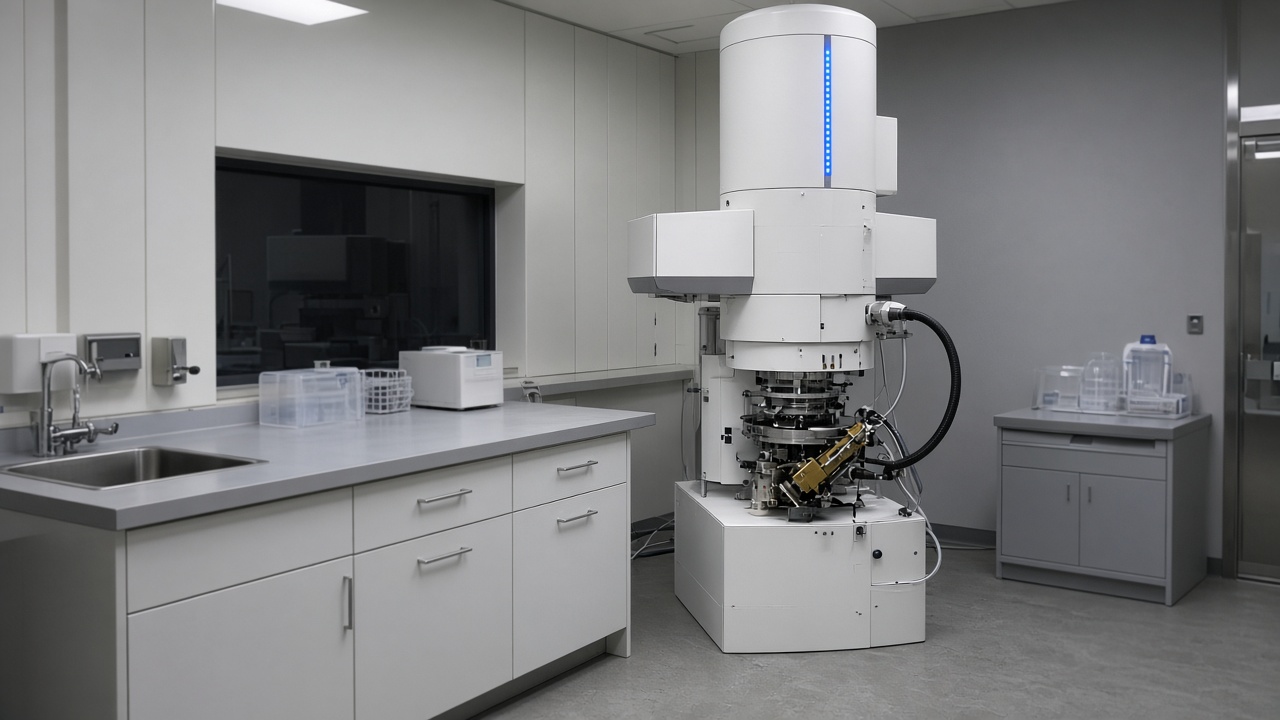
The Rosalind Franklin Institute near Harwell finished commissioning an upgraded cryo-electron microscopy suite on Wednesday, enabling researchers to map viral envelope proteins at resolutions approaching 2.5 angstroms without crystallisation.
The £14 million refit, funded through UK Research and Innovation infrastructure grants, replaces detectors and cold-stage controllers on an existing Titan Krios platform shared with Oxfordshire vaccine labs.
Why envelope imaging matters
Many emerging viruses, including seasonal influenza variants and certain zoonotic coronaviruses, mutate fastest on surface glycoproteins that vaccines and antibodies target. Cryo-EM allows scientists to visualise those structures in near-native membranes, speeding design of broadly neutralising candidates.
Institute directors said the upgrade cuts sample-to-structure time from weeks to days for well-behaved specimens, though highly heterogeneous envelopes still require extensive classification computing on Harwell’s cluster.
Access model
Half of instrument time is reserved for UK academic groups via peer-reviewed proposals; the remainder supports industry partnerships under published fee schedules. Early users include teams from the University of Oxford and the Pirbright Institute studying avian influenza attachment mechanisms.
Data will be deposited in public archives where funders require open release, with embargo options for industry co-funders contributing proprietary adjuvants.
Collaboration network
Harwell’s central facilities team trained additional night-shift operators so the instrument can run continuously during multi-day data collection on fragile particles. Software upgrades integrate with the Electron Bio-Imaging Centre pipelines, reducing manual particle picking time.
Industry partners in the vaccine supply chain said faster envelope imaging could shorten strain selection meetings ahead of flu season formulation, though regulatory agencies still require full clinical trials regardless of structural biology speed.
Environmental controls in the microscope hall were recertified after vibration tests from nearby construction, a routine delay for sensitive instruments on active campuses.
Doctoral students from Imperial College will be first in the queue for training shifts on the new detectors, part of a widening skills pipeline UKRI wants replicated at other national labs.
UKRI programme managers will audit instrument uptime quarterly, tying continued capital subsidies to publication records and industry co-investment pledges signed during the upgrade tender.
Structural biologists from neighbouring Diamond Light Source said they would coordinate beamtime so viral envelope projects can cross-check cryo-EM maps with X-ray crystallography fragments when crystals form.
Graduate training modules added this month teach particle classification on the upgraded detectors, extending Harwell’s role as a national skills hub beyond instrument hosting alone.
Backup power tests completed last week satisfy insurers covering the instrument hall against grid fluctuations.