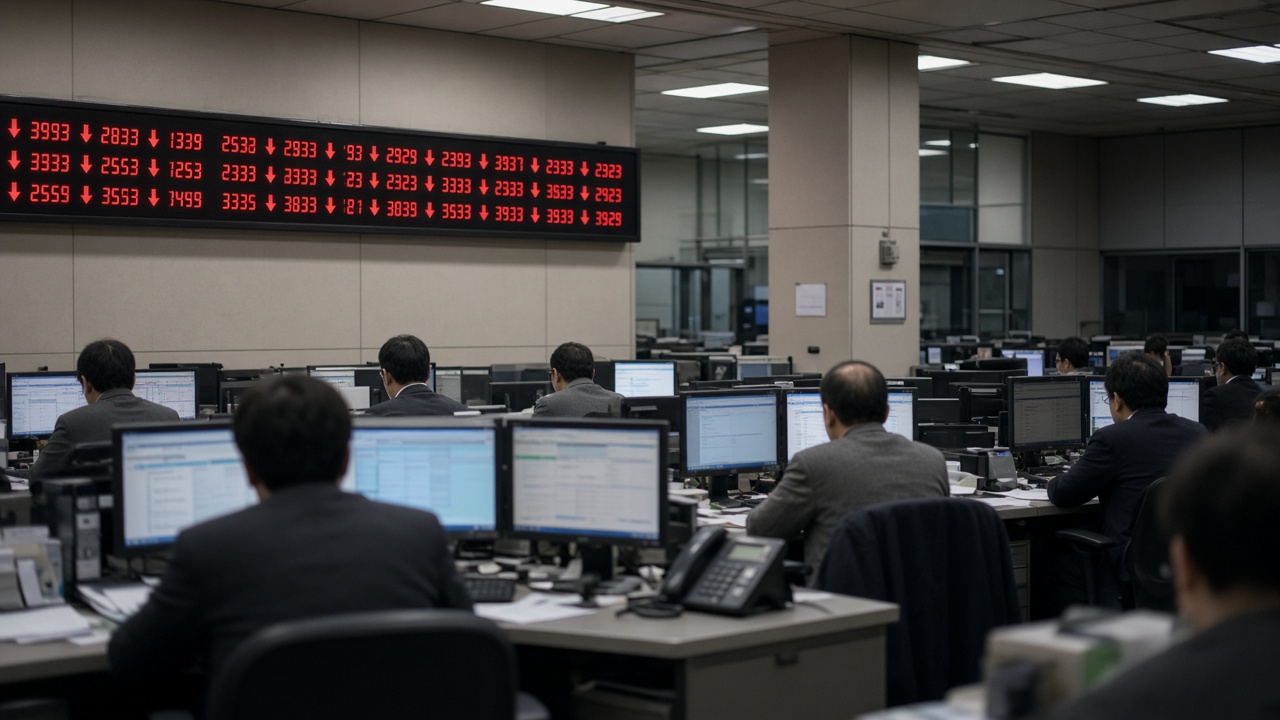
South Korea’s benchmark stock index closed down 3.48 percent on Friday as a global retreat in artificial-intelligence and semiconductor shares dragged Samsung Electronics and SK hynix sharply lower.
How the session unfolded
The Korea Composite Stock Price Index finished at 5,730.74 after shedding 206.92 points, according to exchange data cited by Yonhap News Agency. The index had been down more than 5 percent in early trading and touched an intraday low of 5,599.42, briefly threatening the 5,600 handle that traders watch as a psychological floor.
Exchange rules activated a sidecar mechanism during the morning rout, pausing programmatic buying for a short interval—the first such pause in eleven trading days, local broadcasters reported. The measure is designed to slow automated flows when volatility spikes, giving human desks time to absorb orders without amplifying a cascade.
What pulled chip names down
Investors linked the selloff to renewed questions about whether spending on AI infrastructure can keep pace with lofty valuations. U.S. technology shares had already wobbled after Alphabet reported results that failed to calm skeptics, and Asian chipmakers followed.
Samsung and SK hynix—two of the heaviest weights on the KOSPI—were among the biggest draggers as foreign investors trimmed exposure to memory exporters that have benefited from data-center demand. The won strengthened against the dollar during the session, a mixed signal that sometimes reflects repatriation flows when exporters’ shares fall.
Beyond the headline index
Broader Asian markets were uneven, with Japan’s Nikkei also lower after the Bank of Japan held its policy rate near 1.25 percent, but Seoul’s concentration in semiconductors left the KOSPI especially sensitive to any doubt about AI capex.
Market regulators did not announce new investor-support programs on Friday, and officials have in recent weeks emphasized that sidecar pauses are routine circuit breakers rather than a signal of systemic stress. Even so, the speed of the morning drop underscored how tightly Korean equities remain tethered to a handful of chip stocks—and to the global narrative around AI spending.
What traders watch next
Portfolio managers said they will be looking at U.S. earnings from cloud and chip companies over the coming week for any guidance that either restores confidence or extends the de-risking. Domestically, attention will also stay on foreign net buying figures and whether the KOSPI can hold above 5,700 after repeatedly testing lower levels intraday.
For now, Friday’s close leaves Korea’s headline index still up sharply for the year, but the session was a reminder that when AI trades stumble abroad, Seoul’s market rarely gets a pass.
Retail investors who added chip-heavy funds this quarter will watch Monday’s opening for signs that the morning slide was a one-day flush or the start of a longer reset in memory valuations.
Exchange data showed turnover spiked during the sidecar pause, a pattern desks often see when foreign funds reduce beta quickly rather than unwind positions over several sessions.