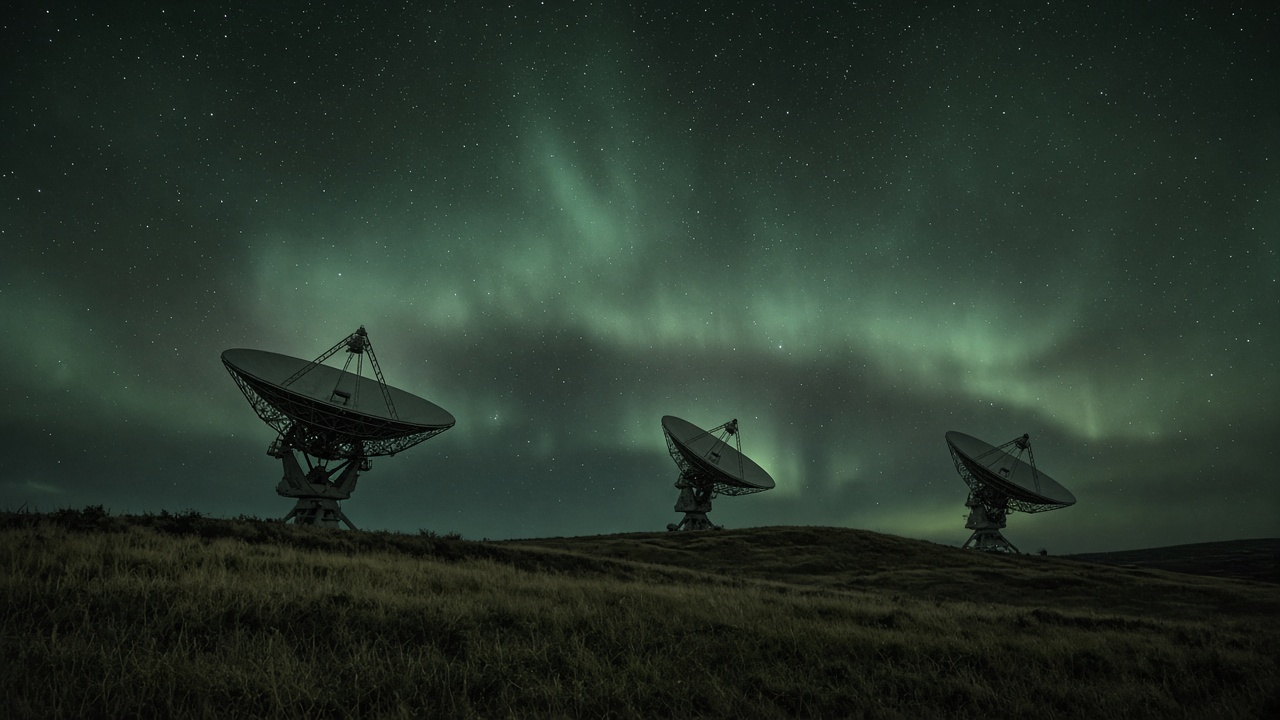
Durham University's telescope array recorded a sharp auroral radio burst on Thursday night, giving northern England sky watchers a Halloween preview before geomagnetic activity peaked early Friday.
Researchers logged a sustained spike in 30-megahertz emissions for nearly forty minutes, matching a moderate G2 storm forecast issued by the Met Office Space Weather Operations Centre. Cloud cover broke over County Durham just long enough for the public outreach team to stream live audio of the signal.
What the array caught
The facility combines small dipole antennas with a phased radio interferometer originally built for pulsar research. Auroral bursts appear as rising static when solar wind particles ionise the upper atmosphere.
Lead physicist Dr Amira Chen said the Halloween timing was coincidence but useful for student recruitment open days this weekend.
Public viewing
Met Office guidance warned that Friday night's display might dip south to Lincolnshire if the storm persisted. Rural dark-sky sites in Northumberland reported green arcs on camera phones despite light pollution near Newcastle.
Power grid operators reported no transformer trips; National Grid ESO noted elevated reactive power flows but stayed within contingency limits.
Research outreach
Undergraduate volunteers streamed the radio signal to schools in Sunderland and Darlington, translating amplitude changes into audio pops that children could hear in classrooms without staying out late. Chen said the Halloween timing boosted attendance at Saturday open labs despite cold weather.
Solar physicists at the Met Office noted the storm originated from a coronal mass ejection observed on Tuesday, with arrival faster than model medians predicted. Faster transit often produces sharper radio signatures at mid-latitudes before visible aurora appear.
Amateur radio operators reported increased interference on HF bands, a nuisance for emergency drills but useful calibration data for the Durham array.
Transport operators on the East Coast main line reported no signaling interference, allaying fears from previous storms that induced voltage fluctuations. Durham County Council promoted dark-sky viewing areas with park-and-ride buses to reduce roadside congestion on the A690.
Secondary schools used the burst as a live physics lesson, with teachers linking magnetosphere activity to GCSE curriculum modules on electromagnetic waves.
Photographers on the Pennines captured still images alongside the radio data, posting long exposures that avoided light pollution from the A1 corridor. Chen cautioned the public not to treat social media filters as scientific measurements of storm intensity.
Funding for the outreach programme comes from a UK Research and Innovation public engagement grant renewed in September, covering school buses and portable speakers for audio demos.