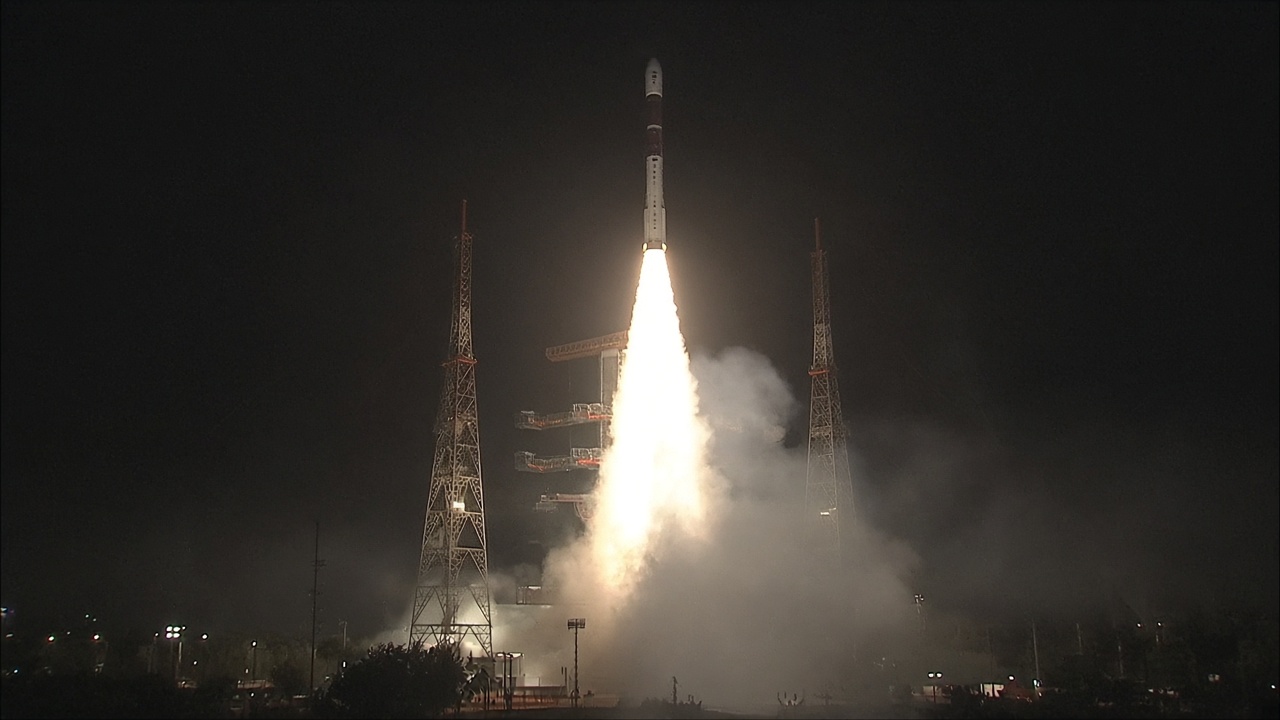
India’s space agency placed its newest regional navigation satellite into orbit late Friday, restarting a launch campaign that underpins the military and civilian signals marketed as NavIC.
The Geosynchronous Satellite Launch Vehicle GSLV-F18 rose from the second launch pad at the Satish Dhawan Space Centre in Sriharikota at 11:51 p.m. local time, carrying the 2,232-kilogram NVS-03 spacecraft. ISRO said the three-stage rocket, with a lift-off mass of about 420 tonnes, was tasked with injecting the satellite into a geosynchronous transfer orbit so on-board propulsion could later circularise its path.
What NVS-03 adds to NavIC
NVS-03 is the third satellite in the next-generation navigation series designed to sustain the Indian Regional Navigation Satellite System, also known as IRNSS or NavIC. The constellation provides positioning over India and a surrounding service area without relying on foreign military-controlled networks. ISRO has marketed NavIC for fleet tracking, disaster response, and smartphone chips, and the defence establishment treats assured access to the signals as strategic infrastructure.
Each NVS spacecraft carries updated atomic clocks and payload improvements compared with the first-generation IRNSS birds launched more than a decade ago. A successful NVS-03 mission keeps the planned refresh on schedule after earlier launches demonstrated the upgraded bus and ground segment.
Launch profile and ground segment
Mission controllers began a 24-hour countdown on Thursday night, ISRO said, with weather and range checks clearing the night window on India’s east coast. Tracking ships and the agency’s network of ground stations were tasked with following the ascent through stage separations and the final injection burn.
Officials will spend the coming days confirming health telemetry, deploying solar arrays, and manoeuvring NVS-03 toward its operational slot. Only after in-orbit tests will the satellite be declared ready to broadcast navigation messages alongside its sister spacecraft.
Why the timing matters in India
A reliable NavIC fleet underpins everything from fisheries safety alerts to precision agriculture pilots and the push to mandate NavIC-capable receivers in some government procurement. Delays in the NVS line would force planners to stretch aging satellites and complicate the sales pitch to handset makers already juggling GPS, Galileo, and BeiDou.
Friday’s launch also follows a year in which ISRO has sought to raise its launch cadence after supply-chain and pandemic-era slowdowns. Clearing GSLV-F18 with a navigation payload signals that the heavier lift vehicle remains in the mix for national-security payloads even as newer commercial rockets attract attention.
ISRO is expected to release a mission summary once all major milestones are confirmed, including whether the cryogenic upper stage delivered the satellite within its target injection parameters. For now, NVS-03 is off the pad and the NavIC refresh has its third brick in space.
Agency leaders have not announced a date for the next NVS launch, but programme managers have said they intend to keep the constellation at full strength before legacy satellites exhaust their fuel reserves.