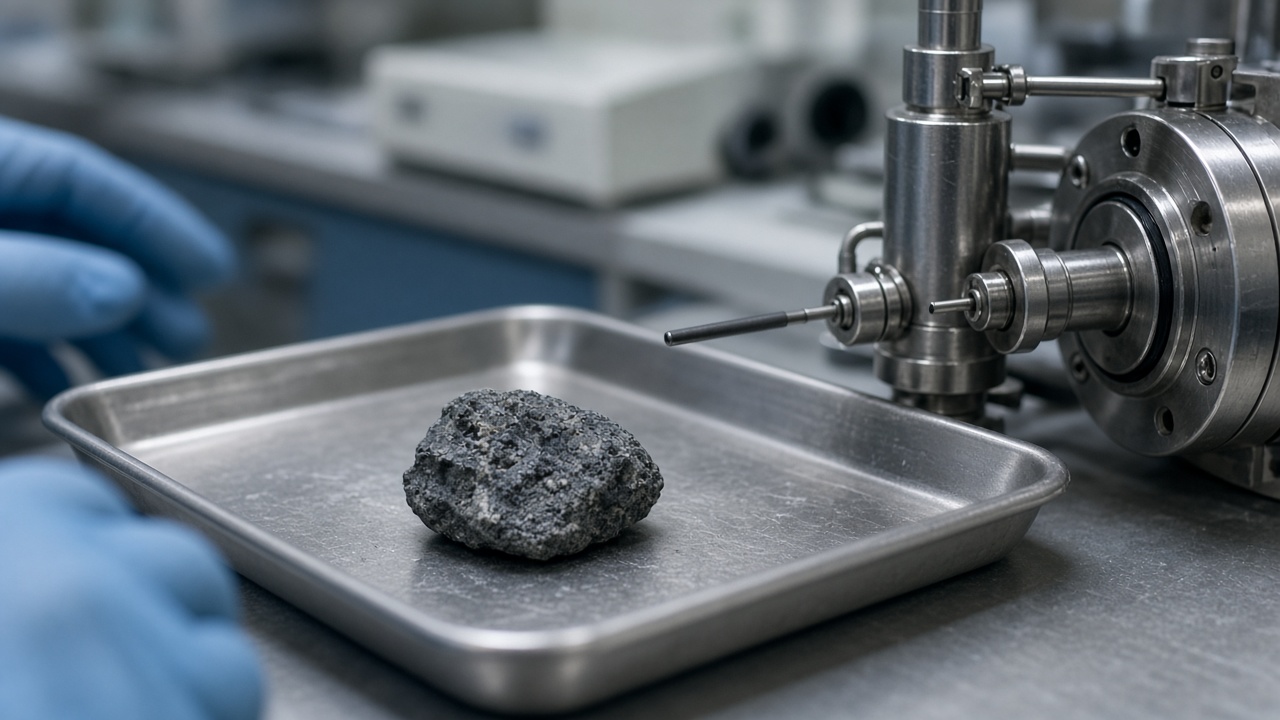
Scientists led by Japan Agency for Marine-Earth Science and Technology researchers said radiometric analysis dates a Mars meteorite recovered in Mali at about 4.1 billion years, making it the oldest known specimen tied to the planet’s crust and supporting theories that liquid water interacted with rock early in Martian history. The team presented the findings at a Tokyo briefing on October 30 ahead of peer-reviewed publication.
Sample provenance
Desert nomads discovered the black fragment in northern Mali; collectors transferred it through meteorite dealer networks to laboratories that confirmed Martian isotope signatures matching prior shergottite classes. Japanese institutes acquired a slice under Antarctic research cooperation channels that share non-Antarctic Mars analogs for comparative studies.
Lead author geochemists used uranium-lead and samarium-neodymium systems on phosphate minerals resistant to shock heating during ejection from Mars. Multiple aliquots converged on 4.1 billion years with uncertainties below twenty million years, tighter than earlier Martian meteorite age spreads.
Water and crust implications
Mineral inclusions show alteration textures consistent with brief liquid water episodes before the rock crystallized, not long-lived oceans. That timing aligns with orbital remote-sensing maps of ancient southern highlands but adds ground-truth chemistry rovers cannot yet retrieve from similar eras.
Planetary scientists said the age pushes back the window when Mars could have hosted habitable niches, independent of later arid climate models.
Method cross-checks
Teams at the National Institute of Polar Research replicated measurements on a second chip to rule out terrestrial contamination during desert exposure. Noble-gas analyses indicated cosmic-ray exposure ages compatible with a recent Earth fall, separating space history from Mars formation age.
International reviewers requested additional electron microscopy before journal acceptance; authors said data will be archived in Japan’s planetary sample repository for independent replication.
Link to JAXA and NASA missions
Japan’s Martian Moons eXploration mission aims to return Phobos regolith later this decade; terrestrial meteorites provide calibration for instruments that will fly. NASA’s Perseverance rover caches younger sediments; the Mali sample bridges geologic eras rovers cannot reach.
Policy makers cite such science in budget defenses for basic research amid pressure to fund defense and energy programs.
Public outreach
Museums in Tokyo and Sendai plan small exhibits using resin casts while the parent slice remains in controlled storage. Educators emphasized that Mali discovery underscores global meteorite trade transparency efforts under UNESCO discussions.
None of the findings alter near-term investment markets, but they reinforce Japan’s role in planetary geochemistry alongside deep-sea drilling expertise housed at the same agency.
Open questions
Researchers still debate which Martian impact event launched the rock toward Earth and whether additional fragments from the same fall remain undiscovered in the Sahara. Follow-up expeditions require security clearance in Mali; Japanese diplomats coordinated with local authorities for future field seasons.
If confirmed in print, the 4.1-billion-year age becomes a textbook anchor for introductory planetary courses across Asia-Pacific universities.
Sample curation and ethics
Museums coordinating with Mali authorities emphasized revenue-sharing for future touring exhibits, a sensitivity after past disputes over meteorite commercialization. Japanese labs store the parent slice under nitrogen purge conditions matching Antarctic treaty sample protocols even though the rock never transited through polar stations.
Graduate programs at Tokyo and Tohoku universities already queued thesis topics on shock metamorphism in the slice, extending the science beyond the headline age number.