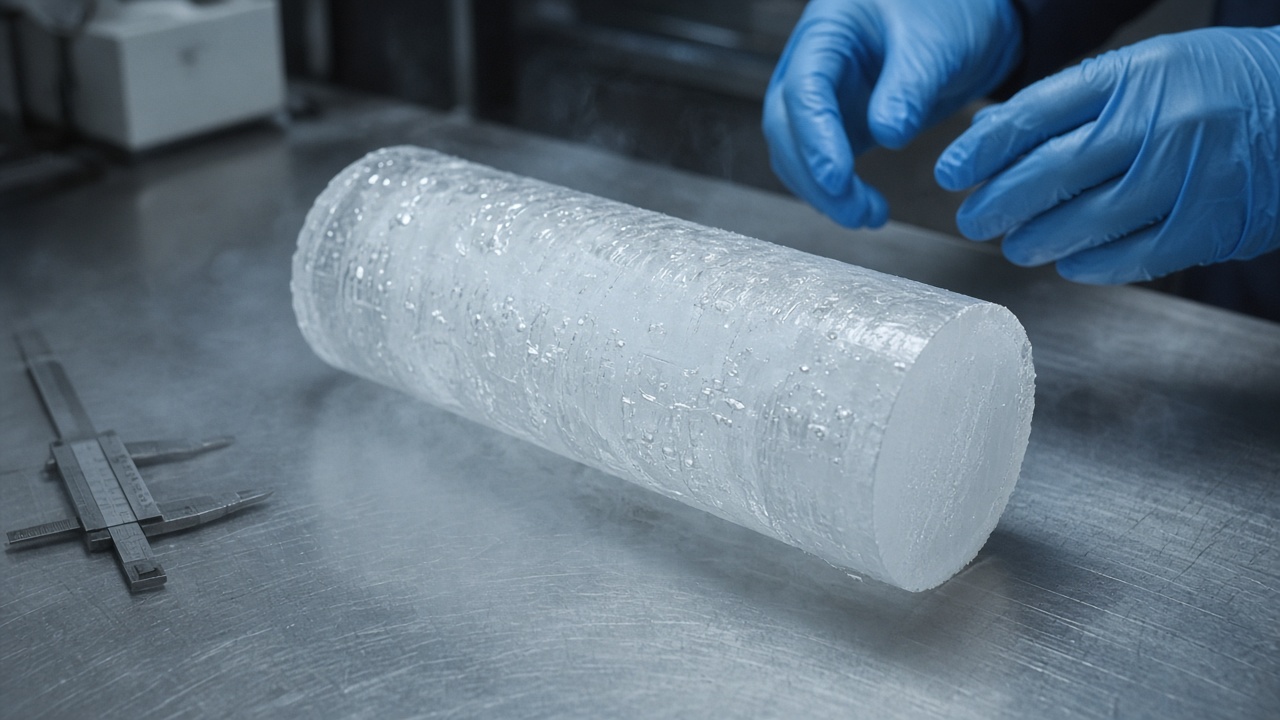
Researchers at the University of Adelaide extended bubble-layer chronology in a coastal Antarctic ice core by roughly one hundred twenty-seven thousand years using laser ablation and isotope mapping, tightening timelines for gases trapped before the last glacial maximum.
The work, accepted for publication in a geochemistry journal and released on preprint servers Sunday, re-dates a section of core drilled near Casey station that previous tie-points had left ambiguous. Lead author Dr Mei Lin Tan said the team focused on a brittle interval where visual layer counting disagreed with earlier gas-age estimates.
Why bubble layers matter
Air bubbles trapped as snow compacts carry greenhouse-gas snapshots and volcanic sulfate signals. If chronology drifts, climate models misalign ice records with marine sediment timelines, blurring cause and effect in past warming episodes. A misdated methane spike can make a Southern Ocean feedback look synchronous with Northern Hemisphere events when they were not.
The Adelaide team scanned micron-scale slices, vaporising material with a laser and feeding mass spectrometers that count oxygen isotopes and methane in single passes. The method reduced sample consumption compared with manual milling, preserving more core for archive storage. Researchers could run repeat scans on adjacent slices to check reproducibility without destroying large segments.
Field to lab chain
Core segments travelled frozen from Antarctica to Adelaide’s cold-room facility, where they were logged at minus twenty degrees Celsius. Australian Antarctic Division logistics provided chain-of-custody records that independent reviewers requested during peer review. Temperature loggers accompanied each shipment; any thaw would have disqualified segments from high-resolution work.
The group cautions the technique does not replace annual-layer counting in younger ice, but it resolves stacked bubble clusters where visual banding disappears. Reviewers asked for blind repeats on a withheld slice; the lab reported matching chronology within stated uncertainty bands.
Casey station staff who drilled the parent core attended a virtual briefing Sunday to hear how the re-dated section fits upcoming field seasons. They said the results may shift where future drills target brittle zones versus stable ice.
Next drills
A planned deep drill near Denman Glacier will test whether the laser pipeline scales to brittle ice below two thousand metres. Funding bodies said Sunday’s results strengthen the case for allocating ship time in the 2027 summer window.
Collaborators in Europe requested Adelaide host a short course on laser ablation prep so other Southern Hemisphere labs can adopt the workflow without reinventing cold-room fixtures. If Denman drilling proceeds, the same chronology pipeline could compare deep gas records with the Casey coastal core within a single modelling framework.
Climate modellers said tighter bubble dating on the Casey section improves alignment with Southern Ocean sediment cores already used in Intergovernmental Panel on Climate Change annexes, even though the new work covers ancient intervals rather than recent decades.