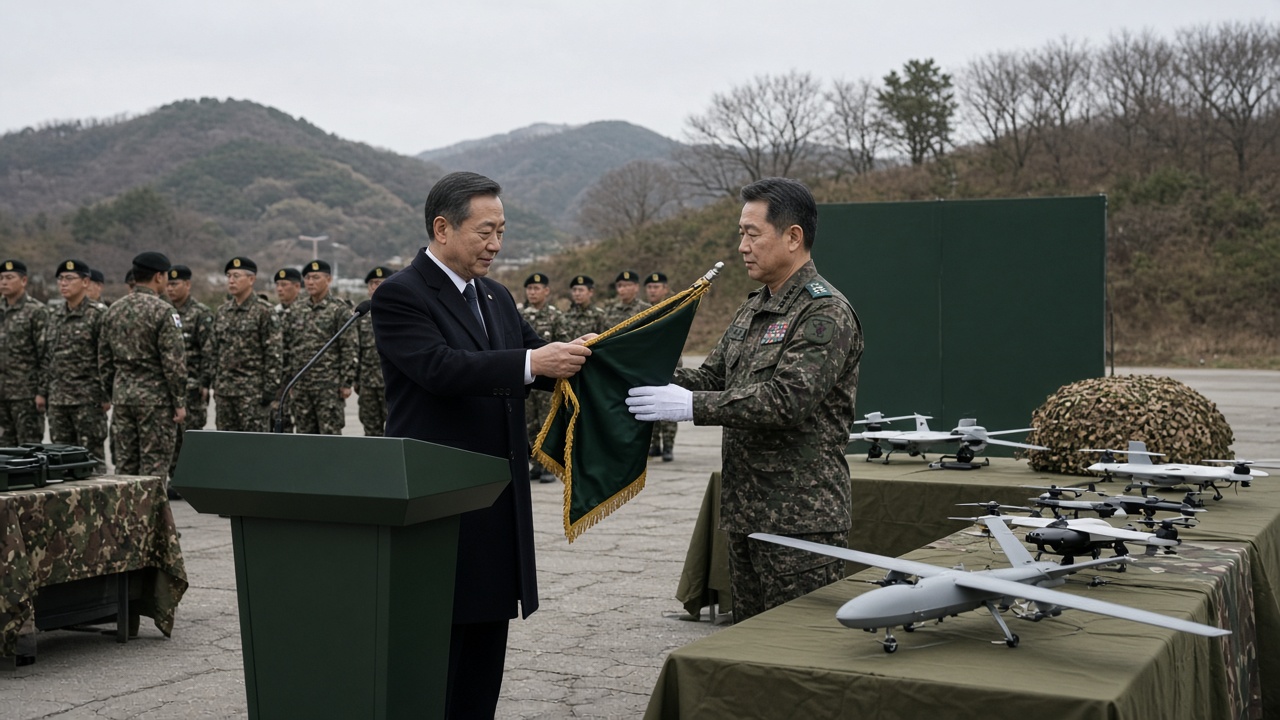
South Korea’s Defense Ministry inaugurated the Defense Drone Headquarters in Pocheon, Gyeonggi Province, on Monday, marking a structural shift in how Seoul plans and buys unmanned systems as North Korean drone incursions keep pressure on the peninsula’s air defenses. Vice Defense Minister Lee Doo-hee presided over the founding ceremony at the new headquarters compound roughly 40 kilometers north of central Seoul.
From operations command to policy hub
The headquarters replaces the Drone Operations Command that the previous administration created in 2023 after North Korean unmanned aircraft crossed the border in late 2022. That command focused on executing strikes and reconnaissance missions; the new body is billed as a ministry-level “control tower” that sets drone and counter-drone strategy across the Army, Air Force, and Marine Corps while leaving combat employment to each service under Joint Chiefs coordination.
Ministry briefers said the Drone Operations Command was dissolved on November 1 under a presidential decree published last month, following recommendations from a civilian-military advisory panel that questioned whether a standalone strike command duplicated service capabilities. Strike and reconnaissance missions that the old command ran will migrate to operational units in each branch, with the Joint Chiefs integrating targeting alongside artillery and manned aviation.
Acquisition, certification and force goals
The headquarters will work with the Defense Acquisition Program Administration to shorten procurement cycles, including a certification framework modeled on the U.S. Blue UAS list so commercially proven platforms can enter service without multi-year trials. Ministry planners reiterated a goal of rapidly fielding more than 20,000 low-cost expendable attack drones and accelerating the Korean Low-Cost Uncrewed Combat Attack System, a domestic loitering-munition program.
Why Pocheon matters for Korea readers
Pocheon already hosts large-scale combined live-fire drills where drone swarms featured in this year’s media days, so placing the headquarters there keeps policy staff near the ranges where concepts are tested against North Korean infiltration scenarios. A three-star general equivalent will lead the headquarters; the ministry said the outgoing drone operations commander will serve in the inaugural role until a permanent chief is named.
Opposition lawmakers had argued that abolishing the strike command would weaken retaliation options after unmanned aircraft appeared over Seoul and near the presidential office in 2024. Defense officials countered that dispersing drones to every maneuver unit—and centralizing only standards, certification, and budget—would harden the force faster than keeping a single 280-person command that owned both policy and trigger pulls.