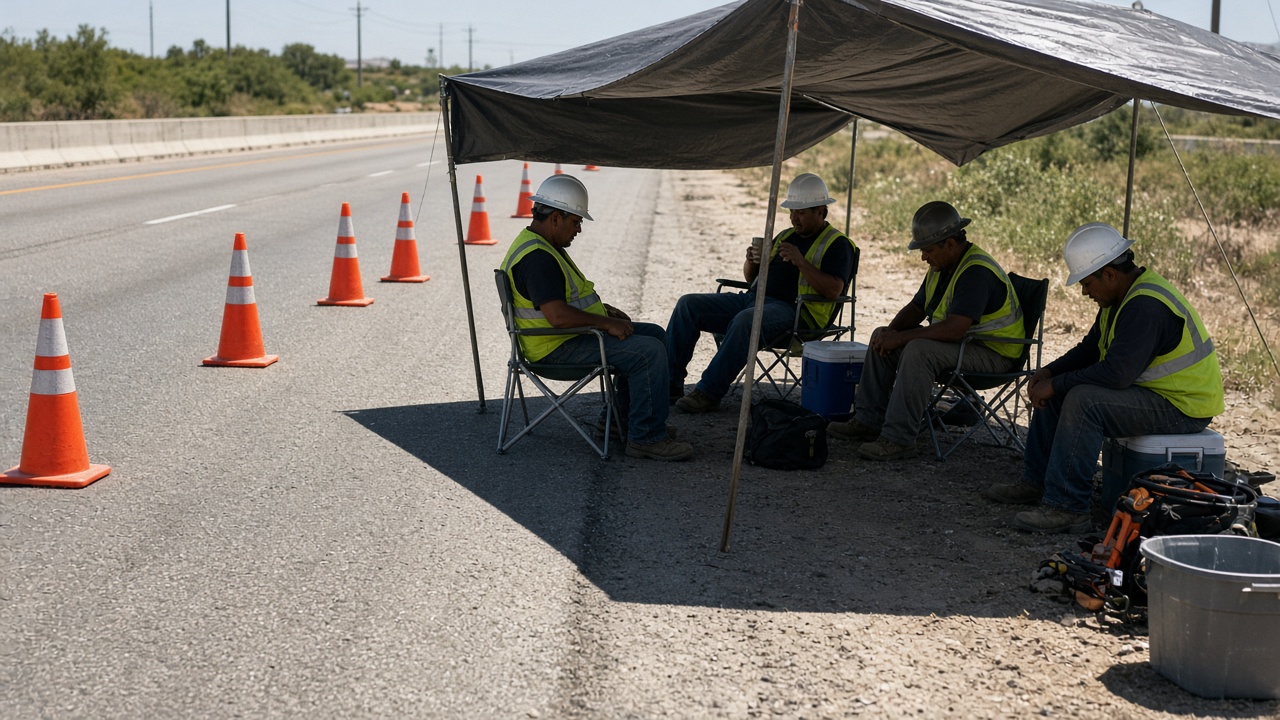
A working paper from the Indian Institute of Management Ahmedabad quantified productivity losses on Gujarat highway maintenance crews during October’s late-season heat spikes, finding that outdoor labourers lost roughly eleven percent of scheduled work hours when wet-bulb readings exceeded safe thresholds by mid-afternoon.
The study tracked 214 workers on National Highway Authority of India contracts near Vadodara and Rajkot, using wearable sensors and supervisor logs rather than self-reported fatigue alone.
Method and findings
Researchers paired India Meteorological Department station data with on-site wet-bulb globe temperature readings every thirty minutes. When readings crossed internal red lines, crews were supposed to rotate to shaded tasks; supervisors recorded actual compliance and output metrics such as lane marking metres completed.
The eleven-percent headline loss aggregates both outright stoppages and slower task completion. Night-shift control groups on the same contracts showed no comparable decline, supporting the heat causality claim.
Policy implications
NHAI contracts already reference Ministry of Labour heat guidelines, but penalties for missed milestones rarely distinguish weather from contractor fault. The authors recommend tying bonus payments to compliant rest cycles rather than raw kilometre targets, a change that would raise bid prices unless clients accept longer timelines.
Climate researchers note that Gujarat freight corridors will see more shoulder-season heat as monsoon withdrawal delays, a pattern IMD documented across western India this year.
Industry response
Large engineering firms said they deploy mist fans and electrolyte stations on select projects, costs they seldom itemise in public bids. Smaller subcontractors told the researchers they skip rest breaks to avoid missing daily wages, suggesting enforcement gaps at the bottom of the supply chain.
Why the number matters
Infrastructure investors treat labour productivity as a silent input to toll-road completion dates. An eleven-percent drag during heat weeks can cascade into penalty clauses and delayed revenue recognition for build-operate-transfer operators.
The paper stops short of prescribing a national midday ban, arguing instead for adaptive scheduling tied to local IMD alerts. Gujarat’s public works department said it would pilot the early-shift model on two NHAI sites this winter before mandating changes statewide.
Union labour ministry officials said they would review the paper before updating model contract clauses for highway projects nationwide, though any change would likely wait until after state elections conclude.