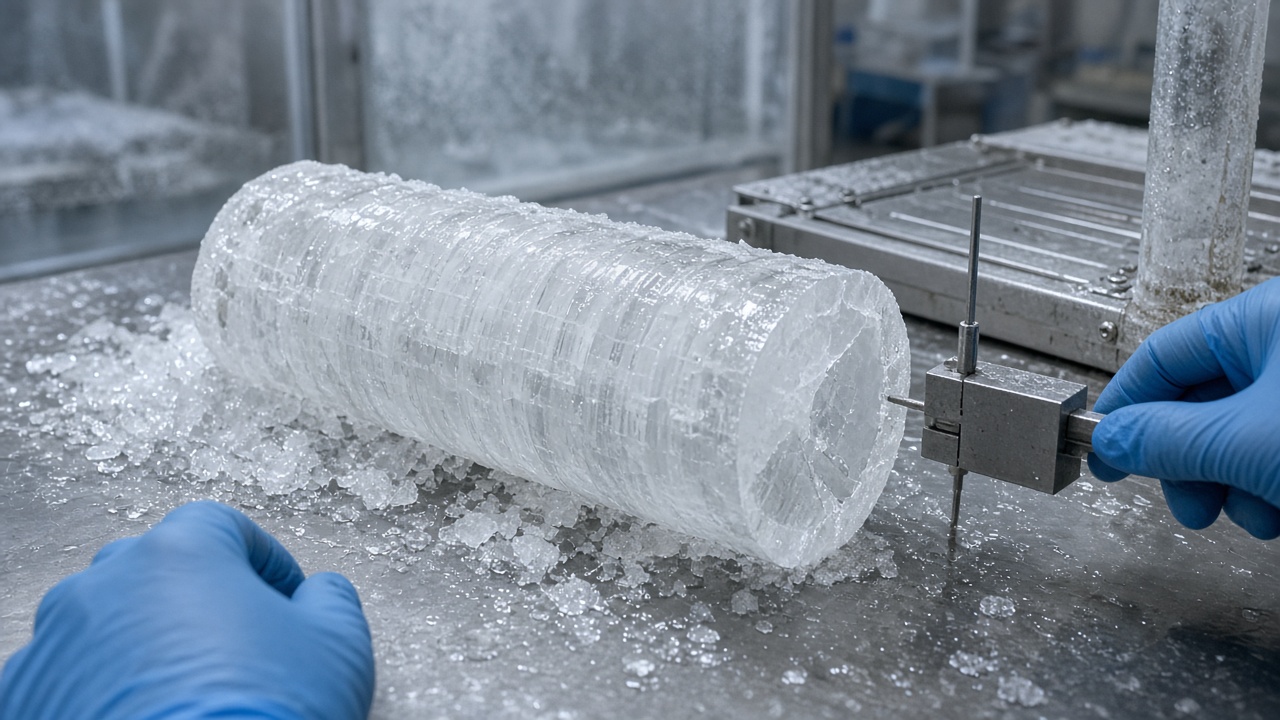
Scientists at the Australian National University have extended a melt-layer record preserved in East Antarctic firn cores, adding roughly four centuries of datable summer melt events that climate modellers use to test how stable the ice sheet’s margins really are.
Firn is the compacted snow layer before it becomes solid glacial ice. Thin refreeze layers mark summers warm enough to melt the surface briefly. Samira Haddad’s desk notes the work does not claim Antarctica is collapsing overnight; it gives statisticians more independent timestamps to compare against satellite-era observations that only begin in the late twentieth century.
Methods and limits
The team analysed cores drilled near Casey research station logistics routes, using density profiles and isotope ratios to separate melt layers from wind-scoured events. They cross-checked against known volcanic sulfate peaks to anchor timelines. Uncertainty grows in older sections where layer thinning makes individual summers harder to count, which the paper flags explicitly rather than smoothing curves for headlines.
Why modellers care
East Antarctica holds most of the continent’s ice volume. Small fractional changes in melt rates translate into large sea-level numbers over centuries. Australian coastal cities care because Southern Ocean circulation links to Antarctic feedbacks. CSIRO and Bureau of Meteorology collaborators will ingest the chronology into ensemble runs testing whether recent melt spikes exceed anything in the extended record.
What this is not
The study is not a tourist weather forecast and not a policy document. It does not prescribe emissions targets. It supplies evidence planners can cite when updating infrastructure codes for storm surge. Replication teams will request aliquots through the Antarctic Division’s sample archive under existing international protocols.
Field season logistics
Drilling teams recovered the cores during the 2025–26 Antarctic summer with Australian Antarctic Division traverse support. Samples are stored at −18 degrees Celsius in Canberra until international collaborators complete duplicate splits for inter-laboratory comparison scheduled for early 2027.
Policy readers should watch whether the extended chronology shifts insurance stress tests for coastal councils; the paper itself stays silent on premiums, but reinsurers subscribe to the same data feeds.
Peer review path
The work is under journal review with data tables uploaded to the Australian Antarctic Data Centre. Reviewers asked for additional sensitivity tests on wind-scour false positives, which the team addressed in a supplementary appendix rather than withholding the chronology until perfect agreement on every layer count.
Undergraduate interns at ANU helped digitise thin-section photographs; their labour is credited in the methods section, a small but meaningful transparency step for public-funded ice science.