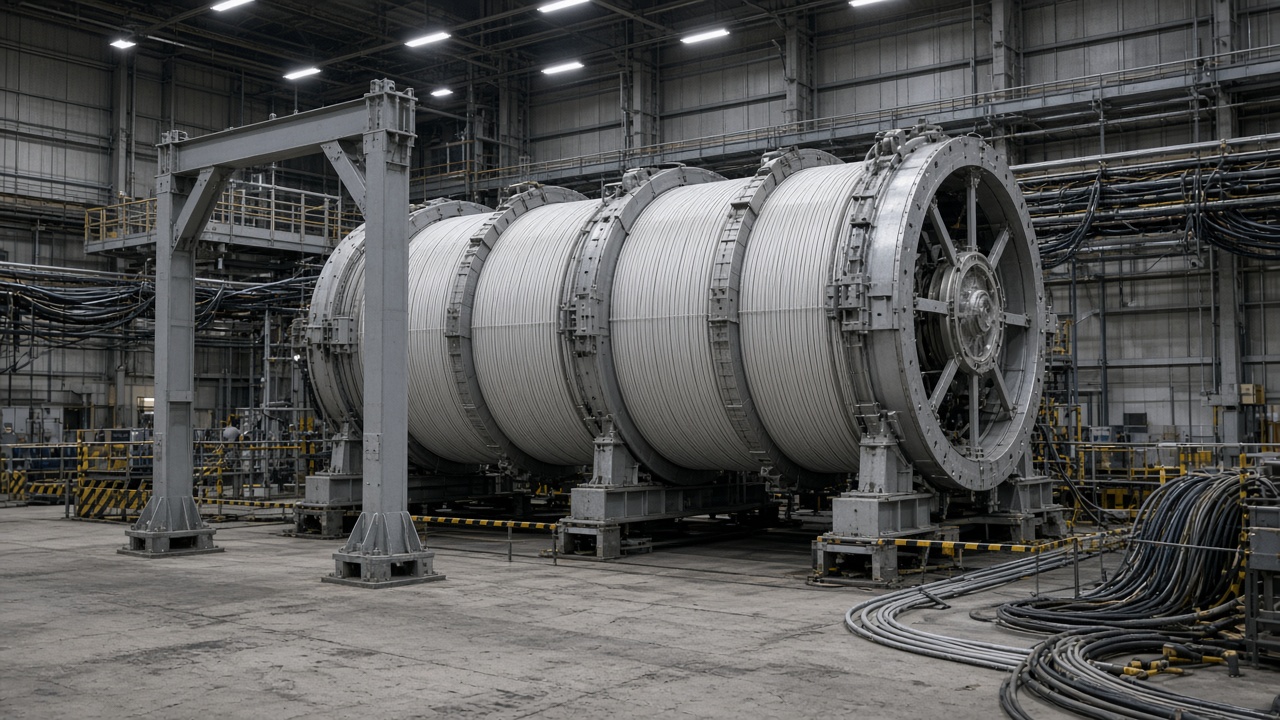
The UK Atomic Energy Authority logged a first full-power cycle on a STEP prototype magnet stack at Culham, pushing Britain’s fusion power plant design closer to engineering reality. Engineers held the toroidal field coils at design current for ninety seconds overnight, within cryogenic temperature margins set for the commercial STEP site planned in Nottinghamshire.
Why the test matters
STEP aims to connect a grid-scale fusion plant by the 2040s, requiring magnets that can cycle without quench events that destroy superconducting wire. Monday’s run used a sub-scale stack but matched the current density planned for the full plant, de-risking supplier contracts for niobium-tin conductors.
Industrial partners
Rolls-Royce Small Modular Reactor teams shared cryogenic plumbing designs, while Oxfordshire suppliers provided quench detection sensors tested during the run. UKAEA said the programme remains publicly funded, with private investors watching magnet reliability data before committing to component factories.
Environmental and policy context
Fusion produces no long-lived waste comparable to fission, but timelines remain decades long. Ministers cite STEP in green industrial strategy speeches; critics note electricity grids need solutions this decade, not only 2040s prototypes.
Next experiments
UKAEA will repeat the cycle with deliberate fault injections to test shutdown speed, then ship a second stack to a Nottinghamshire test pad for outdoor weather exposure. Results feed into planning applications for the eventual STEP site.
Scientific benchmarks
The ninety-second hold matched modelling from EUROfusion collaborators who peer-reviewed Culham data last month. Quench detection triggered twice in earlier runs; engineers adjusted helium cooling flows before Monday’s success.
Published logs will appear in a STEP open-data portal so universities can train plasma physics students on real hardware telemetry, not only simulations.
Community engagement
Nottinghamshire councils hosting the future plant asked for noise and traffic studies linked to magnet factory proposals. UKAEA promised town-hall sessions after Christmas, mindful of past nuclear siting debates.
Funding path
Treasury allocated multi-year STEP capital in the last spending review, but inflation on specialised alloys forced a mid-year supplement request now tied to the late-November fiscal event.
Skills pipeline
Apprentices from Oxfordshire colleges observed the test from a gallery, part of UKAEA outreach to fill welding and cryogenics roles. Fusion hype only converts to jobs if training pipelines keep pace with hardware milestones.
Export controls on superconducting wire remain tight; domestic suppliers argue STEP success justifies capacity investment even before a grid connection exists.
Research links
Culham hosts JET, the joint European tokamak, whose deuterium-tritium campaigns inform STEP magnet stress models. Monday’s test borrowed cooling algorithms validated on JET pulses last year, showing how legacy assets still pay dividends.
Universities in Imperial and Cambridge received telemetry feeds for thesis projects, widening the talent funnels ministers cite when defending fusion spend against nearer-term insulation programmes.