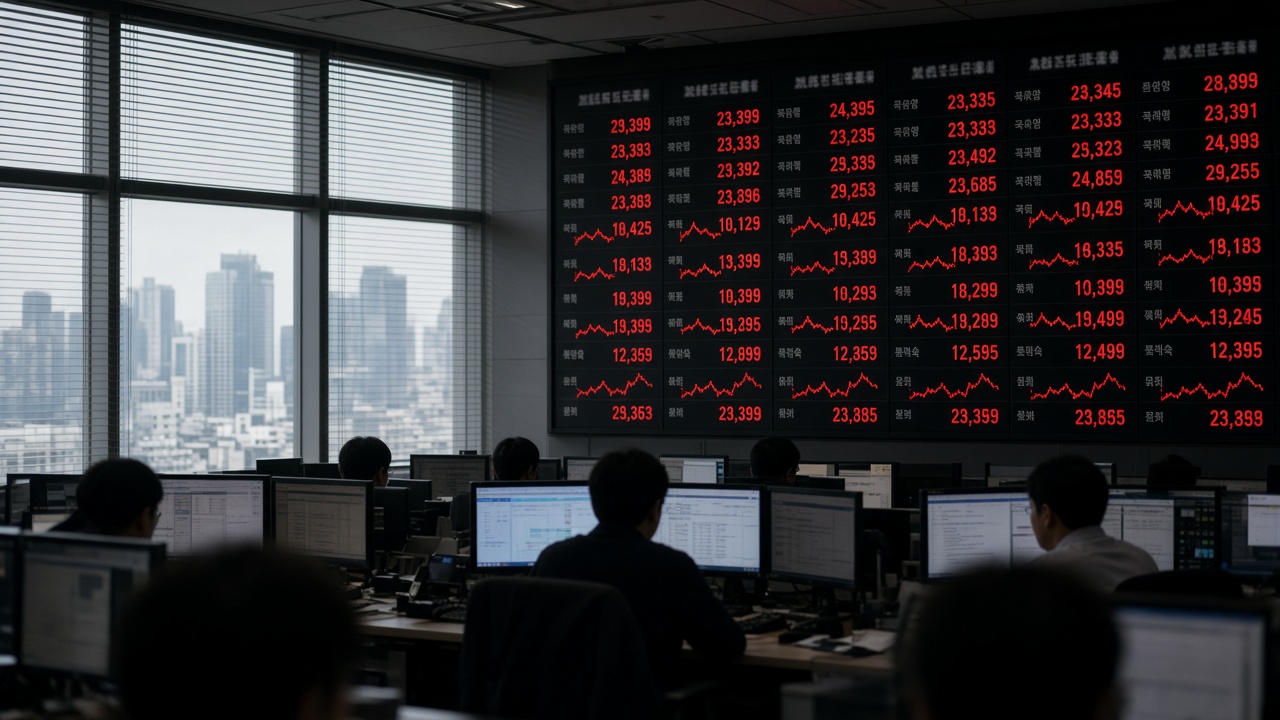
South Korea’s Kospi surrendered its prior session’s gains on Monday, closing down 210.29 points at 5648.79 as worries about artificial-intelligence funding costs pulled chip heavyweights lower and foreigners paired with institutions to dump more than two trillion won of shares.
Overnight tech spillover
Seoul traders opened lower after U.S. megacap tech names retreated on fears that AI infrastructure spending will strain balance sheets. Oracle’s plan to raise about twenty billion dollars through equity and bonds to fund data-center build-outs hit sentiment, and memory peers including Micron, AMD and Intel fell sharply in New York. Anthropic’s revenue growth impressed, but disclosures about massive purchase commitments kept questions alive about whether AI profits will catch up with capex.
With Japanese markets closed for a holiday, Taiwan’s Taiex fell in similar proportion, underscoring how semiconductor-linked benchmarks moved together. Korea’s memory duo led the local slide: Samsung Electronics finished down about 4 percent and SK hynix more than 5 percent, according to exchange data cited by wire services.
Who sold, who bought
Foreign investors net sold about 1.53 trillion won on the main board, while domestic institutions unloaded another 514 billion won. Retail accounts net bought roughly 1.66 trillion won, a familiar pattern when offshore desks reduce risk into a falling market. Kosdaq followed, dropping 4.08 percent to 704.39 with similar foreign and institutional outflows.
FX and the macro calendar
The won-dollar rate settled around 1341 won in late Seoul trading, up 2.8 won on the day, as a stronger dollar and risk-off equity mood combined. A weak won can accelerate foreign selling in a feedback loop traders watched throughout the afternoon.
Market commentary pointed to the U.S. midterm election and post-close earnings from AMD as near-term catalysts that could either stabilize AI sentiment or extend the selloff. Historical notes about midterm-year rebounds circulated in research desks, but strategists cautioned that prior cycles mixed monetary policy and starting valuations, making automatic bounce calls unreliable.
What holders are weighing
Broker notes published during the session debated whether to treat the drop as a buying window for memory leaders or the start of a deeper de-rating of AI beneficiaries. Some analysts outlined downside scenarios using price-to-book bands, while others argued multi-year memory upcycles could still absorb short-term volatility.
For Seoul households with retirement accounts heavily indexed to chip names, Monday’s session was a reminder of how tightly domestic wealth tracks global AI funding headlines—and how quickly a one-day rebound can evaporate when New York tech wobbles.