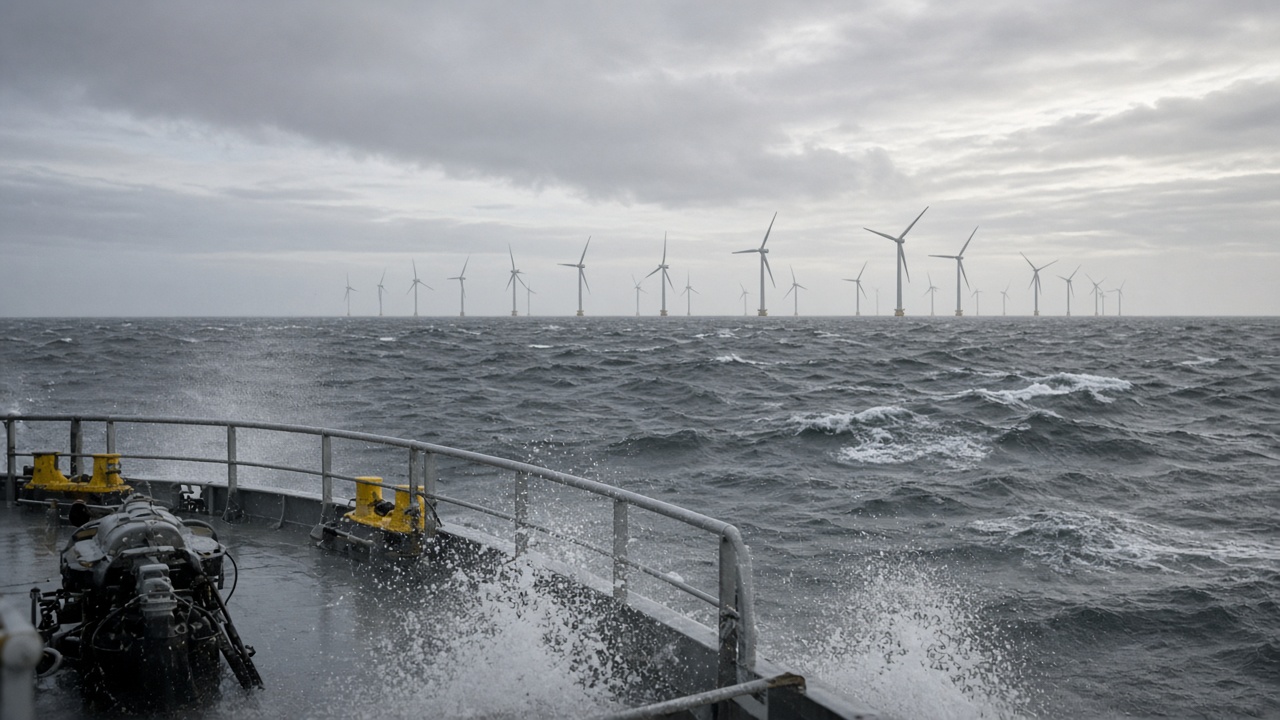
UK Research and Innovation awarded £14 million to a consortium testing quantum atomic clocks on North Sea offshore platforms, seeking microsecond-level synchronisation that could reduce grid balancing costs when wind farms desynchronise from the mainland AC network.
The two-year trial installs portable optical lattice clocks on three wind farms operated by Ørsted and Equinor, linking timing signals to National Grid ESO control rooms via subsea fibre. Accurate phase alignment helps converters switch without triggering expensive remedial actions.
Why clocks matter
Offshore wind now supplies more than 20 percent of Britain’s electricity, but turbine arrays spread across hundreds of kilometres can drift out of phase when voltage fluctuations hit converter stations. Traditional GPS timing lacks precision in storm conditions when GPS itself degrades.
Quantum clocks maintain stability by measuring electron transitions in strontium atoms. The consortium, led by the National Physical Laboratory and Imperial College London, said lab prototypes held accuracy within 100 nanoseconds over 48-hour North Sea simulations.
Engineering rollout
Technicians will mount shielded clock units in platform substations, with backup rubidium sources if optical systems fail. Data travels encrypted to ESO’s Wokingham control centre, where operators currently rely on phasor measurement units that refresh every four seconds.
Ørsted’s Hornsea zone hosts the first deployment next spring, pending Health and Safety Executive approvals for lithium battery backups in explosive atmospheres. Equinor’s Dogger Bank phases follow if early telemetry meets reliability targets.
Broader grid plans
National Grid ESO’s clean power 2030 roadmap cites timing upgrades as a low-capital way to squeeze more capacity from existing cables. If the trial succeeds, UKRI may expand funding to interconnectors linking Britain with Norway and Denmark, where similar phase issues appear.
Academic partners will publish open datasets after a six-month embargo, allowing European grid researchers to compare quantum timing against satellite alternatives being tested in Germany and Finland.
Skills pipeline
The programme funds twelve PhD placements aboard service vessels, pairing physicists with turbine technicians. UKRI said the skill crossover matters because maintenance crews must troubleshoot clock drift without calling shore labs.
European Union Horizon tie-ins remain limited post-Brexit, but bilateral Norway-UK North Sea agreements allow data sharing if security reviews pass.
Environmental groups raised minor concerns about additional power draw on platforms; engineers replied that clock units draw less than 500 watts, negligible compared with hotel loads for offshore crews.
Offshore wind industry groups welcomed timing research that could defer expensive new transmission cables. Grid operators said even modest phase improvements free hundreds of megawatts on congested routes to Yorkshire industrial clusters.
Quantum startups in Oxford and Glasgow compete for follow-on export contracts if North Sea trials succeed, potentially licensing clock modules to Asian offshore developers.
Analysts said the development fits a wider pattern of UK institutions adjusting policy after months of consultation rather than abrupt shifts. Officials promised further updates when new data arrive, leaving room for revision without reversing the core decision announced Tuesday.
Readers tracking household budgets, portfolio exposure or public services should watch accompanying regulator filings and select committee calendars for detail beyond headline moves.