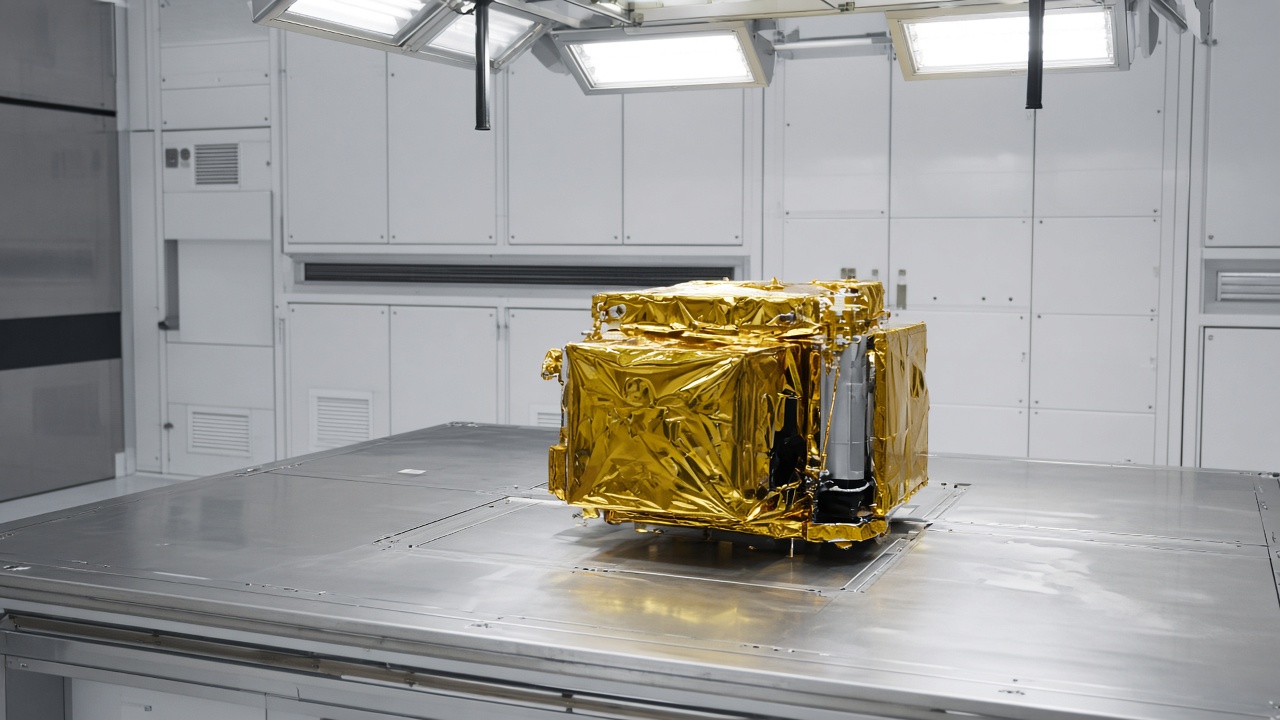
The Indian Space Research Organisation published first-light corona imagery from the PROBA-3 formation-flying mission to domestic space-weather analysts who model how solar storms disturb navigation and communication satellites over the Indian Ocean region.
What the data shows
PROBA-3 pairs two small spacecraft to mimic a coronagraph occulting disk, blocking the solar disk so the faint outer atmosphere is visible. ISRO’s guest investigators received calibrated slices showing coronal mass ejection precursors at higher cadence than many ground telescopes achieve during monsoon-cloud seasons.
India is not lead builder on the European Space Agency mission, but ground stations and scientific participation agreements give domestic labs early access under cooperative frameworks similar to other Sun-Earth physics campaigns.
Why operators care
Geostationary fleets serving DTH and broadband backhaul ride through radiation belts that solar flares can energise. Better corona imaging improves lead time for operators to safe-mode payloads or reroute traffic before a storm front arrives.
Limits of one mission
A single demonstrator cannot replace the full constellation planners want for continuous Sun monitoring. ISRO’s Aditya solar observatory still anchors domestic forecasting, while PROBA-3 adds a sharper, intermittent lens.
Researchers said they will fold the corona clips into monsoon-season training sets for graduate programmes in Pune and Ahmedabad, hoping to grow indigenous talent that can interpret European instruments without waiting for translated summaries weeks later.
Ground segment
Indian Space Research Organisation tracking stations supported acquisition schedules during critical formation-flying manoeuvres, when the occulting spacecraft must hold precise separation distances in orbit.
Data downlinked through European Space Agency networks is mirrored to ISRO science servers under agreements that spell out embargo periods before public release.
Downstream users
Power grid operators consult space-weather scales when deciding whether to pre-position maintenance crews ahead of geomagnetic storms that can trip transformers at high latitudes, though India’s equatorial exposure differs from auroral zones.
Training pipeline
Graduate students at the Indian Institute of Astrophysics will use the corona clips in lab modules on magnetohydrodynamics, linking classroom math to operational space-weather alerts consumed by satellite operators.
What comes next
Officials said updated guidance would follow through exchange circulars, ministry portals, or regulator FAQs as implementations are phased in. Market participants and civil-society groups will watch whether enforcement matches the headline promise, particularly where prior rules saw uneven compliance across states and banks.
Data access
University partners signed memoranda limiting redistribution of raw corona frames until calibration passes peer review, mirroring standard embargoes on other cooperative solar missions.