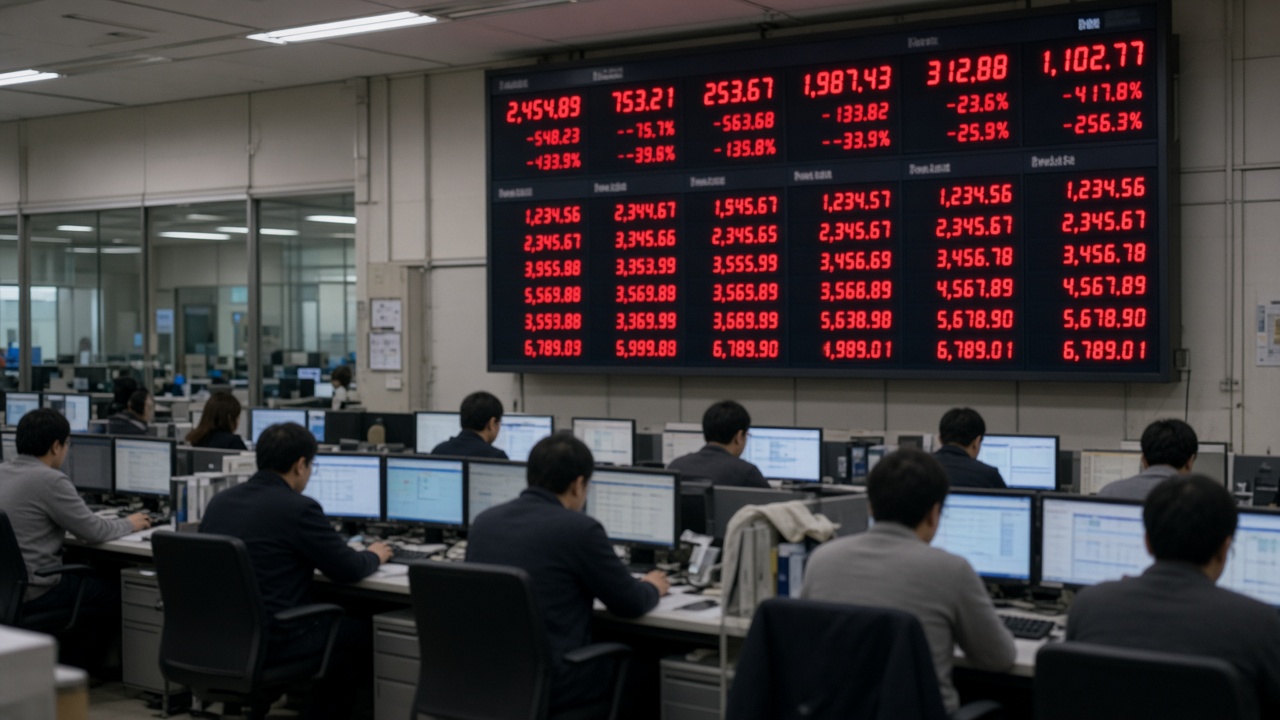
South Korea’s benchmark stock index plunged through the 4,200 level that it had crossed only two days earlier, tumbling as low as 3,867.81 before a late bounce left the Kospi at 4,004.42 on Wednesday. The 117.32-point, 2.85 percent drop tracked an overnight slump on Wall Street driven by fears that artificial-intelligence valuations have run ahead of earnings.
Trading desks in Seoul said foreign investors joined domestic funds in cutting exposure to chipmakers and platform names that had led the year’s rally. Combined market capitalization on the main board fell by roughly 97 trillion won, according to exchange data cited by Yonhap News Agency, a single-session wipeout that rivaled the sharpest reversals of the past year.
Who led the selloff
Large-cap technology and memory shares bore the brunt. Samsung Electronics and SK hynix, which supply Nvidia and other U.S. hyperscalers, fell in tandem with U.S. semiconductor futures. The tech-heavy Kosdaq dropped 16.54 points, or 2.84 percent, to 565.4, showing the breadth of the move beyond the headline index.
Analysts at several brokerages described the session as a valuation reset rather than a macro shock: no new Bank of Korea move, no fresh North Korean provocation, and no domestic policy surprise. Instead, traders pointed to stretched price-to-earnings multiples on AI beneficiaries and to margin calls triggered when U.S. megacap names weakened after the Federal Reserve’s latest rate cut.
Won and flows
The Korean won weakened to its lowest level in seven months against the dollar as equity outflows picked up, amplifying losses for offshore holders. Currency traders said exporters’ hedging demand added pressure once the Kospi broke 4,000 intraday.
President Lee Jae Myung delivered a parliamentary budget speech the same morning outlining a tripling of AI-related spending to 10.1 trillion won next year, part of a broader 728 trillion won fiscal plan. The juxtaposition — aggressive public investment in AI while private markets repriced AI risk — did little to stabilize the tape, though some investors said long-term capex pledges could support equipment makers once volatility eases.
What traders watch next
Seoul market veterans noted the Kospi had set a record high only last week, fueled by the same AI narrative that sparked Wednesday’s unwind. Several house strategists told Yonhap they expect the correction to be short-lived if U.S. tech stabilizes, but warned that repeated intraday breaks below 4,000 could trigger systematic selling from volatility-target funds.
Officials at the Financial Supervisory Service said they were monitoring liquidity at securities firms but had not activated emergency stabilization tools. Pension funds contacted by local media said they were not altering strategic equity allocations, though some sovereign wealth-style accounts trimmed derivatives exposure tied to the Kospi 200 volatility index.
Options desks reported elevated put buying on Samsung and on the index itself, a hedge pattern last seen during the August foreign-selling episode. For retail investors who had piled into AI-themed mutual funds this quarter, Wednesday’s session was a reminder that Seoul remains one of the most beta-heavy markets in Asia when U.S. tech sneezes.
For now, the story is price: a market that had priced perfection in AI suddenly demanded proof that revenue will catch up.